File
File

|
[Outlook on Global Affairs 2026-Special Issue No. 11] Europe in 2026: Complex Challenges and Policy Responses amid Evolving International Order |
| December 11, 2025 |
-
Sungwon LeeResearch Fellow, Sejong Institute | sw.lee@sejong.org
-
In January 2025, European Commission President Ursula von der Leyen stated in her address at the World Economic Forum in Davos that “the era of the peace dividend is over. The age of great-power competition has returned, and Europe must be prepared to defend its interests and values.” In the same speech, she also noted that Europe had faced “the fiercest economic storm and an unprecedented energy crisis in its history” and emphasized the gravity of the challenges confronting the continent as well as the necessity of collective action to respond to them. As President von der Leyen’s assessment suggests, even amid heightened geopolitical instability, Europe demonstrated a degree of short-term resilience by stabilizing energy supplies. However, the Russia–Ukraine war has instead heightened uncertainty regarding Europe’s fiscal capacity and long-term sustainability. Volatility in energy prices, constrained supply chains, and persistently low employment and growth rates have made clear the overall slowdown in industrial competitiveness and the limits of Europe’s response capacity. The challenges facing Europe are not linear or temporary in nature. Rather, amid a rapidly shifting international environment and a deteriorated security landscape shaped by the Russia–Ukraine war, these challenges are becoming entrenched as a chronic crisis structure spanning diplomacy, security, the economy, and society. Europe’s multilayered crisis factors can be summarized as follows.
● Growing uncertainty over U.S. security guarantees: rising concerns over the weakening credibility of NATO and the widening strategic gap between the United States and Europe following the launch of the second Trump administrationTaken together, it is more accurate to view Europe not as having “overcome” the current crisis, but as being in a phase of adaptation to new structural constraints and a highly unstable external environment. This adaptive phase is likely to persist for some time. Against this backdrop, this paper examines the key threats and challenges Europe will face in 2026, as well as emerging response patterns across international relations, military and security affairs, politics, and the economy, and seeks to draw implications for South Korea’s foreign policy.
● Intensifying rearmament pressures amid deepening fiscal constraints: defense spending is rising sharply while fiscal foundations are eroding, with persistent structural bottlenecks in industrial capacity, technological capability, and manpower
●Accumulating fatigue from a wartime economic posture: despite the stabilization of energy prices, Europe continues to face manufacturing weakness, supply-chain fragility, and the entrenchment of a low-growth structure
● Widening social and political fractures: deepening refugee and migration pressures, the rise of far-right and populist forces, and declining public trust in parliaments and governments
-
Europe’s external environment is entering a phase of heightened uncertainty. Above all, the weakening credibility of U.S. security guarantees has emerged as the single most significant source of strategic anxiety in Europe’s international relations. A relative U.S. pullback from the European theater risks undermining NATO’s credibility and destabilizing the alliance-based security order. From a European perspective, the absence of a viable substitute for U.S. military support constitutes a structural vulnerability that makes it difficult for Europe to sustain credible collective defense capabilities on its own. In this context, NATO Secretary General Mark Rutte stated at a press briefing in February 2025 that “European defence without the US will not work,” underscoring the reality that Europe must navigate a difficult balance between maintaining transatlantic ties and strengthening autonomous capabilities.
Europe is currently committing defense resources at historically high levels. The European Parliament assessed that defense spending by EU member states increased by more than 30 percent between 2021 and 2024, with an additional €100 billion or more projected by 2027. Among the 23 EU member states that are also NATO allies, defense spending reached an average of 2.04 percent of GDP in 2025. This trend is particularly pronounced among frontline states geographically proximate to Russia. European efforts to strengthen military capabilities are also moving beyond budgetary expansion toward institutionalization. In March 2025, the EU announced the Readiness 2030 plan, allocating approximately €800 billion in defense-related funding and outlining measures to modernize the European defense ecosystem, including investment in innovation, infrastructure, and supply chains. At the NATO level, heads of state and government agreed at the June 2025 Hague Summit to aim for defense spending of up to 5 percent of GDP by 2035.1)
Despite these unprecedented rearmament efforts, Europe faces a structural dilemma. The political and societal foundations required to sustain and implement such commitments over the long term are weakening. As a result, Europe continues to exhibit structural military disadvantages relative to Russia, while remaining heavily dependent on the United States for critical technologies and weapons systems.2) Beyond defense dependence, divergences between U.S. and European perspectives on ceasefire negotiations have become increasingly pronounced, suggesting that frictions and tensions within the transatlantic alliance are likely to persist for the foreseeable future.
International Relations: “Core European Interests and Strategic Dilemmas Revealed in Ceasefire Negotiations”
The year 2025, marked by the inauguration of the second Trump administration, saw intensified U.S.-led mediation efforts and a series of bilateral and multilateral contacts among the United States, Russia, Ukraine, and European partners aimed at securing a ceasefire. This period was characterized by alternating moments of limited progress and stalemate. In November 2025, President Trump presented a 28-point peace plan, but sharp disagreements between Russia and Ukraine over several key provisions have since sustained intense debate.3) The United States remains optimistic about reaching an agreement, but detailed adjustments will be required to address conditions that are fundamentally incompatible.
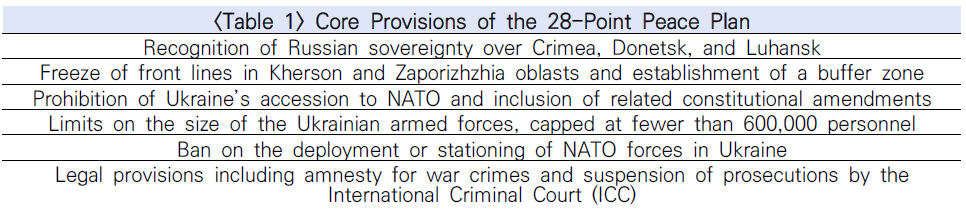
The proposed peace plan includes provisions recognizing Russian sovereignty over Crimea, Donetsk, and Luhansk, freezing current front lines in the Kherson and Zaporizhzhia regions, and establishing a demilitarized buffer zone between Ukrainian-controlled areas and Russian-occupied territories in Donetsk. It also contains constitutional and military clauses related to Ukraine’s NATO aspirations, including a prohibition on joining NATO or any analogous military alliance, a cap on the size of the Ukrainian armed forces at 600,000 personnel, and a ban on the stationing of NATO forces on Ukrainian territory. Provisions related to war crimes include a general amnesty, suspension of prosecutions by the International Criminal Court, and the exclusion of victim compensation.
The fundamental reason the ceasefire negotiations remain deadlocked lies in the structural divergence of interests between Russia and Ukraine. Russia continues to insist on freezing the conflict along current lines and securing recognition of its control over Crimea and the Donbas, whereas Ukraine maintains its demand for restoration of the internationally recognized territorial status quo, based on the 1991 borders. On the issue of NATO membership, Russia seeks a permanent prohibition, while Ukraine has adopted a cautious position, citing the constitutional requirement for a national referendum on any such amendment. These positions have resulted in conditions that are mutually incompatible. Provisions related to war crimes are also an area of particularly strong domestic resistance within Ukraine.
How, then, is Europe responding to the U.S.-led ceasefire proposal? European governments have viewed the 28-point peace plan presented by the United States in November as excessively favorable to Russia and as imposing constraints on Ukraine’s sovereignty. In response, the United Kingdom, France, and Germany issued a joint statement expressing concern that several provisions could undermine Europe’s long-term security and weaken NATO’s collective deterrence framework. The three countries proposed adjustments, including revising the NATO-related provisions from a permanent ban to a temporary suspension and leaving open the possibility of future review of territorial arrangements. The strategic gap between the United States, which prioritizes early termination of the war, and Europe, which places greater emphasis on the sustainability of the regional security architecture, is unlikely to narrow in the near term.
At the same time, divisions within Europe regarding objectives, threat perceptions, and acceptable conditions for a ceasefire have become increasingly pronounced. Recent public opinion surveys indicate that Northern and Central and Eastern European countries, which perceive the Russian threat as more immediate, tend to define Ukrainian victory as a realistic objective and prioritize continued support for Ukraine alongside accelerated domestic defense buildup. By contrast, Western European countries, while maintaining their baseline support for Ukraine, show a greater preference for a negotiated ceasefire. Southern European countries are more inclined to view the war through the lens of regional stability rather than direct national security interests and display a stronger preference for an early cessation of hostilities. This regional differentiation is widely assessed as a structural constraint on the formulation and sustained implementation of a unified European strategy. -
Europe has absorbed substantial human and material losses over the course of more than three years of the Russia–Ukraine war. Ukraine, as the primary battlefield state, is projected to require approximately $524 billion in reconstruction costs over the next decade alone. Over the past year, Europe has spent more than €30 billion on assistance to Ukraine, while cumulative military, humanitarian, and financial support since the outbreak of the war is estimated to amount to several hundred billion euros. At the same time, sustained increases in defense spending have generated additional economic pressures across Europe. According to the European Defence Agency (EDA), EU defense expenditure reached €381 billion in 2025. European military spending has risen steadily since Russia’s annexation of Crimea in 2014, with the pace accelerating markedly following the outbreak of the Russia–Ukraine war. Over the past decade (2014–2024), cumulative defense spending growth is estimated at approximately 82 percent. Prolonged security threats and mounting economic costs have intensified war fatigue across European societies and have begun to reshape public opinion. Eurobarometer surveys indicate that while a broad consensus on the necessity of supporting Ukraine remains intact, levels of public support for military assistance, humanitarian aid, and the acceptance of refugees have declined modestly compared with the early stages of the conflict.
Despite these extensive costs, short-term battlefield prospects remain unfavorable as Europe looks ahead to 2026. Paradoxically, although multiple diplomatic contacts aimed at exploring ceasefire options have continued, negotiations have stalled, and both the frequency and intensity of fighting have increased. Numerous European media outlets report not only an escalation in clashes but also the expansion of Russian operations along new axes of advance, as well as large-scale drone and missile strikes against rear-area cities during periods of diplomatic deadlock. Reports of rising civilian casualties have accompanied these developments.
During periods of ceasefire stalemate in particular, Europe has revealed notable vulnerabilities in its ability to respond to Russia’s hybrid operations conducted simultaneously across air, maritime, undersea, and cyber domains in border and near-border regions. Russia’s tactics appear to reflect a dual objective: improving its negotiating position while simultaneously eroding the morale of Ukraine and its European supporters. By avoiding direct confrontation with NATO, Moscow has pursued a strategy of probing adversary responses, managing escalation thresholds, and incrementally sustaining or expanding its influence. Through the systematic use of gray zone tactics, Russia seeks to widen the scope of confrontation and maintain a calibrated level of instability, thereby encouraging fragmented and uneven responses within Europe over the long term. As Russian operational methods continue to evolve, frontline and eastern flank states have accelerated efforts to strengthen readiness and conventional force posture. However, constraints related to technological capacity, skilled personnel shortages, and limitations in defense industrial production have prevented these measures from fully offsetting emerging vulnerabilities. Europe’s efforts to adapt to changing battlefield conditions and to address exposed weaknesses in deterrence and defense are therefore likely to remain a long-term undertaking. -
Beyond the foreign policy and security domain, Europe faces mounting pressure to generate new sources of economic growth amid the accelerating transition associated with the fourth industrial and technological revolution. The region confronts a convergence of structural challenges, including rising dependence on energy imports, the erosion of manufacturing competitiveness, and a prolonged low-growth trajectory. These vulnerabilities interact and reinforce one another, collectively undermining Europe’s overall economic resilience. According to the European Central Bank’s Monetary Policy Statement released in September 2025, euro area growth has remained around 1.1 percent, reflecting the combined effects of weak productivity growth, deteriorating fiscal conditions, and heightened geopolitical uncertainty. The ECB projects that subdued growth will persist into the following year. Similarly, the OECD Interim Economic Outlook and the IMF’s late-2025 assessments converge on the view that Europe’s fiscal position is under increasing strain due to overlapping demands related to defense spending, the green transition, and digital transformation. These structural constraints are widely expected to further depress medium- to long-term potential growth. BusinessEurope has warned that without the emergence of new growth engines, Europe risks sliding into a trajectory of chronic stagnation that could culminate in what it terms a “slow agony.”
Against the backdrop of prolonged low growth and accumulated fiscal and political fatigue, Europe is also experiencing significant stress across its political and social landscape. The region faces the dual challenge of managing long-standing irregular migration flows from the Middle East and Africa while simultaneously accommodating a sharp increase in Ukrainian refugees following the Russia–Ukraine war. According to UNHCR data, by the end of 2025 Europe hosted approximately 5.3 million Ukrainian refugees, alongside more than 20 million refugees, forcibly displaced persons, and stateless individuals overall. While broad public support for assisting Ukraine remains intact across much of Europe, several countries have seen growing public fatigue and increasingly negative perceptions surrounding government support for refugees. These trends are emerging as medium- to long-term drivers of social polarization and political tension.
The accumulation of economic and social strains has contributed to the intensification of political polarization and the expansion of extremist and populist movements across Europe, forming an additional endogenous source of instability. As overlapping economic, social, and security challenges persist, public trust in national parliaments and governments has weakened across much of the continent. In 2025, the European Council on Foreign Relations (ECFR) assessed that the spread of far-right and radical populist parties has deepened internal EU divisions over immigration, support for Ukraine, and policy toward Russia and China. Looking ahead to 2026, numerous national elections are scheduled across Europe, each with the potential to reshape domestic and regional political dynamics. Parliamentary elections in Sweden and Denmark are expected to hinge on debates over immigration, populism, and attitudes toward Ukraine and Russia. Meanwhile, Hungary and Latvia, both located along Europe’s eastern flank, are set to hold parliamentary elections in the first half of 2026. In these countries, electoral outcomes could carry significant implications, including the persistence or resurgence of pro-Russian political forces and potential shifts in policies toward Ukraine and Russia, with direct consequences for Europe’s eastern deterrence posture. -
The preceding sections have assessed the crises confronting Europe as it enters 2026, the policy responses adopted to date, and the key challenges that remain across major issue areas. Taken together, uncertainty and instability are likely to remain structural features of Europe’s external environment in a context of overlapping and mutually reinforcing crises. Europe is therefore expected to remain in a prolonged phase of adjustment, marked less by crisis resolution than by continued efforts to manage risk, preserve resilience, and adapt to a more volatile strategic landscape.
Against this backdrop, Europe’s evolving situation raises important implications for South Korea’s foreign and security policy. Strategic cooperation with Europe is likely to grow in importance and depth over time. As geopolitical fragmentation intensifies and competition increasingly centers on military power, advanced technology, critical resources, and standards-setting, the strategic room for maneuver available to middle powers is narrowing. Under these conditions, the relative strategic value of cooperation between South Korea and Europe is increasing. This trend is further reinforced by the growing conditionalization of alliances, in which security commitments are increasingly shaped by political negotiation, by the transformation of semiconductors, batteries, artificial intelligence, and energy supply chains into strategic assets, and by the emergence of a complex threat environment where regional conflicts and global risks are becoming more tightly interconnected. Under these shared structural pressures, sustained cooperation among similarly exposed countries is no longer optional but increasingly necessary.
Within this context, South Korea and Europe are widely assessed as highly complementary partners in areas such as critical minerals, semiconductors, batteries, and the green transition. This complementarity is already reflected in the expansion of high-level intergovernmental agreements, strategic partnerships, joint research initiatives, and private-sector investment across multiple sectors. Defense cooperation has also expanded rapidly in the context of the Russia–Ukraine war. Large-scale arms contracts, particularly with Eastern Front states, have positioned South Korea as one of the leading defense suppliers to European NATO members. Given the new South Korean administration’s emphasis on pragmatic, interest-based diplomacy, Europe, which offers substantial capacity for substantive cooperation and mutual benefit, is well positioned to further consolidate its role as a reliable and scalable strategic partner.
At the same time, cooperation with Europe is accompanied by significant and enduring constraints that warrant careful assessment. Although South Korea and Europe are often categorized as “like-minded partners,” they remain structural competitors in key economic and industrial domains. Korean firms hold strong market positions and technological advantages in strategic sectors such as semiconductors, batteries, shipbuilding, and energy, which in turn strengthens Europe’s incentives to reinforce domestic industrial policy. In the defense sector in particular, Europe’s inward-looking policy orientation has intensified. The European Defence Industrial Strategy (EDIS) sets targets to shift at least 35% of defense trade toward the EU internal market and requires that no less than 50% of defense procurement budgets be spent on European products. The Security Action for Europe (SAFE) regulation further conditions defense contracts on EU/EEA/Ukraine-based production and mandates that at least 65% of components in finished systems originate in Europe. Under these conditions, several niche markets currently accessible to South Korean firms, including in the energy sector, are likely to narrow over the medium to long term.
Recent European policy trends underscore this risk. Despite the current momentum of “K-defense” exports, EU-level funding mechanisms and national procurement budgets are increasingly structured to favor European firms. As a result, South Korea’s defense export foothold in Europe may face structural constraints over time. Moreover, defense cooperation entails more than commercial transactions; it involves shared threat perceptions and deeper strategic alignment. Expanding defense ties with Europe therefore carries longer-term diplomatic and military opportunity costs that require careful evaluation, particularly with regard to how such alignment may translate into future political expectations or strategic pressure.
Finally, the current concentration of defense cooperation on conventional systems and on Eastern Front states, where threat proximity is most acute, raises questions about the long-term sustainability and scalability of South Korea’s defense presence in Europe. A realistic assessment is required regarding how far national defense budgets can sustain demand for Korean systems once the immediate wartime imperative recedes. Enhancing competitiveness will therefore require a more layered approach, encompassing not only price, delivery timelines, and operational support, but also joint development, local production, and deeper forms of technological and industrial cooperation.

In sum, cooperation with Europe should be understood not merely as a set of commercial transactions, but as a complex policy choice that entails broader strategic alignment. From a medium- to long-term perspective, this necessitates careful efforts to minimize diplomatic and military opportunity costs, as well as the political constraints that may accompany deeper cooperation. In particular, given Europe’s ongoing shift toward protectionist industrial policies and the possibility of declining demand for Korean defense exports in the post–Russia–Ukraine war environment, sustainable cooperation will require a localization- and integration-oriented strategy. This points to the need for durable partnership models built on joint production, co-development, and collaborative research and development, enabling Korean firms to embed more deeply within the European defense industrial ecosystem rather than relying on transactional export-driven engagement alone. -
Europe is advancing policies aimed at survival and adaptation within a multilayered threat environment, and this evolving posture simultaneously generates new opportunities and constraints for South Korea. Against this backdrop, Seoul needs to clarify several guiding principles in shaping its approach toward Europe. First, while Europe demonstrates strong symbolic commitment to normative values and the defense of rules-based order, its capacity for sustained military and diplomatic power projection remains limited and heavily constrained by internal priorities. Accordingly, rather than placing excessive expectations on Europe’s security role in the Indo-Pacific, South Korea should establish realistic upper bounds by clearly distinguishing between areas of feasible cooperation and those that are structurally unattainable. Instead of reproducing aspirational narratives about European military contributions to East Asia, Seoul should focus selectively on cooperation domains that are viable within Europe’s resource-constrained environment, including supply chains (semiconductors, batteries, and critical minerals), emerging security areas (cybersecurity, space, and subsea infrastructure protection), and global standards and regulatory frameworks.
Second, it is essential to maintain a careful balance between cooperation and competition with Europe in key industrial, technological, and defense sectors. While South Korea and Europe are largely complementary in supply chains, technological leadership, and the green transition, they remain structural competitors in semiconductors, batteries, shipbuilding, and defense industries. Moreover, defense cooperation cannot be treated as a purely industrial issue; it inherently involves strategic judgments about threat perceptions, conflict contexts, and the long-term implications for diplomatic positioning and national credibility. As such, engagement in the defense sector requires a cautious approach that fully accounts for diplomatic neutrality, long-term external relations risks, and potential reputational consequences.
Finally, one of Europe’s central challenges lies in the fragmentation of threat perceptions, core interests, and policy priorities within the continent. This structural reality generates divergent approaches toward Russia, China, and Ukraine, and constrains Europe’s ability to pursue coherent and consistent strategies. Reflecting this condition, South Korea should adopt a differentiated and tailored approach toward Europe’s internal sub-regions. Cooperation with Eastern Frontline states may prioritize defense and technology partnerships; engagement with Western European countries may focus on supply chains, standards, and the green transition; and interaction at the EU level should concentrate on regulatory alignment, technology policy, and infrastructure cooperation. As global attention in 2026 increasingly centers on the possibility of a pause or transition in the Russia–Ukraine war, South Korea will need to continue making strategic choices that carefully weigh both the opportunities and constraints inherent in cooperation with Europe amid shifting geopolitical dynamics.
| Crisis Assessment: Prolonged Crises and Structural Constraints in Europe
| International Relations: “European Rearmament and Continued Dependence on the United States: Constraints on Strategic Choice”
| Military and Security Domain: Evolving Battlefield Dynamics and Structural Vulnerabilities Created by Russia’s “Gray Zone” Strategy
| Political, Social, and Economic Domain: “Wartime Fatigue” and the Acceleration of Internal Fragmentation in Europe
| Risks and Challenges to Be Considered for Sustainable Cooperation with Europe
| Conclusion and Policy Recommendations
1) 3.5 percent of GDP in direct military spending plus an additional 1.5 percent in indirect expenditures
2) According to the International Institute for Strategic Studies (IISS) The Military Balance 2025, Russia increased its military expenditure by more than 40 percent in 2024, reaching approximately USD 146 billion, equivalent to 6.7 percent of GDP. When adjusted for purchasing power parity (PPP), Russia’s military spending is estimated at roughly USD 462 billion, a level nearly comparable to the combined military expenditures of the European Union and the United Kingdom, estimated at USD 467 billion. Russia’s defense spending is projected to remain elevated in 2025, at around 7.5 percent of GDP. Under these wartime economic conditions, Russia’s sustained and aggressive defense outlays continue to underscore Europe’s structural disadvantages in a protracted conflict environment, despite ongoing European rearmament initiatives.
3) Negotiations between the United States and Ukraine held in Geneva on November 25, 2025 resulted in a new 19-point peace proposal, with detailed amendments remaining undisclosed.
※ The contents published on 'Sejong Focus' are personal opinions of the author and do not represent the official views of Sejong Institue