File
File

|
Analysis of the Results of the U.S.-China Summit in Beijing - Focusing on Economic Issues - |
| June 4, 2026 |
Byung Chul LEE
Visiting Research Fellow, Sejong Institute | bcclee65@naver.com
| Introduction
Following the launch of the second Trump administration in January 2025, the United States and China exchanged a series of mutual retaliatory measures centered on tariffs and critical minerals. On April 2, 2025, the United States imposed fentanyl-related tariffs of 20 percent and reciprocal tariffs of 34 percent through the International Emergency Economic Powers Act (IEEPA), and China responded on April 4 through a State Council announcement imposing identical retaliatory tariffs of 34 percent on all U.S. goods. As asymmetric retaliatory measures by both sides continued thereafter, U.S. tariff rates on Chinese goods rose to 145 percent and China's tariff rates on U.S. goods rose to 125 percent.
The two countries agreed through the Geneva talks on May 12 to reduce mutual tariffs to the 10 percent level for 90 days, and at the Stockholm talks on August 12 extended this arrangement for an additional 90 days. However, when the U.S. Department of Commerce's Bureau of Industry and Security (BIS) introduced the so-called 50 percent rule in September, under which subsidiaries in which sanctioned entities hold 50 percent or more equity stakes are designated as sanctioned entities without separate listing procedures, 1) China responded in October by announcing expanded measures that included extraterritorial application provisions in its rare earth and critical mineral export controls. 2)
The two sides subsequently agreed on the occasion of the APEC Busan Summit on October 30 to provisionally freeze major outstanding issues for one year.
Against this backdrop, President Trump paid a state visit to China from May 13 to 15, 2026. This report aims to assess the progress of the Beijing summit, the substance of consultations on individual agenda items, and the achievements and limitations of the talks focusing on the economic sector, and to derive implications for South Korea.
| Progress of the Beijing Summit
President Trump began his Beijing schedule on the evening of May 13, receiving an airport welcome from Chinese Vice President Han Zheng (韩正).
At the first summit held at the Great Hall of the People on the morning of May 14, lasting approximately 135 minutes, President Xi Jinping presented "overcoming the Thucydides Trap" as the central theme and characterized the U.S.-China relationship as a "constructive relationship of strategic stability." According to an announcement by China's Ministry of Foreign Affairs, this was described not as a unilateral proposal by the Chinese side but as an agreement by both leaders to establish this as the direction of future U.S.-China relations, with China presenting it as a new strategic framework to define the bilateral relationship for three or more years going forward. 3) President Xi warned in particular with respect to the Taiwan issue that "if mishandled, it could lead to conflict, or even war." In response, President Trump expressed agreement on the importance of stabilizing the bilateral relationship, while practically focusing the substance of consultations on trade negotiations and the question of freedom of navigation in the Strait of Hormuz.
On the morning of May 15, the two leaders held tea and a working luncheon together at Zhongnanhai (中南海), engaging in more in-depth discussions of sensitive issues including the Taiwan question. President Trump assessed the consultations as having been conducted "in great detail." On this occasion, President Trump invited President Xi to Washington on September 24, 2026, and the schedule for a reciprocal White House visit was finalized.
Separately from the summit, on May 14 Premier Li Qiang (李强) held a separate meeting with 17 American company CEOs who had accompanied President Trump on his visit to China. Premier Li emphasized that China is advancing the 15th Five-Year Plan (2026 to 2030) in earnest, and pledged the continued expansion of opening to the outside world and improvements to the policy environment and strengthening of service support for foreign-invested enterprises. 4) The American company CEOs who accompanied the visit were centered on key figures from big tech and manufacturing, including Elon Musk (Tesla and SpaceX), Tim Cook (Apple), Jensen Huang (Nvidia), and Kelly Ortberg (Boeing).
In contrast to the first Trump administration's state visit to China, during which a joint press conference was held, this summit concluded without a joint press conference or joint statement. China, through its Ministry of Foreign Affairs, immediately released the record of the talks including President Xi's opening remarks on the day of the summit, May 14, and subsequently issued a Ministry of Commerce spokesperson question-and-answer session on May 16 and a "Preliminary Outcomes Interpretation of U.S.-China Economic and Trade Consultations (中美经贸磋商初步成果解读)" by the head of the Ministry of Commerce's Department of American and Oceanian Affairs on May 20. 5) The United States, by contrast, released its results in a single-message format through one White House fact sheet immediately following the conclusion of President Trump's visit to China.
| Outcomes by Major Economic Agendas
1. Tariffs & Trade
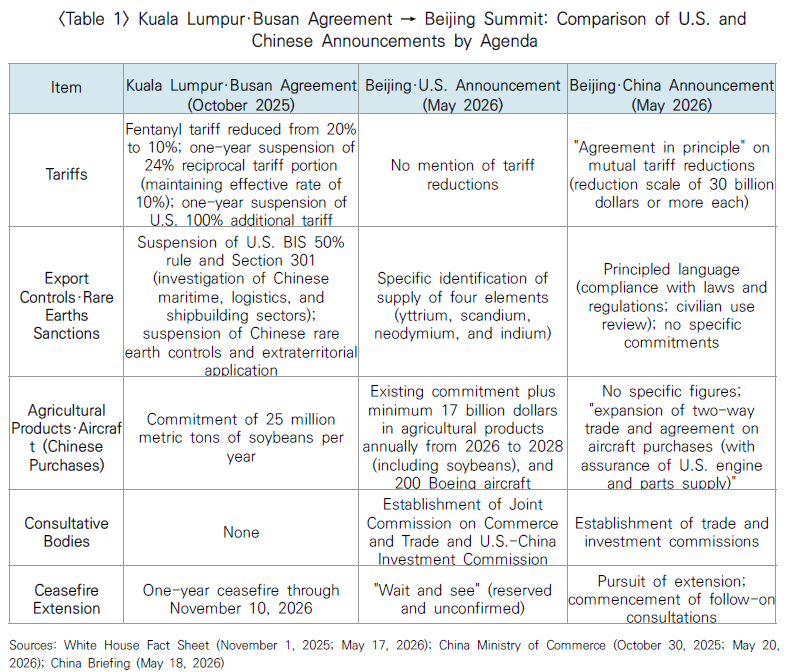
The White House fact sheet presented the expanded Chinese purchase of U.S. agricultural products, automobiles, and aircraft as achievements of the summit. 6) Specifically, it was announced that China had placed a new order for 200 Boeing aircraft, and had committed to purchasing an additional minimum of 17 billion dollars in U.S. agricultural products annually from 2026 to 2028, on top of the 25 million metric tons of U.S. soybeans per year, valued at approximately 10 billion dollars, pledged at the Busan summit in October 2025.
The announcement by China's Ministry of Commerce Department of American and Oceanian Affairs struck a notably different tone. 7) With respect to the 200 Boeing aircraft, it clarified that "China's aviation industry will introduce them in accordance with commercial principles based on its own development needs," making clear that this constitutes a market transaction between private industry parties. On agricultural products, it stated only that both sides had reached a shared understanding on resolving non-tariff barriers and market access issues, without referencing specific quantities or amounts. On mutual tariff reductions, however, it explicitly stated a specific figure of "30 billion dollars or more each (各为300亿美元或更多)."
This reflects a deliberate asymmetric disclosure strategy on China's part: treating figures ambiguously in areas of concession such as agricultural products and Boeing to avoid pressure for implementation, while proactively publicizing figures in areas of benefit such as mutual tariff reductions in order to lock in U.S. commitments.
2. Rare Earths & Critical Minerals
In the area of rare earths and critical minerals, an even more pronounced asymmetry emerged between the two sides' announcements. The U.S. fact sheet explicitly stated that "China will address U.S. concerns regarding supply chain shortages" of rare earths and critical minerals, specifically identifying four key elements: yttrium, scandium, neodymium, and indium. 8) It further noted that "China will also address U.S. concerns regarding the prohibition or restriction on sales of rare earth production and processing equipment and technology."
China's announcement by the head of the Ministry of Commerce's Department of American and Oceanian Affairs (美大司) in its "Preliminary Outcomes Interpretation," by contrast, remained at the level of principle. 9) It stated that "the Chinese and American economic and trade teams conducted sufficient communication on export controls," that "the Chinese government implements export controls on rare earths and other critical minerals in accordance with laws and regulations (依法依规), and is processing license applications for civilian use (民用)," and added only that "China is willing to work with the U.S. side to promote mutually beneficial cooperation and cooperate toward a favorable environment for guaranteeing global supply chains." 10)
3. Pursuit of Extension of the Busan Agreement (Kuala Lumpur Joint Arrangement)
At the Beijing summit, the United States and China reaffirmed their intent to pursue the extension of the "China-U.S. Kuala Lumpur Economic and Trade Consultation Joint Arrangement" (hereinafter the "Kuala Lumpur Joint Arrangement"), which is scheduled to expire on November 10, 2026. 11) This was confirmed through the May 20, 2026, announcement by China's Ministry of Commerce Department of American and Oceanian Affairs; the White House fact sheet of May 17, 2026, did not contain any reference to the matter.
The Kuala Lumpur Joint Arrangement refers to an agreement reached by the two countries' economic and trade teams in Kuala Lumpur on October 25 and 26, 2025, prior to the Busan Summit, and subsequently endorsed by the two leaders in Busan on October 30. Its core element is the mutual suspension of major trade conflict measures by both countries for one year. Specifically, it encompasses: ① a reduction in U.S. IEEPA-based fentanyl tariffs from 20 percent to 10 percent; ② a one-year extension of the 10 percent mutual tariff framework; ③ a one-year suspension of the application of the BIS 50 percent rule; ④ a suspension of the U.S. 100 percent additional tariff; ⑤ a one-year suspension of the Section 301 investigation into maritime, logistics, and shipbuilding; and ⑥ a one-year suspension of China's additional rare earth controls and extraterritorial application measures announced on October 9, 2025, through November 10, 2026. 12)
4. Establishment of New Trade & Investment Consultative Bodies
Both sides jointly confirmed that agreement had been reached on the establishment of the Joint Commission on Commerce and Trade and the U.S.-China Investment Commission as the institutional achievements of the summit. This is the matter on which the two sides' announcements are in the closest and clearest agreement. According to the U.S. announcement, the Joint Commission on Commerce and Trade is designed to be co-chaired by the U.S. Trade Representative and China's Minister of Commerce, while the U.S.-China Investment Commission is designed to be co-chaired by the U.S. Deputy Secretary of the Treasury and the Vice Chairman of China's National Development and Reform Commission.
However, neither side provided specific details regarding the timing of the first meeting of the respective commissions, the specific consultation agenda, the scope of decision-making authority, or the mechanisms for implementing agreed outcomes. The outcomes of the Busan and Beijing summits are summarized in the table below.
| Assessment of the U.S.-China Summit
1. Institutionalization of Relationship Management Mechanisms
The most clearly definable achievement of this summit is the agreement to establish the Joint Commission on Commerce and Trade and the U.S.-China Investment Commission. China's Ministry of Commerce Department of American and Oceanian Affairs characterized this as a transition "from crisis-driven negotiations (危机应对式磋商) to institutionalized management (制度化管理)." 13) Edgard D. Kagan 14) of CSIS assessed the summit as representing a "relatively modest step" toward "stability and predictability" in U.S.-China relations. Laurel Rapp and Max Yoeli of Chatham House 15) characterized the nature of the summit as "managing rivalry, not resolving it." The establishment of consultative bodies is likely to be determined in its success or failure more by the actual operational design and political will to implement than by the mere existence of the institutional framework itself.
2. Regularization of the Summit Channel
The confirmation of President Xi Jinping's reciprocal visit to Washington on September 24, 2026, demonstrates the possibility of regularizing U.S.-China summit diplomacy. The possibility of additional leader-level meetings during 2026 remains open, including the September Washington summit, the November APEC Summit, and the December G20 Summit. Rush Doshi of CFR 16) interpreted this as a phase in which both sides require the "optics of stability." However, an increase in the frequency of summit diplomacy cannot be readily equated with substantive stabilization of the relationship. Even if political events between the two leaders are repeated, as long as the structural factors of conflict between the two countries remain in place, summit diplomacy is unlikely to carry significance beyond serving as a crisis mitigation mechanism.
3. The Absence of the Semiconductor Agenda and the Complexification of the Technology Competition Structure
Semiconductors, the core battleground of U.S.-China technology competition, did not come to the fore as a formal agenda item at this summit. While the last-minute addition of Nvidia CEO Jensen Huang at President Trump's request drew attention to the question of H200 AI GPU sales to China as a potential agenda item, the U.S. Trade Representative stated after the talks that semiconductor export controls had not been a major agenda item, 17) and neither side's official announcements contained any semiconductor-related content. Unlike in the past, China's apparent lack of urgency in securing U.S. cutting-edge GPUs suggests that China's strategic necessity for U.S. advanced chips is gradually diminishing, as the domestic AI semiconductor and computing ecosystem centered on Huawei has advanced to a certain degree.
U.S. semiconductor sanctions against China have operated an exception approval process reflecting the demands and commercial realities of U.S. companies, and while the Nvidia H200 is subject to export controls on advanced semiconductors to China, a limited exception approval system has been applied since 2026. It is understood that U.S. government export approvals have been granted to certain Chinese companies including Alibaba, Tencent, and ByteDance, though actual transactions have yet to take place. In this connection, CSIS noted that "export restrictions alone cannot prevent all chip technology transfers," while ITIF analyzed that U.S. export controls are simultaneously reducing the revenue, research and development investment, and employment of U.S. semiconductor companies, while Chinese and third-country companies are filling the gap and gradually narrowing the technology gap. 18)
4. Maintenance of Asymmetric Rare Earth Leverage
The asymmetry in negotiating power between the United States and China was most clearly manifested in the area of rare earths and critical minerals. While the White House fact sheet specifically identified guaranteed supply of four key elements, no corresponding concrete commitments were confirmed in the Chinese announcement. Heidi E. Crebo-Rediker of CFR 19) assessed this by stating that "China arrived at the negotiating table with a decisive advantage in an era of economic statecraft." This demonstrates that in contrast to the gradual weakening of U.S. technology control leverage in the semiconductor domain, China's strategic leverage in the critical minerals domain remains strongly maintained.
In summary, this summit reflects a transition toward "managed strategic competition" 20) in which surface-level stability is secured through individual transactions while conflicts are left unresolved rather than addressing structural competition, and the foundation of that stability appears to remain fragile.
| Implications for South Korea
During President Trump's first-term Beijing visit in November 2017, at a U.S.-China business event, Trump directly raised ① market access, ② forced technology transfer, and ③ intellectual property theft, and the United States subsequently formalized and directly raised ④ state-owned enterprise subsidies as a fourth structural issue through the Section 301 investigation, resulting in a March 2018 report that presented four major structural agenda items. 21) Eight years later at the 2026 Beijing summit, however, these structural agenda items have yielded ground to transactional agenda items such as Boeing aircraft and soybeans. This appears to reflect not a change in U.S. negotiating will but a weakening of U.S. negotiating capacity itself. Contributing factors appear to include the transfer of rare earth leverage to China, the rise in China's semiconductor self-sufficiency rate, and the destabilization of the tariff basis following the U.S. Supreme Court's February 2026 ruling that the IEEPA, the Trump administration's core instrument of pressure, was unconstitutional.
This summit signifies the United States' transition from "an era of demanding systemic change in China" to "an era of managing competition while leaving the system unchanged," and the "constructive relationship of strategic stability" framework jointly established by the two countries appears to have effectively converged in a direction closer to China's vision. These changes carry important strategic implications for South Korea as well.
First, as China's technological self-reliance accelerates, South Korea's standing in the Chinese market for advanced industries such as semiconductors is likely to continue shrinking. While China was previously a core demand base for South Korea's advanced semiconductors, Chinese companies will increasingly substitute for the role of South Korean companies as domestic production advances.
Second, the more the United States loses negotiating capacity to pressure China, the more the pressure on U.S. allies to align with U.S. positions is likely to intensify. This means that South Korea may face an increasingly pronounced dual-pressure situation in which its strategic space of choice within U.S.-China competition narrows while being compelled to choose sides by both.
Third, while China's leverage over rare earths and critical minerals is strengthening, U.S. technology control leverage is revealing its limits. Accordingly, the risk of raw material supply chain disruption in South Korea's key industries, including semiconductors, secondary batteries, and displays, is likely to become increasingly real.
In a scenario of managed strategic competition between the United States and China going forward, if China adopts a conciliatory posture, South Korea may secure time for supply chain stabilization and strategic adjustment, though the possibility also exists of a reduction in the indirect benefits arising from the easing of pressure on China. Conversely, should China choose a hardline course, supply chain risks would expand but South Korea's strategic value and negotiating leverage could increase. South Korea needs to strengthen strategic autonomy on the basis of cutting-edge technological competitiveness in semiconductors and other sectors, while reinforcing a scenario-based response framework that pursues in parallel a cooperative framework with the United States, supply chain diversification, and stable communication with China.
- U.S. Department of Commerce, Bureau of Industry and Security, "Expansion of End-User Controls to Cover Affiliates of Certain Listed Entities" (Interim Final Rule), 90 Fed. Reg. 47201, 2025.9.30.
https://www.federalregister.gov/documents/2025/09/30/2025-19001/expansion-of-end-user-controls-to-cover-affiliates-of-certain-listed-entities. - 中华人民共和国商务부公告 2025년 제61호(2025.10.9.),
https://www.mofcom.gov.cn/zwgk/zcfb/art/2025/art_7fc9bff0fb4546ecb02f66ee77d0e5f6.html; 동 제62호(2025.10.9.),
https://www.mofcom.gov.cn/zwgk/zcfb/art/2025/art_6cb42957741440c6984de696b70df9ae.html. - 中华人民共和国外交부, 「习近平同美国总统特朗普会谈」, 2026.5.14,
https://www.mfa.gov.cn/zyxw/202605/t20260514_11910264.shtml. - 中华人民共和国外交부, 「李强会见美国工商界代表」, 2026.5.14,
https://www.mfa.gov.cn/zyxw/202605/120260514_11910659.shtml. - 中华人民共和国商务부, 「商务部美大司负责人解读中美经贸磋商初步成果」, 2026.5.20,
https://www.mofcom.gov.cn/syxwfb/art/2026/art_3e89743a8d5d4a95bccdda685830afbd.html. - The White House, "Fact Sheet: President Donald J. Trump Secures Historic Deals with China," 2026.5.17,
https://www.whitehouse.gov/fact-sheets/2026/05/fact-sheet-president-donald-j-trump-secures-historic-deals-with-china-delivering-for-american-workers-farmers-and-industry/. - 中华人民共和国商务부, 「商务部美大司负责人解读中美经贸磋商初步成果」, 2026.5.20,
https://www.mofcom.gov.cn/syxwfb/art/2026/art_3e89743a8d5d4a95bccdda685830afbd.html. - Ibid. Original Text on Rare Earths and Critical Minerals: "China will address U.S. concerns regarding supply chain shortages related to rare earths and other critical minerals, including yttrium, scandium, neodymium, and indium."
- 中华人民共和国商务부, 「商务部美大司负责人解读中美经贸磋商初步成果」, 2026.5.20,
https://www.mofcom.gov.cn/syxwfb/art/2026/art_3e89743a8d5d4a95bccdda685830afbd.html. - 中华人民共和国商务부, 「商务部美大司负责人解读中美经贸磋商初步成果」, 2026.5.20,
https://www.mofcom.gov.cn/syxwfb/art/2026/art_3e89743a8d5d4a95bccdda685830afbd.html. - 中华人民共和国商务부, 「商务部新闻发言人就中美吉隆坡经贸磋商联合安排答记者问」, 2025.10.30,
https://www.mofcom.gov.cn/syxwfb/art/2025/art_e8453c07ce374814ba65bdb6ff5813c4.html; The White House, "Fact Sheet: Trump Strikes Deal on Economic and Trade Relations with China," 2025.11.1,
https://www.whitehouse.gov/fact-sheets/2025/11/fact-sheet-president-donald-j-trump-strikes-deal-on-economic-and-trade-relations-with-china/. - 中华人民共和国商务부, 「商务部新闻发言人就中美吉隆坡经贸磋商联合安排答记者问」, 2025.10.30,
https://www.mofcom.gov.cn/syxwfb/art/2025/art_e8453c07ce374814ba65bdb6ff5813c4.html; The White House, "Fact Sheet: Trump Strikes Deal on Economic and Trade Relations with China," 2025.11.1,
https://www.whitehouse.gov/fact-sheets/2025/11/fact-sheet-president-donald-j-trump-strikes-deal-on-economic-and-trade-relations-with-china/. - 中华人民共和国商务부, 「商务部美大司负责人解读中美经贸磋商初步成果」, 2026.5.20,
https://www.mofcom.gov.cn/syxwfb/art/2026/art_3e89743a8d5d4a95bccdda685830afbd.html. - Edgard D. Kagan, "Trump-Xi Summit in Beijing: Managing the World's Most Important Relationship," CSIS, 2026.5.8,
https://www.csis.org/analysis/trump-xi-summit-beijing-managing-worlds-most-important-relationship. - Laurel Rapp and Max Yoeli, "Trump-Xi Summit Will Be About Managing US-China Rivalry, Not Resolving It," Chatham House, 2026.5,
https://www.chathamhouse.org/2026/05/trump-xi-summit-will-be-about-managing-us-china-rivalry-not-resolving-i1. - Rush Doshi et al., "At the Trump-Xi Summit, China Will Have the Upper Hand," CFR, 2026.5.10,
https://www.cfr.org/articles/at-the-trump-xi-summit-china-will-have-the-upper-hand. - Reuters(Investing.com 재게재), "Chip Export Controls Not Major Topic in China Talks, U.S. Trade Rep. Greer Tells Bloomberg," 2026.5,
https://www.investing.com/news/stock-market-news/chip-export-controls-not-major-topic-in-china-talks-us-trade-rep-greer-tells-bloomberg-news-4691031. - CSIS, "The Limits of Chip Export Controls in Meeting the China Challenge," 2025.5,
https://www.csis.org/analysis/limits-chip-export-controls-meeting-china-challenge; ITIF, "Decoupling Risks," 2025.11.10,
https://itif.org/publications/2025/11/10/decoupling-risks-semiconductor-export-controls-harm-us-chipmakers-innovation/. - Heidi E. Crebo-Rediker, "China's Critical Mineral Dominance Makes Beijing Confident Ahead of Summit," in At the Trump-Xi Summit, China Will Have the Upper Hand, CFR, 2026.5.10,
https://www.cfr.org/articles/at-the-trump-xi-summit-china-will-have-the-upper-hand. - Kevin Rudd, "Short of War: How to Keep the U.S.-Chinese Confrontation From Ending in Calamity," Foreign Affairs, 2021.3/4,
https://www.foreignaffairs.com/articles/united-states/2021-02-05/kevin-rudd-usa-chinese-confrontation-short-of-war. - The White House, "Remarks by President Trump at Business Event with President Xi of China," Beijing, 2017.11.9,
https://trumpwhitehouse.archives.gov/briefings-statements/remarks-president-trump-business-event-president-xi-china-beijing-china/; USTR, "Section 301 Report," 2018.3.22,
https://ustr.gov/about-us/policy-offices/press-office/press-releases/2018/march/section-301-report-chinas-acts.
※ The opinions expressed in Sejong Focus are those of the author and do not represent the official views of the Sejong Institute.