File
File

|
[Outlook on Global Affairs 2026-Special Issue No.9] Outlook for Australia’s Political Landscape in 2026 |
| December 11, 2025 |
-
Chansong C. LeeResearch Fellow, Sejong Institute | clee@sejong.org
-
Australia is the world’s sixth largest country, with a land area of approximately 7.68 million square kilometers. It is also one of seven states that claim sovereignty over parts of Antarctica, amounting to approximately 14.2 million square kilometers. In terms of exclusive economic zones, Australia ranks third globally, after France and the United States, with jurisdiction over roughly 8.5 million square kilometers of maritime space. However, its population stands at approximately 27.5 million, accounting for only about 0.3% of the world’s population. In addition to its vast territory and maritime domain, Australia possesses substantial mineral resources, including iron ore (31% of global production, ranked first), gold (ranked first), lead (40%, ranked first), nickel (23%, ranked first), uranium (32%, ranked first), zinc (27%, ranked first), lithium (29%, ranked second), and cobalt (20%, ranked second). A small population combined with abundant resources represents both a blessing and a burden. What external policy challenges does Australia face in managing approximately 5% of the world’s landmass, an exclusive economic zone larger than its territory, and extensive mineral resources? What efforts is Australia undertaking to protect and promote its social values internationally?
Australia’s foreign policy orientation is, in broad terms, similar to that of other U.S. allies. Amid the intensification of U.S.–China strategic competition, Australia has shared the basic direction of sustaining U.S. security engagement, strengthening linkages among allies and partners, and expanding the scope of cooperation. In addition, Australia’s distinctive geographic and geological characteristics have, unlike those of many other countries, elevated maritime security and resource exports to the highest level of its external agenda. Domestically, the Australian Labor Party (ALP) government has pursued a policy of “stabilization” toward China. In this context, Australia’s external environment in 2026 can likewise be assessed from structural, semi-structural, institutional, and domestic political perspectives. -
Around the May 2025 Australian federal election, Australia’s foreign policy entered a period of relative pause. This reflected a tactical response by the Australian government aimed at securing electoral victory amid uncertainty in the external environment. In the election, the Labor Party government led by Prime Minister Anthony Albanese secured a decisive victory over the opposition party coalition led by Peter Dutton. Labor won 94 of the 150 seats in the House of Representatives, an increase of 18 seats over its previous total. Securing more than 90 seats marked only the fourth such instance in Australian history, and the first time a single party achieved this result without forming a coalition. Prime Minister Albanese thus established a strong foundation for his second term, and the “Australian Way” foreign policy orientation pursued by his majority government is expected to continue with consistency. This orientation centers on an Indo Pacific policy, a regional stabilization policy, and a policy of upholding a rules based international order. While tensions exist among these policy strands, they have been coordinated around Australia’s national interests.
Indo-Pacific Policy and Alliance Diplomacy
The Indo-Pacific policy has served as a macro strategic framework pursued since 2013 to support Australia’s survival and security. In Australia in the World: Snapshot 2025, published by the Australian Department of Foreign Affairs and Trade, the Indo-Pacific is described as the center of Australia’s prosperity, security, and strategic environment, while the expansion of China’s influence, the intensification of U.S.–China competition, and rising regional uncertainty are identified as key challenges. The conceptual alternative to the Indo-Pacific policy would be an isolationist “Oceania Policy.” In theory, it would be possible for Australia, in coordination with New Zealand and Pacific Island countries, to adopt a neutral posture and position itself and its surrounding region outside the scope of U.S.–China strategic competition. However, Australia’s external trade structure, the growing influence of China in Pacific Island states, and its longstanding alliance with the United States have compelled Australia to assume a more active regional security role rather than pursue strategic distancing.
Australia’s Indo-Pacific strategy encompasses strengthened cooperation with ASEAN, sustained partnerships with Pacific Island countries, diversified cooperation with countries such as India, Japan, and South Korea, as well as maritime security, climate change, and expanded regional development cooperation. At its core, however, lies the alliance with the United States. The United States occupies the central position in overlapping minilateral security frameworks, including AUKUS, Quad, IP4, and trilateral Australia–U.S.–Japan security cooperation. As a result, major upheavals in U.S. domestic politics in 2025 generated significant tension within Australia’s foreign policy community. In March 2025, the Trump administration, under its “America First” approach, terminated exemptions from Section 232 steel and aluminum tariffs that had been granted to Australia and other countries and imposed tariffs of 25%. Despite requests from the Australian government to restore the exemptions, the United States instead raised steel and aluminum tariff rates to 50% in June. A universal tariff of 10% announced in April 2025, was finalized beginning in July following negotiations with Australia, a measure that was difficult for Australia to accept given that it ran a trade surplus in favor of the United States. Nevertheless, the Australian government expressed satisfaction that no additional reciprocal tariffs were imposed, while domestically emphasizing that negotiations with the United States would continue. The government presented the prevention of further tariff increases as a successful outcome of those negotiations.
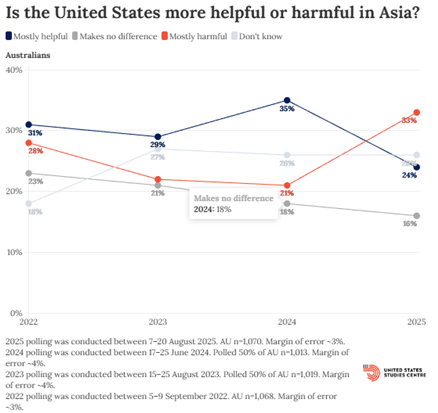
Prime Minister Albanese’s electoral victory in May was driven not only by economic issues such as the housing market, but also by negative public sentiment in Australia toward U.S. President Donald Trump. For example, a public opinion survey of Australian respondents released in October 2025 by the U.S. Studies Centre found that only 16% viewed a second Trump administration positively, while 56% expressed negative views. 33% of respondents considered the United States to be a harmful presence in Asia, whereas 24% believed the United States contributes positively to the region. Although a majority of Australians continue to support maintaining the alliance with the United States, confidence in the alliance has declined significantly.1) In this context, the Labor leadership required a calibrated approach during the election, refraining from direct criticism of the Trump administration while strategically leveraging elements of Trumpism within the conservative coalition and rising anti-American sentiment to its electoral advantage. Australia’s election outcome resembled the experience in Canada, where the progressive Liberal Party secured the defeat of the Conservative Party amid low approval ratings for Prime Minister Justin Trudeau by drawing on anti Trump sentiment as a political counterweight.
The Albanese–Trump summit was held in October 2025, coming nine months after President Trump’s inauguration. The two leaders signed a critical minerals agreement centered on promoting a total of $5 billion in investment through $3 billion in joint investment over the subsequent six months. The agreement included measures to strengthen bilateral cooperation in mining and processing, such as the establishment of price floors. In particular, the U.S. Department of Defense announced plans to invest in the construction of an advanced gallium refinery in Western Australia with an annual production capacity of 100 tons. In addition, Australia committed to expanding the investment of its pension funds in the United States to $1.44 trillion by 2035, approximately three times current levels, as well as to enhancing access to the Australian beef market, cooperation under the Artemis program, and other forms of technological collaboration.2) Australia thus faced the need to conclude an arrangement that aligned with “America First” priorities while sustaining U.S. extended deterrence, within a broader framework of exchanging resource cooperation for security assurances.
For Australia, the continuity of the AUKUS initiative was as important as its trade relationship with the United States. Regardless of the change in U.S. administrations, the Australian government succeeded in securing legislative authorization in the U.S. Congress in December 2024 to ensure the long term sustainability of the project. However, in June 2025, the U.S. Department of Defense formally announced a comprehensive review of AUKUS amid competing priority demands from the U.S. Navy and a broader reassessment of defense strategy, increasing uncertainty regarding the future of the initiative. At the October summit, President Trump stated that Australia would obtain nuclear powered submarines, offering a more definitive assurance than the cautious remarks by U.S. Secretary of the Navy John Phelan, who had emphasized that elements of ambiguity remained. In response, Australia committed to providing an additional $1 billion by the end of 2025, on top of its existing $1 billion investment, along with various defense procurement commitments, to support the realization of AUKUS. The Albanese government thus succeeded in managing the alliance with the United States while securing re-election amid heightened anti-American sentiment within Australia.
Stabilization Policy Toward China
The Australian government continued to frame its China policy in 2025 within the concept of “stabilization.” Since taking office in May 2022, the Albanese government has assessed that the previous government’s emphasis on strategic competition and deterrence generated unnecessary friction with China. In order to ease these tensions and reduce China’s use of trade pressure, the government pursued a stabilization-oriented approach. China remains a critical export market for Australia. According to one report, exports to China accounted for 32.5% of Australia’s total exports in 2023, and trade with China represented approximately 8.4% of Australia’s total nominal GDP.3) As Australia pursued diplomatic thawing, China removed all trade barriers imposed on Australia by 2024, including measures affecting wine, barley, coal, cotton, beef, timber, and rock lobster. High level Australia-China dialogues were also resumed, and Australian journalist Cheng Lei was released after three years of detention in China.
However, beyond stabilizing relations with China, no new initiatives aimed at advancing the relationship were introduced. In the 2023 Defence Strategic Review and the 2024 National Defence Strategy, the Albanese government explicitly identified China as a strategic challenge. While increasing defense spending, the government also carried forward key policies of the previous administration, including the foreign interference legislation, AUKUS, Quad, and measures responding to China’s restrictions on Australia’s critical minerals. Australia continues to maintain a high level of travel advisories for its citizens traveling to China, remains cautious in areas such as scientific and technological cooperation, and continues efforts to counter China’s growing influence in Pacific Island countries. In other words, Australia has exercised restraint in its rhetoric and sought to manage the overall tone of the relationship in order to avoid provoking China, but it has not revised the firm strategic posture toward China that has been in place since the COVID-19 period. This explains why the government has chosen to describe its approach as one of “stabilization,” rather than using the term “reset,” in characterizing Australia’s relationship with China.4)
Australia’s strategic interests continued to take precedence over its economic interests with China on multiple occasions in 2025. Early in the year, Australia made an advance payment of $1 billion to the United States to facilitate progress on the AUKUS initiative, and in July, the U.S. Army’s Dark Eagle hypersonic missile system, with a reported range of 2,700 kilometers, was deployed to northern Australia. Overall, U.S. military utilization of Australian bases increased. In April 2025, Australia expressed concern through a Ministry of Foreign Affairs statement regarding China’s military exercises around Taiwan, and in September, Australian naval vessels transited the Taiwan Strait alongside Canadian warships. In February and October 2025, Chinese fighter aircraft released flares near Australian P-8A maritime patrol aircraft over the South China Sea. From February to March, the Chinese navy, for the first time, conducted live fire exercises in the Tasman Sea within Australia’s exclusive economic zone and subsequently circumnavigated Australia. Tensions observed in 2024 thus reemerged in 2025. Australia’s stabilization policy toward China represented a shift from overt criticism to silence, rather than an endorsement of or acquiescence to China’s actions.
Policy on Upholding the Rules-Based International Order
Australia has sought to uphold the international order that it assesses is being eroded by the United States, China, and Russia, in cooperation with Canada, New Zealand, and European partners. Australia supports global climate governance and a transition to clean energy, and emphasizes adherence to nuclear nonproliferation principles and international maritime law. It has continued policies recognizing Ukraine’s independence and sovereignty, and in September 2025, announced its formal recognition of Palestine as an independent and sovereign state as a warning against what it described as Israel’s actions against humanitarian principles. In July, Australia issued a joint statement with ASEAN titled “Our Shared Future,” strengthening the strategic partnership and underscoring values such as respect for international law, openness, inclusiveness, and transparency. -
Strengthening the Australia-U.S. Alliance and Managing AUKUS Risks
The domestic political foundation of the Albanese government remains solid. The government is expected to continue pursuing a distinctly Australian national interest-oriented foreign policy in a consistent manner, with the maintenance of the alliance with the United States as its top priority. At a practical level, the future status of Caroline Kennedy, the United States ambassador to Australia appointed under the Biden administration, remains an unresolved issue. Rising tensions in Eastern Europe, the Middle East, and South America present important challenges for Australia as it seeks to uphold the international order. However, developments in these extra regional theaters are likely to be assessed primarily through the lens of their implications for strategic competition between the United States and China in the Indo-Pacific. As the United States approaches the 2026 midterm elections, the Trump administration is expected to pursue an unpredictable and forceful America First agenda, prompting the Australian government to prepare across multiple dimensions. Strained relations between the United States and Canada as well as NATO members are unfavorable for Australia, given its close coordination with these partners. While the continued closeness between the United States and the United Kingdom offers some reassurance to Australia. Washington’s increasingly unilateral posture toward Indo-Pacific allies and partners remains a concern. In particular, trade frictions with India risk undermining Australia’s efforts to build a cooperative regional network. Such dynamics may instead increase China’s leverage by raising the value of its counteroffers.
The most critical security issue in Australia’s relationship with the United States is the sustainability of the AUKUS program. Although AUKUS has secured President Trump’s political support, the Department of Defense review has yet to be released, and the possibility of substantive changes to the arrangement remains. The U.S. Navy continues to prioritize the expansion of its own force structure. Even the AUKUS legislation passed by Congress includes provisions that allow the United States to suspend implementation if the agreement is deemed to undermine American capacity or conflict with U.S. national interests. In practical terms, the two shipyards responsible for constructing Virginia-class attack submarines lack the capacity to meet the demand. Producing an average of 2.3 submarines per year, equivalent to two U.S. submarines annually and one Australian submarine every three years, is widely considered unfeasible. Australia’s unease is further heightened by the fact that General Dynamics Electric Boat and Huntington Ingalls Industries are prioritizing their most experienced submarine construction workforce for the Columbia-class SSBN program. This reinforces concerns that AUKUS implementation will remain subordinate to U.S. domestic naval requirements.5)
In early 2026, Australia will prepay approximately USD 2 billion to support the expansion of U.S. shipbuilding industrial capacity. As part of the AUKUS framework, it has also announced investments totaling USD 8 billion to transform the Henderson shipyard in Western Australia into a maintenance hub for the AUKUS submarine force. At the same time, upgrades to HMAS Stirling at Garden Island are underway to enable the rotational deployment of U.S. and UK nuclear-powered submarines beginning in 2027. Close coordination with the United States will remain necessary on a range of sensitive issues, including submarine delivery schedules, the scope of technology transfer, arrangements for nuclear fuel supply, and the establishment of Australia’s domestic nuclear regulatory framework. Any significant delay or failure of the AUKUS program would impose substantial political costs on the Albanese government.
Positioning Australia as Hub for Western Supply Chain Resilience
Australia has already pursued the expansion of critical minerals production as part of its efforts to create jobs and increase national income. Drawing on initiatives such as the U.S. Inflation Reduction Act and the EU Green Deal Industrial Plan, the Australian government began designing the FMIA Act (Future Made in Australia Act) in 2022. The legislation was announced in 2024 and has been in effect since 2025. It constitutes a comprehensive legislative package that integrates national industrial strategy, supply chain policy, and clean energy investment strategy. Between 2024 and 2034, approximately AUD 22.7 billion will be allocated through the federal budget. Of this amount, the AUD 15 billion National Reconstruction Fund is designated to support investment in critical minerals. The policy objective extends beyond expanding extraction capacity to include downstream processing and refining within Australia. As an example, in January 2025 the federal government committed AUD 200 million to Arafura’s rare earths project in central Australia, which is backed by Gina Rinehart. In addition, Liontown Resources is expanding lithium production, while Renascor Resources is developing graphite projects. As of January 2025, total committed investment in critical minerals had reached AUD 1 billion. Government support was conditional on Arafura securing AUD 840 million in private sector financing.6) Going forward, close attention is required to assess how Australia’s critical minerals ecosystem across production, processing, and exports evolves in conjunction with private investment estimated at three to four times the scale of public funding.
The details of the critical minerals agreement signed by Prime Minister Albanese and President Trump in October 2025 have not been disclosed. The first project identified for support is the Alcoa Sojitz gallium project in Wagerup, Western Australia. The project is reported to account for approximately ten percent of global supply, with offtake rights expected to be granted to both Australia and the United States.7) However, it remains uncertain whether the Australian government can move beyond expanding critical minerals output and successfully localize downstream processing and refining. At present, ninety seven percent of Australia’s lithium exports, valued at approximately AUD 12 billion, are destined for China. China has actively sought to constrain Australia’s expansion into downstream segments such as refining and processing, as well as outward expansion into overseas mining. Volatility in critical minerals markets represents an additional variable. China has repeatedly employed low price strategies to undermine competitors’ entry into rare earth value chains. The Trump administration’s anti-climate policy orientation also sits uneasy with the Albanese government’s emphasis on expanding global renewable energy industries. Australia has agreed to prepare the substantive agenda for COP 31, scheduled to be held in Turkey in November 2026. The government plans to emphasize Australia’s role as a supplier of critical minerals for clean energy transition. How this positioning can be reconciled with U.S. anti-climate policies, competition with China centered critical minerals supply chains, and opposition from domestic environmental groups to expanded resource development remains to be seen. It should also be noted that, to date, China’s manufacturing overcapacity has contributed to favorable conditions for Australia’s resource sector.
Australia’s Role in China-Japan Tensions over the Taiwan Strait
Australia continues to adhere to the One China policy while opposing any unilateral change to the status quo in the Taiwan Strait. Following the escalation of China–Japan tensions triggered by remarks made by Prime Minister Sanae Takaichi in the House of Representatives on November 7, Australia and other regional states have responded with caution. Australia is likely to maintain its established position that peace and stability in the Taiwan Strait serve the shared interests of all parties and to urge the parties concerned to pursue dialogue as the means of resolving differences. China’s accession to the Comprehensive and Progressive Agreement for Trans-Pacific Partnership (CPTPP), over which Australia currently serves as chair, has effectively been placed on hold. At the same time, Australia has little interest in seeing China–Japan tensions escalate into broader regional trade disruption or armed conflict.
Meanwhile, China’s restrictions and bans on rare earth exports to Japan are likely to highlight Australia’s position as an alternative supplier of rare earths. Australia is expected to seek to prevent disruptions to Japan’s Mogami-class destroyer procurement program. In this context, Australian Minister for Defence Richard Marles is scheduled to proceed with a planned visit to Japan in December, while Australian Minister for Foreign Affairs Penny Wong criticized China on December 5 for projecting military power in the Asia Pacific without transparency. Although senior Australian officials have avoided direct references to China–Japan tensions, their actions and statements have indirectly aligned with Japan’s position. Should China–Japan tensions persist or intensify in 2026, close attention will be required to how Australia positions itself and what role it assumes within the evolving regional security landscape shaped by this conflict. -
Conceptualizing a ROK-U.S. Nuclear-Powered Submarine Cooperation Benchmarking the AUKUS
With the Lee Jae Myung administration having formally advanced a nuclear-powered submarine program, the implications of Australia’s AUKUS model for South Korea have become increasingly salient. The South Korean government should closely examine the strategic rationale underpinning AUKUS, a program that is likely to materialize at least a decade earlier than Korea’s own nuclear-powered submarine initiative, and use these insights to develop a Korea-specific framework. Strategic concept development must precede weapons system acquisition, and such an approach could contribute to a broader reassessment of South Korea’s naval and maritime strategy. To date, government and media attention has largely focused on the technical capabilities of nuclear-powered submarines, while insufficient consideration has been given to their actual operational use and strategic role. Within U.S. policy circles, questions remain regarding the adequacy of the strategic justification for South Korea’s pursuit of nuclear-powered submarines, alongside calls for clearer articulation of the underlying rationale. In this context, examining the evolution of Australia’s maritime strategy over the past 15 to 20 years could provide valuable reference points for the formulation of South Korea’s naval and maritime strategy.
Second, it is necessary to assess legal, political, and financial challenges that have been raised in relation to AUKUS, and to examine how the Australian and U.S. governments negotiated and addressed these issues. The South Korean government should closely identify the issues that may arise about the location of submarine construction, and engage the U.S. government through negotiations that comprehensively account for all relevant factors. By treating AUKUS as a reference model, South Korea should examine how the Australian government structured an integrated project implementation framework encompassing the Department of the Prime Minister, Department of Defence, Department of Foreign Affairs and Trade, and the Royal Australian Navy. Seoul should study as well how Canberra engaged with Washington and U.S. Congress and responded to challenges as they emerged. In particular, there is a need to analyze the core arguments advanced by international and domestic opposition groups and how the Australian government addressed and managed these points of contention.
Third, South Korea could expand advanced technology cooperation through participation in AUKUS Pillar-II and strengthen linkages with Australia’s AUKUS program, thereby laying the groundwork for the multilateralization of a future ROK–U.S. nuclear-powered submarine initiative. As South Korea has now officially articulated its intention to pursue a nuclear-powered submarine capability, participation as a Pillar-II member would differ substantially, both in practical terms of technological cooperation and in symbolic significance, from a scenario in which it does not participate. Such participation could broaden the scope of technological collaboration with Australia and other like minded partners and, over the medium to long term, create opportunities with the United States, the United Kingdom, and Australia for reciprocal submarine base access, enhanced interoperability, and expanded multilateral training. In addition, participation could help mobilize political support among partner countries, which would be useful in responding to potential international criticism of the initiative.
Strengthening South Korea’s Critical Mineral Supply Chain
South Korea’s dependence on China remains extremely high in key areas including battery grade graphite, rare earth refining, and imports of gallium and germanium. Diversification of supply sources through Australia is therefore necessary. From the perspective of supplier countries, Australia’s middle power model of economic security enhancement can be linked in a complementary manner with supply chain stabilization policies pursued by demand side countries such as South Korea. South Korean firms can participate in the implementation of the Future Made in Australia Act through joint ventures with Australian based entities, leveraging their technological capabilities and capital. South Korea has established global competitiveness in precursor production, a critical stage of the battery materials supply chain, and continues to hold leading positions in high nickel cathode manufacturing technologies and high purity lithium hydroxide refining. For South Korean companies including POSCO, EcoPro, LG Energy Solution, SK On, Samsung SDI, and Hanwha, expansion into the Australian minerals market represents a strategic opportunity. POSCO has diversified its access to nickel and lithium through projects such as the Pilbara Minerals joint venture and the Galaxy Orocobre project, now Allkem. LG Energy Solution and Samsung SDI are deepening cooperation in nickel and cobalt refining, processing, and intermediate materials manufacturing within Australia. Hanwha is accelerating its supply-chain internalization strategy by expanding acquisitions and equity participation in rare earth and other critical mineral assets. EcoPro continues to expand nickel procurement and precursor production projects through sustained cooperation with Australian partners.
South Korea and Australia have already emphasized supply chain cooperation through their 2+2 Foreign and Defense Ministers’ Meetings and have concluded a memorandum of understanding on critical minerals. Both countries are seeking to reduce exposure to China-related risks, expand cooperation on carbon neutrality technologies, and advance collaboration in the development of clean hydrogen. Notably, both South Korea and Australia are core members of the Minerals Security Partnership (MSP), launched under U.S. leadership in 2022. Within this economic multilateral security framework, often described as a “NATO for critical minerals,” the two countries are positioned to cooperate closely in promoting international supply chain stability for critical minerals.
However, strategies to strengthen linkages with Australia’s critical minerals supply chain also entail risks. The Australian government is currently advancing a “Buy Australia” orientation and aligning itself with broader global trends toward protectionist trade and national industrial policy. In this context, Australia is ultimately pursuing domestic localization of midstream industries, including refining, processing, and intermediate material production. Over the long term, this trajectory is likely to place Australia in direct competition with South Korean firms. At the same time, Australia is unlikely to pursue developing country–style resource nationalism or attempts to nationalize the mining sector. Instead, it is expected to seek to play a responsible role as a core contributor to supply chain stability within the Western bloc. Under these conditions, there remains scope for rational negotiation and stable project implementation.
Deepening ROK-Australia Security Cooperation
Australia is a contributing nation to the United Nations Command and is playing an active role in the Multilateral Sanctions Monitoring Team. South Korea has exported K9 self propelled howitzers and Redback infantry fighting vehicles to Australia, and Hanwha Ocean is expanding its equity stake in the Australian defense shipbuilder Austal. Going forward, expanded cooperation mediated through AUKUS is expected to broaden both the scope and substance of security cooperation between the two and ultimately contribute to deterrence against North Korea. The Comprehensive Strategic Partnership adopted in 2021 should be continuously advanced through high level and working level dialogues. South Korea and Australia are already conducting multilateral combined exercises, including Talisman Sabre, RIMPAC, Pacific Vanguard, Exercise Kakadu, and Exercise Pitch Black. Looking ahead, bilateral South Korea-Australia military exercises and multilateral exercises conducted in areas near the Korean Peninsula could be pursued.
| Review of Australia’s External Relations in 2025
| Key Observations on Australia’s External Relations in 2026
| Australia’s 2026 Foreign Policy Outlook and the Korean Peninsula
1) United States Studies Centre, “The Albanese-Trump Summit: Where Do Australians Stand on Their Most Important Ally?” October 16, 2025, https://www.ussc.edu.au/the-albanese-trump-summit-where-do-australians-stand-on-their-most-important-ally?utm_medium=email&utm_campaign=PUBLICATION%20ALERT%20%20Polling%202-pager&utm_content=PUBLICATION%20ALERT%20%20Polling%202-pager+CID_f80142bd5dd7f8c366a3484b60549d0a&utm_source=USSC%20Campaign%20Monitor&utm_term=The%20Albanese-Trump%20summit%20Where%20do%20Australians%20stand%20on%20their%20most%20important%20ally (Accessed: November 30, 2025)
2) U.S. Embassy in Canberra, “Fact Sheet: President Donald J. Trump Closes Billion-dollar Deals with Australia,” October 21, 2025, https://au.usembassy.gov/fact-sheet-president-donald-j-trump-closes-billion-dollar-deals-with-australia/#:%7E:text=The%20Export%2DImport%20Bank%20of,projects%20between%20our%20two%20countries (Accessed: November 30, 2025)
3) National Australia Bank, “Thematic – China’s Economic Evolution and Implications for the Australian Economy,” Markets Research (November 8, 2024), https://www.nab.com.au/content/dam/nab-email-composer/nabmarketsresearch/economics/pdf/2024-11%20Thematic%20-%20China-Australia%20Economic%20Transmission.pdf (Accessed: November 30, 2025)
4) Kevin Magee, “Australia and the People’s Republic of China: Stabilization and Contradiction,” Australia-China Relations Institute, University of Technology Sydney, November 28, 2024, https://www.uts.edu.au/news/2024/11/australia-and-peoples-republic-china-stabilisation-and-contradiction (Accessed: November 30, 2025)
5) Peter Briggs, “Virginia, We Have a Problem,” Australian Strategic Policy Institute, January 14, 2025, https://www.aspistrategist.org.au/virginia-we-have-a-problem/ (Accessed: November 29, 2025).
6) The government’s investment was conditional on Arafura securing AUD 840 million in private sector investment. Dan Jervis-Bardy, “Commonwealth to Invest a Further $200m in Rare Earth Mining Project Backed by Gina Rinehart,” January 14, 2025, https://www.theguardian.com/australia-news/2025/jan/15/commonwealth-to-invest-a-further-200m-in-rare-earth-mining-project-backed-by-gina-rinehart (Accessed: November 30, 2025)
7) Josh Butler, “Albanese at the White House: Trump Endorses Aukus, Signs $8.5bn Rare Earths Deal and Calls PM ‘Great Leader” October 20, 2025, https://www.theguardian.com/australia-news/2025/oct/20/albanese-at-the-white-house-trump-endorses-aukus-signs-85bn-rare-earths-deal-and-calls-pm-great-leader (Accessed: November 29, 2025).
※ The contents published on 'Sejong Focus' are personal opinions of the author and do not represent the official views of Sejong Institue