File
File
|
The Global Geopolitical Crisis of 2026 and the Rise of a New International Order: Focusing on Sino-Russian Strategic Cooperation |
| March 4, 2026 |
-
Jae-hung CHUNGSenior Research Fellow, Sejong Institute | jameschung@sejong.org
-
The international order in 2026 is entering a period of profound structural transformation, as the so-called "Rules-Based International Order (RBIO)," established in the aftermath of World War II and long sustained under American and Western leadership, faces a fundamental challenge. The post-Cold War unipolar order under American primacy is experiencing an accelerating fracture, driven by the powerful strategic alignment between China and Russia in their shared pursuit of a multipolar order. This has transcended mere diplomatic friction, manifesting as a geopolitical crisis of global dimensions. In particular, the near-simultaneous crises that erupted beginning in January 2026, including the U.S. operation to apprehend Venezuelan President Nicolás Maduro, the escalation of the Iran-Israel conflict, and the intensification of Sino-Japanese tensions alongside heightened military tensions in the Taiwan Strait, cannot be reduced to discrete, localized disputes between individual states. Rather, these developments are deeply interconnected, functioning as critical geopolitical fault lines along which the existing Western-led unipolar order and the emerging multipolar order championed by China and Russia are locked in direct confrontation. This analysis seeks to examine the evolving patterns of global geopolitical crisis intensifying in 2026 and to elucidate the nature of what is variously characterized as a new Cold War, a bloc-to-bloc confrontation, and an emerging multipolar international order. Central to this inquiry are the questions of how Russia, operating under sustained Western sanctions in the wake of nearly four years of war in Ukraine, has pursued strategic alignment with China, Iran, and North Korea, and how this anti-Western solidarity is manifesting across three pivotal geopolitical theaters: Latin America, the Middle East, and Northeast Asia. Furthermore, the tectonic shifts and fragmentation underway in international politics are directly impacting South Korea's foreign policy, rendering a reassessment of Seoul's traditionally fixed alignments around the United States, Japan, China, and the broader West increasingly inevitable. Should South Korea limit itself to merely acknowledging the China- and Russia-led push for multipolarity and Eurasian order integration, or confine its strategic response to a narrow focus on bilateral relations with Beijing and Moscow, Seoul is likely to face considerable external challenges ahead.
One of the most notable transformations in international politics over the past several years has been the rapid evolution of the strategic partnership between China and Russia. This relationship has moved beyond a simple convergence of interests reminiscent of the Cold War era and has developed into a quasi-alliance encompassing military, economic, and diplomatic cooperation. Under the stated objective of countering U.S.- and Western-led unilateralism and defending UN-centered multilateralism, the two countries have in practice been actively working to expand and restructure institutions such as BRICS and the Shanghai Cooperation Organisation (SCO), particularly by incorporating countries from the Global South, in order to construct an independent sphere of influence.
The meeting held in Beijing on February 1, 2026, between Wang Yi, Director of the Office of the Central Commission for Foreign Affairs of the Chinese Communist Party, and Sergei Shoigu, Secretary of the Russian Security Council, symbolically demonstrated the institutionalization of the growing China-Russia alignment. During the meeting, the two sides reaffirmed their firm mutual support for each other's core national interests and further upgraded their joint response mechanisms regarding major global geopolitical issues. At the same time, the joint statement titled the "Eurasian Peace Charter for Diversity and Multipolarity in the 21st Century," issued by Russia, North Korea, Iran, Myanmar, and Belarus, signifies the formal launch of a large-scale political, economic, and security consultative framework centered on the Eurasian continent, led primarily by China and Russia. Moreover, with indications that China as well as several countries in Central Asia and Eastern Europe may align themselves with this initiative, the restructuring of the international order, traditionally centered on the United States and the Western bloc, is increasingly emerging as an unavoidable reality.
Furthermore, during the China-Russia leaders' virtual summit held on February 4, President Xi Jinping and President Vladimir Putin strongly affirmed the principle of indivisible security across the Eurasian region and expressed solidarity, while also voicing serious concerns over the eastward expansion of NATO under U.S. and Western leadership, the strengthening of trilateral security cooperation among the United States, South Korea, and Japan, and the formation of exclusive bloc-based military groupings. This development suggests that both China and Russia perceive the transformation of the international order triggered by the Russia-Ukraine War as a "great transformation unseen in a century" (百年未有之大變局), and can be interpreted as a manifestation of their strong determination to complete a structural transition of global power. -
In the early hours of January 2, 2026, U.S. special forces launched a surprise raid on a military base on the outskirts of Caracas, Venezuela, capturing President Nicolás Maduro and his wife in what was designated Operation Absolute Resolve. This event symbolically marked the opening phase of the emerging global geopolitical crisis. The operation to arrest Maduro, rooted in the Trump administration's interpretation of the Monroe Doctrine, was not merely an attempt to replace a corrupt and authoritarian regime. Rather, it represented a striking move based on sophisticated strategic calculations aimed at blocking the rapidly expanding influence of China and Russia in Latin America, a region traditionally regarded as the United States' geopolitical backyard.
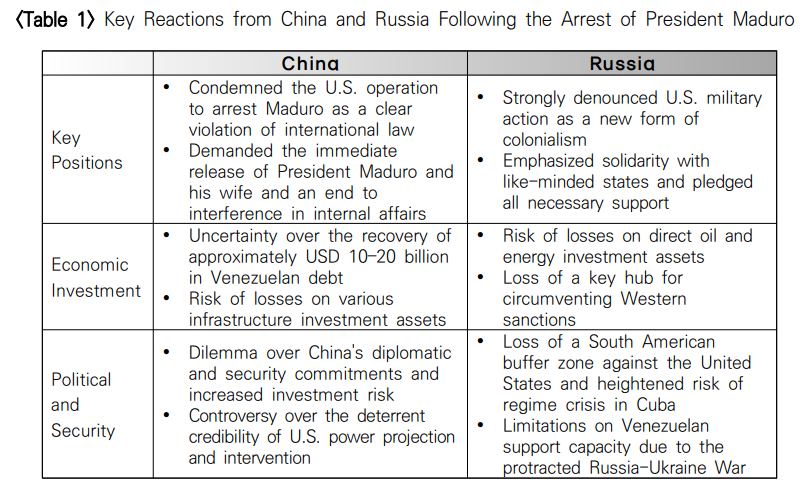
The collapse of the Maduro regime in Venezuela, which had long demonstrated a pro-China and pro-Russia orientation, has inflicted painful geopolitical and economic losses on both powers. Over the years, China invested tens of billions of dollars in Venezuela, not only securing a stable supply of inexpensive crude oil but also utilizing the country as a key strategic gateway for the expansion of Chinese enterprises into Latin America, particularly in the fields of energy, telecommunications, and infrastructure. As a result of these developments, China now faces serious uncertainty regarding the recovery of its substantial outstanding debt as well as major disruptions to its oil supply chains. Nevertheless, China has chosen to avoid direct military confrontation with the United States and has instead focused on condemning what it describes as American unilateralism and hegemonism, emphasizing its longstanding diplomatic rhetoric of "respect for sovereignty and non-interference in internal affairs." This approach can be interpreted as part of a strategy of strategic patience: even if China must absorb short-term economic losses, it seeks in the long term to expand and sustain its political, diplomatic, and economic influence in Latin America by leveraging latent anti-American sentiment within the region and by positioning itself as a leading force in the emerging multipolar international order.
Russia, while its economic investment in Venezuela falls short of China's in scale, has long regarded the country as a high-value asymmetric asset for counterbalancing the United States. Having cultivated deep ties with the Maduro regime in the energy and arms sectors by circumventing Western sanctions imposed on Russia, Moscow has responded with strong opposition to the recent developments. The fact that China and Russia jointly convened the UN Security Council immediately following Maduro's arrest to strongly condemn what they characterized as unlawful U.S. conduct suggests that the strategic alignment between the two powers in pursuit of a new international order is operating with considerable coherence on the Latin American stage as well, extending well beyond the management of individual state crises.
-
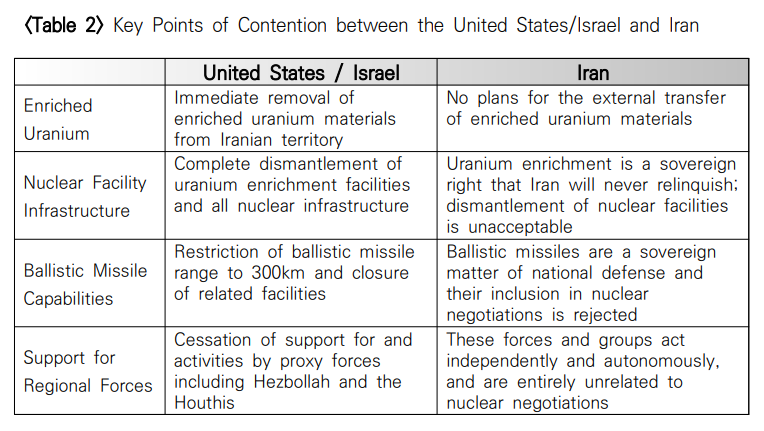
Alongside the Venezuelan crisis, a complex security emergency centered on Iran has been sending severe shockwaves through the global geopolitical environment. The intense full-scale war with Israel in 2025 inflicted devastating blows on Iran's military and civilian infrastructure, while prolonged U.S. and Western economic sanctions contributed to a large-scale popular uprising in late 2025 that exposed serious internal vulnerabilities within the Iranian regime, including deep-seated ethnic tensions. Seizing on the power vacuum and internal disorder within Iran, the Trump administration intensified pressure on Tehran to abandon its nuclear and missile programs entirely, and on February 28, 2026, launched a large-scale airstrike campaign targeting Iranian leadership compounds and nuclear and missile military installations.
The large-scale U.S. and Israeli airstrike campaign resulted in the death of Supreme Leader Ayatollah Ali Khamenei, with Ali Larijani, Secretary-General of the Supreme National Security Council, stepping forward as interim leader and vowing swift and severe retaliation. Iran has since launched successive large-scale retaliatory strikes using hypersonic ballistic missiles and attack drones against major Israeli cities as well as key U.S. military installations across the Middle East, including those in Bahrain, the UAE, Kuwait, and Qatar. As Iran's wave of retaliatory strikes continues, Houthi government forces, Hezbollah, Hamas, and other pro-Iranian Shia armed groups have all joined the fight, causing the conflict to spread across the broader Middle East region. Iran has also moved to blockade the Strait of Hormuz, a critical global oil transit chokepoint, forcing large oil tankers to halt or reroute and triggering sharp spikes in energy prices, as the global geopolitical crisis has begun to rapidly spill over into the economic and energy domains.
Unable to accept a situation in which the collapse of the pro-China, pro-Russia Iranian Islamic regime could strengthen U.S. and Israeli dominance in the Middle East, China and Russia are expected to assume a more active mediating and interventionist role, deepening their strategic alignment with Iran to preserve the regional balance of power. The clearest illustration of this trend is the large-scale trilateral naval exercise conducted by China, Russia, and Iran in the Strait of Hormuz under the designation "Maritime Security Belt 2026." Russia dispatched the corvette Stoiky and provided Iran with S-400 medium-to-long-range surface-to-air missile systems and communications personnel. China, for its part, deployed its latest electronic warfare reconnaissance vessel, the Liaowang (818A), to Oman near the Persian Gulf and has reportedly provided Iran with intelligence on U.S. military asset movements through its BeiDou satellite network. The exercise goes beyond a symbolic display of naval force. Its primary objective appears to be the development of practical combined maritime operational capabilities aimed at protecting the so-called "Shadow Fleet" transporting Iranian oil from potential U.S. and NATO naval blockades. 1)
The recent trilateral naval exercise conducted by China, Russia, and Iran has been characterized by Nikolai Patrushev, Security Adviser to President Vladimir Putin, as part of an emerging maritime strategic competition between the United States and the West on one side and BRICS on the other, aimed at constructing a new multipolar maritime order. Notably, China has actively supported Iran, which constitutes a key node in the Belt and Road Initiative (BRI) and a critical pillar of China's energy security, while simultaneously expanding its influence across the Middle East. In March 2023, Beijing hosted a historic trilateral meeting between China, Saudi Arabia, and Iran, during which China mediated a rapprochement between Riyadh and Tehran for the first time in history, demonstrating its growing diplomatic role in the region.
Russia has likewise strengthened its military, security, and energy ties with Iran following the outbreak of the Russia-Ukraine War, treating Tehran as a strategic partner in its resistance against the United States. Moscow and Tehran have already cooperated closely on regional issues since the Syrian civil war, and Russia has continued to signal its willingness to play an assertive role in shaping stability across the Middle East and the broader Eurasian region. Ultimately, the admission of Iran as a full member of both the Shanghai Cooperation Organisation (SCO) and BRICS can be interpreted as part of a medium-to-long-term Eurasian strategy by China and Russia. By incorporating Iran into the institutional framework of an emerging multipolar international order, Beijing and Moscow seek to undermine U.S. and Western efforts to isolate Iran while providing Tehran with political, economic, and military backing. -
In Northeast Asia, located at the eastern edge of the Eurasian continent, intensifying tensions between China and Japan, coupled with the Taiwan issue, have turned the region into one of the most acute flashpoints of the emerging new Cold War. Following remarks by Japanese Prime Minister Sanae Takaichi in November 2025 suggesting the possibility that Japan could exercise its right of self-defense in the event of a Taiwan contingency, China regarded the statement as a serious challenge to, and infringement upon, its core national interests and implemented retaliatory measures of an unprecedented scale. These measures have gone far beyond the political and diplomatic protests of the past. They have taken the form of severe economic coercion, including a comprehensive suspension of exports of critical minerals such as rare earth elements, gallium, and germanium, which are vital to Japan's manufacturing sector, as well as embargoes on dual-use items.
Behind this extreme confrontation between China and Japan lies the deeper structural competition between the United States and China over Taiwan. The government of President Lai Ching-te of the Democratic Progressive Party, which has consistently pursued a course of Taiwan independence, has sought to counter Beijing's pressure by strengthening coordination with the United States, Japan, and other liberal democratic partners. By contrast, the leadership of Xi Jinping has repeatedly declared that national reunification with Taiwan constitutes the core of China's core interests (核心利益), while refusing to rule out the use of force. In parallel, Beijing has continued to conduct large-scale military exercises encircling Taiwan while applying sustained diplomatic and economic pressure.
Meanwhile, at the Munich Security Conference held on February 14, 2026, Chinese Foreign Minister Wang Yi sharply criticized Japan's recent posture, describing it as a revival of militarism and a serious challenge to the post-war international order. He stated that "East Asia has on the whole remained peaceful, and China has served as its central pillar (中流砥柱) of stability. Prime Minister Takaichi's remarks, however, represent a dangerous signal that shakes the post-war regional order," adding that China could not and would not accept such developments. More specifically, Wang Yi characterized Prime Minister Takaichi's suggestion that Japan might exercise collective self-defense in the event of a Taiwan contingency as a grave challenge to the post-war international order. Drawing comparisons between Germany's post-war reckoning with its past and Japan's historical approach to militarism, he called on Tokyo to undertake deeper reflection and responsibility regarding its wartime history.
At the same time, Beijing reiterated its firm determination to ultimately achieve national reunification with Taiwan, presenting it as an essential step toward realizing the unity and rejuvenation of the Chinese nation. Under the leadership of Xi Jinping, China has increasingly emphasized the development of a "strong military" in line with the concept of building a world-class armed force, while openly reaffirming its commitment to the reunification of Taiwan. Accordingly, the ongoing modernization and restructuring of the People's Liberation Army is being accelerated with a clear focus on preparing for potential contingencies in the Taiwan Strait. From this perspective, China's military modernization and strategic posture can be interpreted as aimed at preemptively constraining the potential military role of Japan, a key U.S. ally, in the event of a Taiwan-related crisis.
Russia has likewise aligned itself closely with China by strongly supporting Beijing's "One China" principle (一個中國原則). In December 2022 and again in October 2024, the two countries conducted joint naval exercises and coordinated patrols by their naval and coast guard forces near the Taiwan Strait, in attempts to breach the First Island Chain. During an official visit to China on February 1, 2026, Sergei Shoigu, Secretary of the Russian Security Council, reaffirmed Moscow's firm support for the One China principle and expressed clear opposition to Japan's moves toward becoming a major military power in the wake of the escalation of Sino-Japanese tensions. These developments suggest that, in the strategic perception of both Beijing and Moscow, tensions between China and Japan are not merely a bilateral dispute but a matter closely linked to the broader security landscape of Eurasia. In this sense, the Sino-Russian principle of the indivisibility of Eurasian security appears to be moving beyond the strategic level and taking on increasingly concrete military dimensions. -
China and Russia have accelerated their efforts to build a new multipolar international order by strengthening solidarity and cooperation with countries of the Global South, using platforms such as BRICS and the broader Eurasian region as strategic bases. Of particular significance, the two countries have strongly criticized what they describe as U.S. hegemony and unilateralism, while increasingly coordinating their positions on major international issues. This alignment has been evident in their responses to developments such as the U.S. pursuit of the arrest of Venezuelan President Nicolás Maduro and his wife, the Iranian crisis, escalating Sino-Japanese tensions, and the Taiwan issue. At the same time, it remains difficult to conclude that China and Russia would engage in direct military intervention, or "boots on the ground," in response to U.S. military pressure against Iran. Nevertheless, the confrontation and geopolitical fragmentation triggered by the Iranian crisis suggest that changes in the international order may become unavoidable, particularly depending on how China and Russia choose to respond to the evolving situation.
The harsh competition and confrontation among the great powers, particularly the United States, China, and Russia, are presenting emerging economies and countries of the Global South with profound dilemmas and strategic challenges. Many developing countries increasingly recognize the potential economic benefits associated with a multipolar international order promoted by China and Russia, as well as the need for alternative financial systems, and have shown stronger cooperation and solidarity through institutions such as BRICS and the Shanghai Cooperation Organisation (SCO). Ultimately, as the strategic competition among the United States, China, and Russia intensifies over the future restructuring of the global order, the prospects for resolving regional conflicts may become increasingly constrained. At the same time, the possibility of a more fragmented international system, characterized by entrenched bloc-based rivalry and persistent geopolitical confrontation, cannot be ruled out.
In conclusion, the intensifying geopolitical crises and conflicts of 2026 have taken on the character of a complex systemic crisis, driven by the prolonged Russia-Ukraine War, the deepening strategic rivalry between the United States and China, and a series of simultaneously unfolding regional crises across the world. These dynamics are generating a form of systemic instability that, in many respects, exceeds the tensions of the Cold War era. The current situation, in which trilateral cooperation among the United States, South Korea, and Japan confronts the growing alignment among North Korea, China, and Russia, suggests that the international order is increasingly fragmenting into competing and mutually exclusive blocs under the broader label of multipolarity.
China has characterized the present moment as a period of "great changes unseen in a century" (百年未有之大變局), emphasizing that structural transformation of the existing U.S.-led and Western-led international order has become unavoidable. In response, Beijing has accelerated cooperation through institutions such as the Shanghai Cooperation Organisation (SCO) and BRICS while promoting a series of global initiatives aimed at reshaping international governance. Under the broader vision of the Belt and Road Initiative (BRI) and the concept of a "community with a shared future for mankind" (人类命运共同体), China has advanced the Global Development Initiative (GDI), Global Security Initiative (GSI), Global Civilization Initiative (GCI), and Global Governance Initiative (GGI), seeking to promote what it describes as a more equitable and balanced multipolar international order.
Russia has articulated a similar vision. In its revised Foreign Policy Concept issued on March 1, 2023, Moscow declared that a more just multipolar international order is emerging and defined the construction of such an order as a historic mission under the principle of "sovereign centres of global development." In pursuing this objective, Russia has emphasized closer cooperation with China and with countries of the Global South while expanding its engagement in regions such as Latin America, the Middle East, and Northeast Asia. As China and Russia have sought to reshape the international order through expanding strategic cooperation, the United States and its Western partners have reacted strongly against these efforts. As a result, the international system appears to be entering a period of systemic transition, or fragmentation, marked by intensifying geopolitical rivalry and growing polarization between competing blocs.
Within this severe and complex diplomatic and security environment, South Korea's diplomatic position faces a significant test. The Lee Jae-myung administration, which has emphasized pragmatic diplomacy centered on national interests, must maintain the ROK-U.S. alliance that has underpinned South Korea's security for the past seven decades while simultaneously demonstrating a high degree of diplomatic balance to prevent a rapid deterioration in relations with China and Russia. In particular, careful preparation is required to address the possibility that external regional crises could spill over into security risks for the Korean Peninsula. These include the prolonged Russia-Ukraine War, escalating Sino-Japanese tensions and the Taiwan issue, and the ongoing Iran-Israel conflict. South Korea is especially vulnerable to instability in the Middle East, as the country depends on the region for approximately 70 percent of its imported crude oil. Any disruption of maritime routes, particularly a potential blockade of the Strait of Hormuz, would therefore have direct and immediate consequences for South Korea's energy security.
Against this backdrop, the Lee Jae-myung administration will need to pursue pragmatic diplomacy centered on national interests while maintaining the ROK-U.S. alliance as a core pillar of its foreign policy. At the same time, it will be necessary to expand South Korea's diplomatic space through a new multilateral approach that does not exclude China and Russia and that is grounded in autonomy and multilateral cooperation. Furthermore, efforts to improve inter-Korean relations and to achieve the early establishment of lasting peace on the Korean Peninsula will require a more innovative and flexible diplomatic strategy. Moving beyond a foreign policy framework oriented predominantly toward specific major powers or structured around bilateral relationships with countries such as the United States, Japan, and China, South Korea will need to pursue a more creative form of multilateral diplomacy in order to stabilize the peninsula and navigate the emerging geopolitical landscape.
To avoid being swept up in rapidly evolving global geopolitical crises, South Korea must remain cautious not to become fully absorbed into the logic of international fragmentation or bloc politics. Instead, it will need to expand its multilateral diplomacy and diplomatic autonomy by leveraging its position as a middle power. In a period of international order realignment triggered by global geopolitical crises, ensuring the nation's survival and prosperity will require moving beyond ideological rigidity and one-sided alignments. Developing a medium-to-long-term foreign strategy grounded in flexibility and strategic creativity has therefore become more urgent than at any previous point in South Korea's modern history.
| The Unfolding of the Global Geopolitical Crisis and the Deepening of Sino-Russian Strategic Cooperation
| The First Fault Line: The Arrest of President Nicolás Maduro and U.S.–China–Russia Strategic Competition in Latin America
| The Second Fault Line: The Iran-Israel Conflict and the Deterioration of the Middle East Security Environment
| The Third Fault Line: Intensification of Sino-Japanese Conflict and Crisis in the Taiwan Strait
The Prospect of a New International Order and the Phenomenon of Fragmentation
1) The term "Shadow Fleet" refers to aging tankers, some owned by Iranian or Russian entities, that transport sanctioned Russian and Iranian crude oil by disabling their Automatic Identification Systems (AIS), frequently changing ownership and flags of registry, and conducting ship-to-ship transfers on the high seas in order to evade Western sanctions.
※ The contents published on 'Sejong Focus' are personal opinions of the author and do not represent the official views of Sejong Institue