File
File
|
The Transformation and Challenges of ROK-U.S.-Japan Security Cooperation under the Second Trump Administration |
| April 28, 2026 |
-
Bee Yun JOResearch Fellow, Sejong Institute | bjo87@sejong.org
-
The Camp David Summit in August 2023 marked a turning point that advanced both the scope and operating mechanisms of ROK-U.S.-Japan cooperation. The three leaders went beyond a simple political declaration and presented a framework for cooperation that included the regularization of high-level consultative bodies, the multi -domain expansion of military cooperation, the institutionalization of deterrence cooperation against North Korea, economic security and supply chain cooperation, and joint commitments to regional threats. In particular, measures such as the real-time sharing of North Korean missile warning information, the establishment of a multi-year trilateral exercise plan, and the creation of a cyber cooperation framework can be seen as having moved ROK-U.S.-Japan cooperation beyond ad-hoc coordination toward a more institutionalized structure.
Yet ROK-U.S.-Japan cooperation in 2026 clearly looks different from the heightened political atmosphere that surrounded Camp David. Under the Lee Jae Myung administration, a trilateral summit has not yet been held, and some high-level consultative mechanisms are being operated in a limited or lower-visibility manner. On the surface, these changes make it appear as though the momentum behind ROK-U.S.-Japan cooperation has substantially weakened. A closer look, however, suggests that this cannot simply be understood as a weakening or retreat.
As this paper shows, ROK-U.S.-Japan security cooperation after Camp David has neither expanded nor contracted evenly; rather, it appears to be proceeding at different speeds across different issue areas. In core security areas such as the regularization and multi-domain expansion of military cooperation, responses to North Korean missiles, and real-time missile warning information sharing, relatively tangible signs of institutionalization and continuity can be observed. By contrast, in areas such as the expansion of high-level consultative bodies, economic security and supply chain cooperation, and coordination on regional threats, the institutions themselves remain in place, but summit-level political momentum and external visibility have shown signs of weakening.
Against this backdrop, this paper first reviews the implementation status of the major agenda items presented by the leaders of the South Korea, the United States, and Japan at the Camp David Summit and evaluates the current state of ROK-U.S.-Japan security cooperation. It then examines the structural factors driving these changes, before offering several policy implications for sustaining and managing trilateral security cooperation amid a changing strategic environment.| Camp David: Retrospect and Assessment of Implementation -
What Was Envisioned?
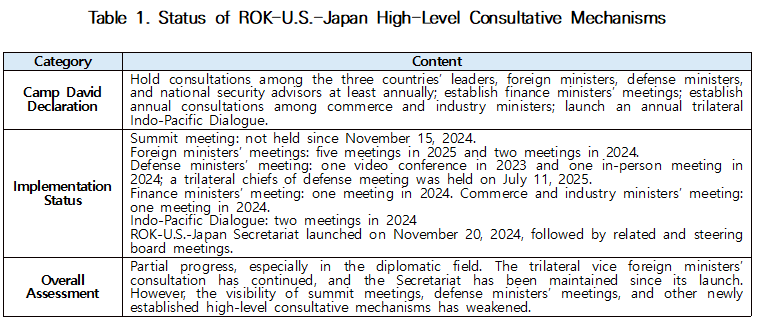
The major agenda items envisioned by the three countries at the Camp David Summit can be summarized as follows. First, at the level of high-level consultative mechanisms, the three countries agreed to hold consultations among leaders, foreign ministers, defense ministers, and national security advisors at least annually. They also agreed to establish finance ministers’ meetings and commerce and industry ministers’ meetings, as well as an annual trilateral Indo-Pacific Dialogue. This was an attempt not only to expand the scope of ROK-U.S.-Japan cooperation, but also to turn trilateral cooperation from a mechanism that operated intermittently in response to specific issues into a policy coordination structure with regularity and continuity.
The direction of security cooperation was also clear. For the first time, the three countries agreed to establish a multi-year exercise plan and to conduct regular exercises across multiple domains based on that plan. In this process, Freedom Edge became a representative framework, while the scope and missions of security cooperation expanded to include maritime interdiction exercises, counter-piracy, maritime missile defense and anti-submarine warfare, disaster response, and humanitarian assistance exercises.
Security cooperation against North Korea was also a core pillar of the Camp David vision. The three countries reaffirmed their commitment to the complete denuclearization of North Korea and strongly condemned North Korea’s nuclear and missile programs and its unprecedented number of ballistic missile launches. In particular, building on the Phnom Penh commitment, they agreed to establish a real-time sharing mechanism for North Korean missile warning information by the end of 2023. They also included ballistic missile defense cooperation, cyber coordination aimed at countering North Korea’s illicit cyber activities and sanctions evasion, and cooperation on North Korean human rights, abductees, detainees, and unrepatriated prisoners of war. This showed that cooperation on North Korea was designed not merely as military deterrence, but as a multi-layered structure encompassing intelligence, sanctions, cyber, and human rights dimensions.
Economic security and supply chain cooperation were also newly emphasized at Camp David. The three countries agreed to expand cooperation in advanced sectors such as semiconductors, batteries, clean energy, critical minerals, biotechnology, artificial intelligence, and quantum computing. They also agreed to strengthen information sharing and pursue the launch of a pilot supply chain early warning system to respond to economic coercion. In addition, they agreed to strengthen cooperation with third countries on export controls to prevent their technologies from being diverted to military or dual-use capabilities. The inclusion of science and technology, people-to-people exchanges, support for Ukraine, global infrastructure, and cooperation with developing countries also suggests that Camp David sought to expand ROK-U.S.-Japan cooperation beyond the security and military fields into a broader strategic cooperation framework.
Above all, Camp David raised the level of coordination on regional threats. The three countries explicitly expressed shared concerns regarding unlawful maritime claims in the South China Sea, attempts to unilaterally change the status quo, the coercive use of maritime militia and coast guard vessels, and illegal fishing. They also clearly affirmed the importance of maintaining “peace and stability in the Taiwan Strait.” In addition, they included a commitment to consult expeditiously at the trilateral level on regional challenges and threats affecting their common interests and security.
How Far Has It Come?
How much of the Camp David vision has been implemented since then? In short, progress has not been even across all areas. Rather, the pace and visibility of implementation have differed by issue area, and in this process the character of ROK-U.S.-Japan cooperation itself has also been changing.
(1) High-Level Consultative Bodies: Progress, Yes; Visibility, Weaker
The first area that stands out is high-level consultative mechanisms. It is true that summit-level momentum has weakened, as no ROK-U.S.-Japan summit has yet been held under the Lee Jae Myung administration. The trilateral Indo-Pacific Dialogue was held twice, on January 5 and December 11, 2024, but has not convened since. The ROK-U.S.-Japan defense ministers’ meeting was held once by video conference on November 12, 2023, and the first in-person meeting was held in Japan on July 28, 2024. In 2025, however, what took place was not a defense ministers’ meeting but a trilateral chiefs of defense meeting on July 11. Military cooperation has continued, but ministerial-level political visibility at the trilateral level can be seen as having somewhat declined.
The same applies to the finance ministers’ meeting and the commerce and industry ministers’ meeting. Their first meetings were held in Washington on April 17 and June 27, 2024, respectively, but no follow-up meetings have yet taken place. By contrast, the diplomatic and working-level frameworks appear to be maintained. For example, trilateral foreign ministers’ meetings have continued relatively steadily. They were held twice in 2024, on February 22 and September 23, and five times in 2025, on February 15, April 3, July 11, September 22, and October 29, demonstrating the continuity of ROK-U.S.-Japan diplomatic coordination.
In addition, the ROK-U.S.-Japan Secretariat was launched on November 20, 2024, creating a mechanism to support institutional continuity. After one meeting was held on February 29, 2025, the Secretariat’s steering board met three times, on May 20 and August 28, 2025, and January 29, 2026. Given that the Secretariat and the position of Secretary-General are designed to rotate every two years among South Korea, the United States, and Japan, it can be assessed that, although summit-level political momentum has weakened in the area of high-level consultative mechanisms, diplomatic and working-level institutional frameworks have been maintained and partially consolidated.
(2) Security and Military Cooperation: Continuity Maintained
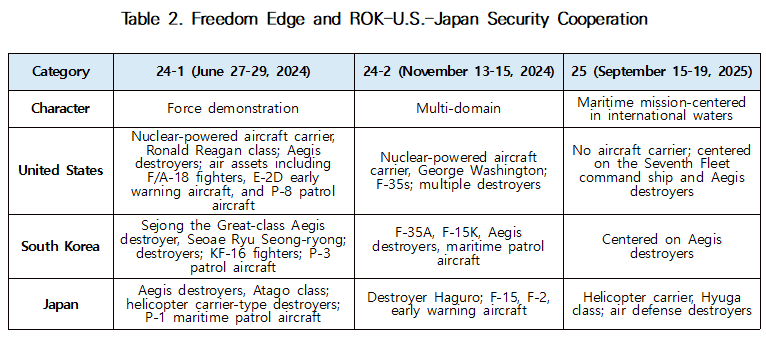
By contrast, security/military cooperation has been one area showing the clearest continuity. Freedom Edge exercises were conducted three times: in June 2024, November 2024, and September 2025. This shows that the multi-year trilateral exercise plan presented at Camp David has managed actual implementation.
The evolution of Freedom Edge is particularly noteworthy beyond the simple number or continuity of exercises. The first 2024 exercise had a strongly demonstrative character, involving a nuclear-powered aircraft carrier, Aegis destroyers, early warning aircraft, and patrol aircraft on the largest scale. The second 2024 exercise placed greater emphasis on multi-domain integrated operations, especially ballistic missile defense, and interoperability. The 2025 exercise, conducted without a U.S. aircraft carrier, focused on maritime missile defense, anti-submarine warfare, and maritime operations, giving it a more mission-oriented character. This demonstrates that ROK-U.S.-Japan military cooperation is gradually evolving from a simple display of strategic assets and solidarity toward actual mission execution and functional operation.
(3) Cooperation against North Korea: Progress in Missiles, Deterrence, and Cyber
Security cooperation against North Korea has also shown relatively clear progress. Most importantly, the real-time sharing mechanism for North Korean missile warning information has been assessed as having entered full operation in 2024, after its complete activation was announced in December 2023. Its utility was reaffirmed during North Korea’s ballistic missile launch in January 2026.
Commitments to denuclearization, deterrence against North Korea, responses to ballistic missiles, and extended deterrence have also been repeatedly reaffirmed in subsequent ROK-U.S. and ROK-U.S.-Japan joint statements. Of course, the shift in wording between “complete denuclearization” and “denuclearization of the Korean Peninsula” should not be treated lightly. It contains significant sensitivities regarding North Korea policy, regional strategy, and message coordination within the alliance. Nevertheless, it can be said that the basic consensus on the need to maintain security cooperation in response to North Korea’s nuclear and missile threats has remained.
Cyber cooperation has received relatively less attention, but its working-level continuity has also been confirmed. The trilateral cyber working group has met four times since its first meeting on December 7, 2023: on March 29 and September 6, 2024, and from August 27 to 28, 2025.
(4) Coordination on Regional Threats: Visibility Has Declined the Most
By contrast, coordination on regional threats can be described as the area whose visibility has declined the most since Camp David. Immediately after Camp David, coordination on regional threats was reaffirmed in a relatively clear form, including peace and stability in the Taiwan Strait, the South China Sea issue, opposition to unilateral changes to the status quo, and the defense of a rules-based order. However, in the absence of further ROK-U.S.-Japan summit meetings, this agenda has inevitably faced structural limits in visibility. In particular, while the Lee Jae Myung administration maintains the language of peace and stability in the Taiwan Strait and our government’s basic position on Taiwan, it has not moved toward actively developing these into coordinated trilateral summit-level language.
In sum, ROK-U.S.-Japan security cooperation after Camp David has proceeded at different speeds across different issue areas. In core security areas such as the regularization and multi-domain expansion of military cooperation, responses to North Korean missiles, and real-time missile warning information sharing, relatively clear institutionalization has taken place. By contrast, in the expansion of high-level consultative bodies, economic security and supply chain cooperation, and coordination on regional threats, the institutions remain in place, but political momentum and external visibility have weakened. In particular, the sluggishness of summit meetings, the limited convening of defense ministers’ meetings and newly established ministerial-level bodies, and the weakening of coordinated language on the Taiwan Strait and the South China Sea indicate that these areas have entered a phase of management rather than expansion. As a result, current ROK-U.S.-Japan cooperation is moving toward a structure in which selective institutionalization in core security areas coexists with the low-visibility continuation of other areas. -
As examined above, ROK-U.S.-Japan security cooperation after Camp David has clearly accumulated some achievements in institutionalization. However, its development has not been uniform; it has unfolded at different speeds and with varying intensity across issue areas. These changes are difficult to explain through a single cause. Rather, the recent transformation of ROK-U.S.-Japan cooperation should be understood as the result of several overlapping structural factors.
Weakening of Camp David’s “Declaratory Continuity”
The first point to note is the weakening of what may be called Camp David’s declaratory continuity. Camp David was the product of a particular political alignment among then-Presidents: Biden, Yoon Suk Yeol, and Kishida. Since then, the governments of the South Korea, the United States, and Japan have not fundamentally reversed the institutions and content created at Camp David, but none have they actively reactivated them as their vision or mechanism. In other words, the institutions of cooperation remain, but the driving force that tied them together through strong political symbolism and narrative has weakened.
The Second Trump Administration and Changes in Alliance Management
The second Trump administration adds another structural change. The Trump administration prefers bilateral and transactional approaches to alliances. Paradoxically, this approach makes allies once again recognize the necessity of ROK-U.S.-Japan cooperation. The less consistent U.S. policy becomes, the more South Korea and Japan come to value the institutional foundations of cooperation. At the same time, however, Trump-style alliance management also increases uncertainty over the durability of U.S. commitments and the direction of U.S. policy. Ultimately, the Trump factor should not be understood simply as a linear factor weakening ROK-U.S.-Japan cooperation. Rather, it is a structural factor that, on the one hand, makes cooperation more necessary, while on the other hand, pushes that cooperation to be managed in a more cautious and lower-visibility manner.
The Persistence of the North Korean Threat: Functional Utility Factor
The third important factor is the persistence and intensification of the North Korean threat. North Korea’s advancing nuclear and missile capabilities provide the most direct basis for maintaining the shared perception that ROK-U.S.-Japan cooperation remains necessary. The real-time missile warning information sharing mechanism and regular exercises such as Freedom Edge are both directly linked to the functional need to respond to the North Korean threat. Even if the political symbolism of ROK-U.S.-Japan cooperation has weakened, the practical need for cooperation does not easily disappear as long as North Korea remains a common threat. This is precisely why current ROK-U.S.-Japan cooperation is being maintained as regularized, mission-oriented, and functional cooperation centered on responding to North Korea.
Shifts in the Three Countries’ China Policy
However, the structure of ROK-U.S.-Japan cooperation cannot be explained by the North Korea factor alone. Another important background factor is the change and divergence in the three countries’ China policy. Since Prime Minister Takaichi took office, Japan has taken a clearer line on countering China and adopted a more forward-leaning and stronger position on Taiwan and regional security issues.
By contrast, the Lee Jae Myung administration in South Korea has made clearer its position that, while maintaining ROK-U.S.-Japan cooperation, it must also actively manage relations with China. Its attempt to address the Provisional Measures Zone in the West Sea and maritime boundary issues directly at the South Korea-China level illustrates this approach.
The United States also continues to place strategic competition with China at the center of its policy, but it has sent mixed signals of both strategic competition and management, making it difficult for allies to read a consistent direction. Moreover, with the Middle East war and the war in Ukraine continuing simultaneously, there is also a reality in which the United States’ focus on China cannot remain as clear as before.
As a result, current ROK-U.S.-Japan cooperation maintains a relatively clear consensus on responding to the North Korean threat, but shows considerable divergence in the strategic priorities and rhetorical intensity of the three countries regarding China and the regional order.
This difference in temperature is most clearly reflected in the adjustment of visibility on the Taiwan issue. At the time of Camp David, peace and stability in the Taiwan Strait emerged as an official agenda item, clearly expanding the scope of ROK-U.S.-Japan coordination on regional threats beyond responses to North Korea’s nuclear program. Today, however, differences in the three countries’ perceptions of China have become more pronounced. Japan has become more proactive, South Korea more cautious, and the United States has been sending both hardline and management-oriented signals. As a result, Taiwan-related coordination can no longer be brought to the forefront in the same way as it was during the Camp David period.
Ultimately, the recent transformation of ROK-U.S.-Japan cooperation is not the product of a single variable, but the result of overlapping structural factors. The weakening of Camp David’s political symbolism, the second Trump administration factor, domestic political changes in South Korea and Japan, the persistence of the North Korean threat, and differences in the three countries’ China policies intersect to shape the current structure of cooperation.
Possible Scenarios
Based on these structural factors, the future trajectory of ROK-U.S.-Japan cooperation can be considered through several scenarios.
The first is a ‘low-visibility autopilot’ scenario in which current trends continue. In this case, visible political momentum such as summit meetings would remain limited. However, the persistence of the North Korean threat, closer DPRK-Russia ties, and the uncertainty of U.S. alliance management would continue to sustain the functional need for ROK-U.S.-Japan cooperation. As a result, working-level and military channels such as Freedom Edge, real-time missile warning information sharing, the cyber working group, and foreign and vice-ministerial consultations would continue to operate.
From the perspective of the current Lee Jae Myung administration, this appears to be the most realistic path, as it allows Seoul to maintain the core functions needed to respond to North Korea while managing political burdens and diplomatic friction at a relatively low level. However, since the symbolism and external visibility of cooperation would remain low, South Korea’s strategic influence and diplomatic initiative through ROK-U.S.-Japan cooperation could also be limited.
The second is a scenario of ‘deepening contraction’ in ROK-U.S.-Japan cooperation. If the second Trump administration’s transactional alliance management intensifies, and if differences between South Korea and Japan over China policy and South Korea’s priorities on North Korea policy widen further, ROK-U.S.-Japan cooperation could shrink to a more limited scope than at present. In this case, the absence of summit meetings could become prolonged, ministerial-level consultative bodies could be maintained only formally or come to a halt, and regional issues such as the Taiwan Strait and the South China Sea could disappear from the agenda once again.
For South Korea, this scenario would be the most burdensome. On the surface, it might appear to provide greater room for managing relations with China. In reality, however, at a time when DPRK-Russia ties are tightening and DPRK-China relations are recovering at the same time, it could push South Korea back toward a response centered primarily on the bilateral alliance. This would reduce room for responding to linked North Korea, DPRK-Russia, and DPRK-China-Russia threats, weaken strategic alignment with the United States and Japan, and narrow South Korea’s diplomatic and security options.
The third is a ‘revitalization’ scenario. A high-intensity North Korean provocation, further deepening of DPRK-Russia military cooperation, or a heightened regional security crisis surrounding the Taiwan Strait or the South China Sea could provide an opportunity for the three countries to again strengthen high-level coordination and political cooperation to some extent. For South Korea, this scenario would offer the advantages of strengthening deterrence and increasing strategic visibility. At the same time, however, depending on how hardline the China policies of the Trump administration and Prime Minister Takaichi become, it cannot be ruled out that relations with China could deteriorate at a much more sensitive level than before and that regional tensions could further escalate. Above all, given the Lee Jae Myung administration’s emphasis on managing relations with China and controlling tensions on the Korean Peninsula, this scenario has clear security necessity but relatively limited prospects for actual realization. -
Some argue that the stronger ROK-U.S.-Japan cooperation becomes, the stronger DPRK-China-Russia alignment will also become. In reality, however, the deepening of DPRK-China-Russia relations should be understood less as a product of ROK-U.S.-Japan cooperation alone and more as the result of broader overlapping structural factors, including U.S.-China strategic competition, the war in Ukraine, the Middle East war, changes in DPRK-Russia relations, and the prolonged nature of sanctions against North Korea.
In particular, given that the current DPRK-China-Russia alignment consists of a multi-layered structure combining strong DPRK-Russia military cooperation, DPRK-China relations recovering under management, and China-Russia strategic alignment, it will not be easy for South Korea to respond sufficiently either alone or solely through its bilateral alliance with the United States. In this regard, South Korea needs to secure a broader range of means to support its security in both specific contingencies and unexpected crises, and ROK-U.S.-Japan cooperation is an important strategic tool among them.
However, as discussed above, it will not be easy in the near future for the three countries to reproduce the level of political visibility and symbolism seen at Camp David. Considering the second Trump administration’s approach to alliance management, the continuation of the Middle East and Ukraine wars, Japan’s China policy, and the Lee Jae-myung administration’s emphasis on managing relations with China and controlling tensions on the Korean Peninsula, it is realistically difficult to recreate the level of political cohesion and symbolism seen at Camp David in 2023. Therefore, the future task of ROK-U.S.-Japan cooperation lies not in recreating the political moment of Camp David, but in how to maintain and operate the core of cooperation that has already been established.
Against this background, this paper offers several policy recommendations regarding the future direction of ROK-U.S.-Japan security cooperation.
First, rather than insisting on Camp David 2.0, the three countries should focus at this stage on a strategy of maintaining the minimum core. What is needed now is not the creation of a new declaration, but the preservation and strengthening of the durability of already institutionalized cooperation. In particular, real-time missile warning information sharing, Freedom Edge, and high-level foreign and defense consultations should be understood as the minimum core that must be maintained under any political environment, including possible phases of U.S.-DPRK or inter-Korean dialogue.
Second, deterrence against North Korea and regional strategy must be managed in parallel. In an increasingly uncertain international environment, South Korea should place the center of ROK-U.S.-Japan cooperation on deterrence against North Korea and the strengthening of response capabilities toward the North. Functional and practical cooperation in areas such as missile response, maritime security, and cyber cooperation should continue to be strengthened. However, if South Korea treats regional strategy issues such as Taiwan or the South China Sea too passively, it could be seen as disregarding issues that the United States and Japan consider important. This could ultimately narrow the breadth and sustainability of cooperation. Therefore, while South Korea should make deterrence against North Korea the central axis, it should manage regional strategy coordination in parallel rather than avoid it altogether.
Regarding the Taiwan issue in particular, South Korea does not need to introduce new language. Instead, it should make more active use of the already accumulated phrase peace and stability in the Taiwan Strait, rather than simply repeating it passively. First, it is necessary to repeatedly reaffirm this existing language in trilateral forums such as the Indo-Pacific Dialogue, foreign ministers’ meetings, vice-ministerial consultations, and Secretariat-level consultations. Furthermore, when preparing ROK-U.S. or ROK-U.S.-Japan joint statements or foreign ministers’ joint press statements, South Korea should ensure that its counterparts clearly understand that Seoul does not merely accept this language, but treats it as one of the starting points for consultation. This is a realistic approach that allows South Korea to maintain a cooperation agenda centered on deterrence against North Korea while continuing to confirm and manage strategic consensus at the ROK-U.S.-Japan level.
Third, ROK-U.S.-Japan cooperation should continue to develop into cooperation on crisis management and resilience. Amid the continuing contingency in the Middle East, the legitimacy of ROK-U.S.-Japan cooperation should be built around more functional and practical issues such as responses to North Korea, supply chain resilience, maritime safety, disaster response, and cybersecurity.
Finally, South Korea needs a differentiated response strategy toward North Korea, China, and Russia--one that neither exaggerates nor underestimates their alignment. If North Korea, China, and Russia are treated as a fully consolidated bloc, the response may become excessive. Conversely, if they are seen as already loosened, preparedness may weaken. Therefore, South Korea needs to differentiate its response according to the character of each axis rather than treating DPRK-China-Russia as a single uniform entity. For example, with regard to DPRK-Russia cooperation, the focus should be on strong deterrence and the strengthening of military intelligence cooperation. For DPRK-China linkages, economic and diplomatic management, along with monitoring of sanctions evasion and illicit transactions, is more important. For China-Russia relations, strategic dialogue with the United States and Japan and coordination on the regional order should be the core focus.
The future task of ROK-U.S.-Japan cooperation is not to revive the Camp David moment. Rather, what is needed now is to maintain the core functions of cooperation in a stable manner amid a changed strategic environment, manage deterrence against North Korea and regional strategy in parallel, and design a more refined response strategy tailored to the asymmetric and multi-layered structure of DPRK-China-Russia alignment. It would be desirable to maintain the regularity of ROK-U.S.-Japan summits whenever possible. Even if it is difficult to recreate a political moment comparable to Camp David, it remains important for the leaders of the three countries to meet, confirm the direction of cooperation, and thereby support continuity at the working level. Ultimately, ROK-U.S.-Japan cooperation should move forward by maintaining and developing stable cooperation at the working, diplomatic, and multi-domain levels, alongside summit-level coordination, in a way that expands both South Korea’s strategic space and its practical response capabilities amid an uncertain international environment.
| Introduction: Has Cooperation Weakened after Camp David?
| Structural Factors Behind the Transformation of ROK-U.S.-Japan Cooperation
| Policy Recommendations
※ The contents published on 'Sejong Focus' are personal opinions of the author and do not represent the official views of Sejong Institue