File
File
|
Implications of the First Session of the 15th Supreme People’s Assembly of North Korea: Institutional Realignment and Economic Policy |
| April 6, 2026 |
-
Eunju CHOIResearch Fellow, Sejong Institute | ej0717@sejong.org
-
North Korea convened the First Session of the 15th Supreme People’s Assembly (SPA) in Pyongyang from March 22 to 23, 2026. The session addressed six agenda items, including the reappointment of the President of the State Affairs Commission, personnel appointments to key state leadership organs, constitutional amendments, adoption of legislation related to the Five-Year Plan for National Economic Development, and the settlement of the 2025 budget along with approval of the 2026 budget. Formally, the session marked the official inauguration of the 15th SPA, which begins a new five-year term. Substantively, however, it functioned primarily as a follow-up measure to institutionalize the policy direction set forth at the 9th Congress of the Workers’ Party of Korea (hereafter “the 9th Party Congress”) held in February 2026, translating party directives into legislation, budgetary decisions, and personnel arrangements.
Another important implication of the session lies in its role as a turning point in aligning the operational cycles of the party and the state. Even under Kim Jong Un’s leadership, the electoral cycle of the SPA and the convening of party congresses had previously operated on different timelines: SPA elections were held in 2014 (13th SPA) and 2019 (14th SPA), whereas party congresses took place in 2016 (7th Congress) and 2021 (8th Congress). In 2026, however, North Korea synchronized these cycles by holding both the party congress and the SPA elections in the same year, followed by the 9th Party Congress in February and the First Session of the 15th SPA in March. This sequence can be interpreted as an institutional realignment aimed at linking the party’s strategic directives more closely with the state’s implementation mechanisms and ensuring that central party leadership bodies and state governing institutions operate under a unified term and shared responsibilities over the next five years.
This article examines the key agenda items of the First Session of the 15th SPA and their implications from both political and economic perspectives. It analyzes changes in governance resulting from the reorganization of state institutions, as well as the direction of economic and livelihood policies. Particular attention is given to the Five-Year Plan for National Economic Development, fiscal and budgetary management, and the external economic sector, with the aim of assessing their implications and deriving policy considerations for the South Korean government. -
The major agenda and personnel reshuffles addressed at this session carry significance in two respects: reaffirming the governing legitimacy of the Kim Jong Un regime and reorganizing the state operating system for the implementation of the new Five-Year Plan for National Economic Development. In his address proposing the reappointment of Kim Jong Un as President of the State Affairs Commission, Deputy Ri Il-hwan, a member of the Presidium of the Political Bureau of the Workers’ Party of Korea, emphasized that “the dignity and security of the state can only be defended by the strong,” and that “the greatness of Comrade Kim Jong Un constitutes the foremost national strength of this country.” At the same time, he attributed achievements in strengthening nuclear capabilities, ensuring national security, economic development, and improvements in people’s living standards entirely to Kim Jong Un’s leadership. Unlike Choe Ryong-hae’s nomination speech in 2019, which emphasized continuity with the legacy of previous leaders and revolutionary traditions, the current address largely omitted references to inheriting the ideology and achievements of past leaders. This suggests a shift away from legitimacy narratives rooted in dynastic succession toward highlighting the autonomous consolidation of the Kim Jong Un regime.
A comparison with the Cabinet composition confirmed up to the 13th Session of the 14th SPA indicates that approximately 57 percent of vice premiers were replaced through the current appointments. In addition, based on the 37 ministries announced at this session, roughly 45.9 percent of minister-level officials were replaced. This scale of personnel turnover indicates a substantial reshuffling of senior officials ahead of the full-scale implementation of the new Five-Year Plan, reflecting an effort to strengthen both policy execution capacity and accountability.
This trend is also evident in key appointments. Within the State Affairs Commission, Jo Yong-won, a member of the Presidium of the Political Bureau, was appointed First Vice Chairman. In the Cabinet, while Premier Pak Thae-song retained his position, a new post of First Vice Premier was created and assigned to Kim Tok-hun. By concurrently serving as First Vice Premier and Vice Chairman of the SPA Foreign Affairs Committee, Kim Tok-hun is positioned as a central official linking domestic economic management with external economic affairs. Although some interpretations view this appointment as a recalibration of his status, given his previous roles as Premier and Party Secretary for economic affairs, it is more appropriately understood as assigning him responsibility for coordinating Cabinet-led economic planning and external economic management. The retention of Pak Jong-gun as Vice Premier and Chairman of the State Planning Commission further reflects an emphasis on continuity between planning and implementation functions. -
A particularly noteworthy aspect of this SPA session is that it provides relatively concrete insight into how North Korea perceives the current international environment, its economic conditions, and the everyday demands of its population, and how it intends to adjust its governance approach accordingly. While issues such as external messaging, inter-Korean positioning, the introduction of a police system, and constitutional revisions are important, a broader pattern emerges: the regime is explicitly identifying practical governance challenges and linking them directly to policy and institutional adjustments.
In particular, issues affecting daily life are articulated in greater specificity. Measures such as eliminating extrabudgetary burdens, addressing practices that generate public dissatisfaction, protecting citizens’ legal rights, and correcting the behavior of officials who impose inconvenience or undue burdens on residents collectively point to efforts to improve both citizen rights protection and administrative performance. At the same time, policies promoting childbirth, reducing infant mortality, ensuring regular access to rest and leave, and expanding medical coverage through health insurance funds reflect an increased emphasis on living standards and welfare conditions. Additional issues, including reducing educational disparities between urban and rural areas, improving product quality, and enhancing the treatment of inminban leaders, are also identified as concrete governance tasks requiring direct state intervention. Among these, the expansion of medical coverage through health insurance funds is particularly significant. It suggests that North Korea is moving beyond adjustments to existing legal and institutional frameworks and basic infrastructure in the health sector toward modifying the underlying financing mechanisms of the healthcare system. While this may contribute to stabilizing medical services and modernizing facilities, it also raises the possibility of increased burdens on enterprises and individuals and differentiated access to healthcare. As such, this measure signals not only changes in healthcare financing but also broader transformations in the structure and operation of the healthcare system.
These developments should also be considered alongside the “requirements of the era of comprehensive development” emphasized since the 9th Party Congress and elaborated in Rodong Sinmun commentary. These include strengthening discipline and unity among state institutions and officials, overcoming outdated formalism, conservatism, and empiricism, prioritizing scientific rigor, foresight, and practical effectiveness, enhancing professional competence, improving methods of leadership and command, and mobilizing ideological commitment and mass participation. Collectively, these elements point to an effort to reinforce discipline and cohesion in regime operation while addressing rigidity and inefficiency in existing governance practices, thereby improving policy implementation capacity and effectiveness.
The introduction of a police system can also be understood within this broader process of regime reorganization. It reflects an effort to formalize and administrative public order management and population control mechanisms. The simultaneous emphasis on eliminating extrabudgetary burdens and protecting citizens’ legal rights suggests a dual objective of containing public dissatisfaction while enhancing the predictability and institutional legitimacy of rule. At this stage, however, it remains unclear whether the police system represents merely a nominal change in the designation of existing public security institutions or a substantive shift in functional differentiation and operational practices.
North Korea’s assessment of the international environment also provides important insight into its broader strategic orientation. Kim Jong Un characterized the current international situation as one defined by unpredictability and emphasized the need to prioritize long-term strategic interests over short-term and visible gains. The strengthening of nuclear deterrence, the development of a heavy industry-centered economic base, the reorganization of regime operation, and adjustments in diplomatic priorities can all be understood as choices prioritizing long-term regime sustainability over immediate outcomes. This suggests that North Korea is designing its economic, diplomatic, and inter-Korean policies as components of an integrated strategy for long-term survival rather than as separate domains. With regard to South Korea, the regime reaffirmed its designation as the “most hostile state,” thereby further narrowing the political space for improving inter-Korean relations. At the same time, by stating that diplomatic priorities would be adjusted based on securing mid- to long-term strategic national interests, it signaled that room remains for pragmatic external engagement. -
North Korea evaluated its economic performance during the 8th Party Congress period (2021–2025) as a “great era of transformation in which socialist construction has firmly entered a stage of comprehensive development.” While this overall assessment does not differ significantly from that presented at the 9th Party Congress, the current SPA session provided more detailed explanations by presenting specific figures and sectoral achievements, particularly in heavy industry and the strengthening of a self-reliant economic base. At the same time, by highlighting achievements in agriculture, construction, fisheries, and regional development, the regime extends the narrative of economic performance to areas more directly experienced by the population in their daily lives.
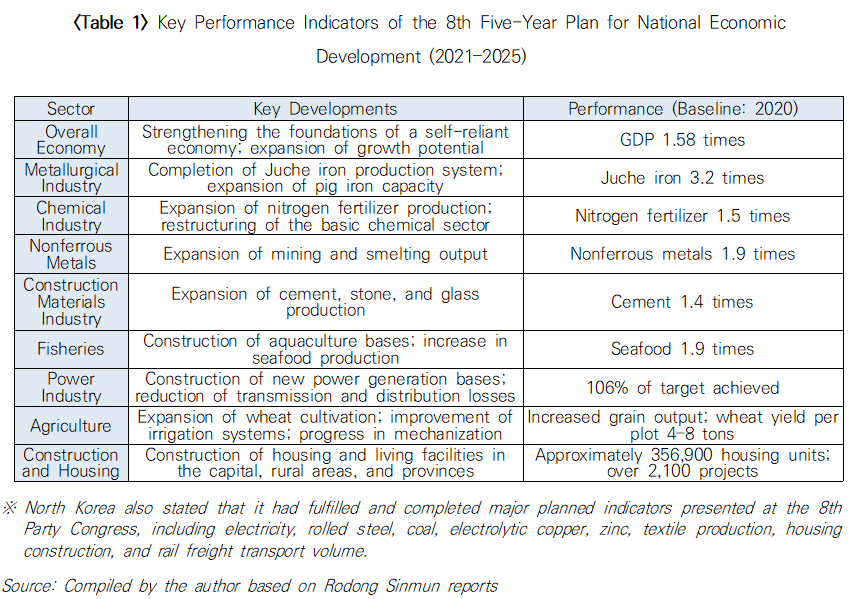
However, these achievements are better understood as establishing the foundations for sustained expansion of production rather than achieving full normalization of production. In particular, the growing demand for electricity and coal continues to outpace supply, remaining a key constraint on economic development. In addition, aging facilities and production processes, along with weaknesses in economic management and quality control systems, persist as structural challenges. This explains why the new Five-Year Plan for National Economic Development (2026–2030) again identifies technological upgrading of heavy industry and the resolution of imbalances in electricity and coal supply as core priorities. In other words, North Korea appears to assess its current economic conditions not as having reached a stable phase of normalized production, but as a stage requiring further consolidation of the foundations for subsequent development.
At the same time, the newly announced Five-Year Plan (2026–2030) defines its primary tasks along two dimensions: establishing a stable and sustainable foundation for economic development and achieving tangible improvements in people’s living standards. The overarching policy orientation emphasizes stabilization and gradual qualitative development rather than rapid growth. Priority sectors include heavy industry, particularly metallurgy, chemicals, electricity, coal, machinery, and rail transport. North Korea has presented quantified targets, including increasing steel production by 1.8 times, establishing local development foundations in 100 cities and counties over the next five years, and constructing 370,000 housing units nationwide. In addition, plans include the concentrated construction of 80,000 housing units in coal-mining regions over four years and, in the agricultural sector, achieving 100 percent mechanization of sowing and harvesting, along with greenhouse vegetable production targets of approximately 300 tons per jeongbo.
These targets are largely predicated on the normalization of existing facilities, the easing of constraints in electricity and raw material supply, technological upgrading, and the stabilization of operational systems. This indicates that the new Five-Year Plan focuses on reinforcing the foundations of a self-reliant economy and improving management efficiency to create conditions for sustainable development. In particular, the simultaneous emphasis on strengthening heavy industry and promoting local development suggests that economic performance is being evaluated not only through aggregate central indicators but also through practical outcomes such as the operational status of local factories, housing supply, hospital functionality, and the stability of food and consumer goods provision.
The extent to which these policy directions are reflected in actual resource allocation can be observed in the 2026 budget. A comparison of the major components of the 2025 and 2026 budgets is presented in <Table 2>.
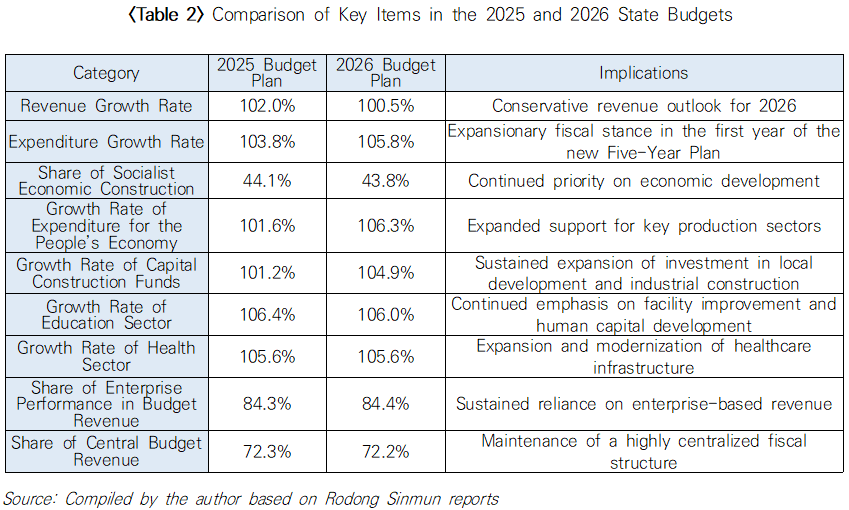
The most notable feature in <Table 2> is the widening gap between the revenue growth rate (0.5%) and the expenditure growth rate (5.8%). This unusually higher increase in expenditure relative to revenue cannot be explained solely by weakening fiscal conditions. In 2025, state budget revenue was executed at 105.1% of the plan, marking the highest execution rate since Kim Jong Un came to power. Moreover, at the time of the 2025 budget announcement, North Korea projected that transaction revenues and state enterprise profits would account for 84.3% of total budget revenue, indicating that fiscal income remains heavily dependent on the production and transaction performance of the state sector. Taken together, the over-fulfillment of 2025 budget revenue suggests that a degree of economic recovery, particularly in the state sector, translated into increased fiscal income.
However, the decision to set the 2026 revenue growth rate at a low 0.5% can be interpreted as reflecting both the exceptional overperformance in 2025 and a conservative adjustment based on the base effect of the previous year’s high performance. As a result, the 2026 budget reflects a cautious assessment of the sustainability of the recovery in state-sector production and fiscal revenue, while partially incorporating the exceptional revenue gains of the previous year.
Meanwhile, the structure of fiscal revenue and the share of central budget income indicate that North Korea’s fiscal system continues to exhibit a highly centralized character. In his policy speech, Kim Jong Un framed the expansion of fiscal revenue not merely as an issue of increasing income, but as a matter of strengthening state capacity, linked to the normalization of production, improved control over distribution, and more effective management of land and resources. In addition, Kim Kwang-nam, newly appointed Minister of Metallurgical Industry, referred during SPA discussions to the introduction and strengthening of new economic management methods, including the sectoral budget system. These developments suggest that, while maintaining a centrally concentrated fiscal structure, North Korea may seek to enhance sectoral accountability and local-level implementation capacity in order to sustain regional development policies and improve economic self-reliance.
With regard to external economic relations, the Cabinet work report delivered by the Premier stated that North Korea would “continue to vigorously advance the construction of tourist zones and the development of tourism resources while actively promoting external economic activities.” This reflects the regime’s continued emphasis on tourism as a key sector capable of generating foreign currency while supporting regional development. In fact, major tourism projects such as Samjiyon and the Wonsan-Kalma Coastal Tourist Zone have progressed during the 8th Party Congress period, indicating continuity in policy orientation. The recent resumption of passenger train and air services between North Korea and China further suggests efforts to revive cross-border exchanges and external economic activities. At present, while detailed plans remain unclear, the available information points to a limited expansion of external economic activity centered on tourism. The scale and pace of such expansion are likely to remain contingent on future diplomatic and security conditions. -
The First Session of the 15th Supreme People’s Assembly provides a relatively clear picture of how North Korea is concretizing its policy orientation for 2026 in terms of both state governance and economic policy. Politically, it clarified a direction toward further consolidating a Kim Jong Un–centered governing system and aligning the operational cycles of the party and the state, thereby integrating state management and policy implementation more closely. This reflects an intention to reorganize the overall structure of governance around the supreme leader while strengthening both control and accountability in policy execution over the next five years. This orientation is supported, to some extent, by the economic outcomes accumulated during the 8th Party Congress period and the notable improvement in budget revenue performance in 2025.
However, achieving the stated goal of “stabilization and gradual qualitative development” over the next five years will require more than strengthening domestic production capacity and improving state management capabilities. Securing a certain degree of external economic space will also be necessary. In this regard, the simultaneous emphasis on the construction of tourism zones, the development of tourism resources, and the activation of external economic activities indicates that North Korea recognizes the need for external economic engagement. At the same time, given Kim Jong Un’s emphasis on the “unpredictability” of the international environment and the prioritization of long-term strategic interests, North Korea appears to view external economic engagement not as a fixed precondition for policy implementation, but as a contingent opportunity to be managed under uncertain external conditions. In other words, while acknowledging the practical necessity of external economic engagement, the regime continues to place primary emphasis on strengthening domestic production capacity and reorganizing state management.
Taken together, these findings suggest that the South Korean government should design its North Korea policy by simultaneously considering the potential for sustained economic development in North Korea, its structural constraints, the practical need for external economic engagement, and the political and security limitations surrounding it.
First, the South Korean government needs to develop a more precise understanding of North Korea’s economic trends and outlook in order to calibrate expectations, modes of cooperation, and the pace and scale of engagement in line with reality. An overemphasis on economic achievements and opportunities risks underestimating implementation capacity and structural constraints, while excessive focus on limitations may obscure limited but meaningful opportunities for cooperation and policy change. A balanced assessment is therefore required, taking into account both indicators of economic recovery—such as improved fiscal conditions—and structural constraints, including energy supply imbalances, aging infrastructure, and the need for reform in economic management systems.
Second, the alignment of party and state operational cycles and the full-scale launch of the new Five-Year Plan indicate that North Korea is prioritizing the long-term foundations of development and regime sustainability rather than short-term gains. Accordingly, the South Korean government should move beyond a narrow focus on immediate contingencies and adopt a more medium-term perspective in refining the direction and priorities of its North Korea policy.
Third, North Korea’s renewed emphasis on economic development and improvements in people’s living standards, along with its commitment to expand these efforts over the next five years, suggests that sectors directly linked to livelihoods and regional development—such as agriculture, public health, local development, housing, and tourism—will remain sustained policy priorities. The South Korean government should therefore proactively examine and prepare for potential cooperation in these areas, in anticipation of conditions in which political and security environments become more conducive and a basis for engagement emerges. Given that the feasibility of such cooperation will be shaped not only by inter-Korean relations but also by sanctions and broader international dynamics, multiple pathways should be considered, including engagement through international organizations and third-party or multilateral frameworks.
Fourth, although North Korea recognizes the need for external economic engagement, its implementation will likely be highly sensitive to political and military conditions as well as changes in the international environment. The emphasis on tourism and external economic activities reflects an awareness of their importance in the development process. However, Kim Jong Un’s focus on unpredictability and long-term strategic interests suggests that the scale and pace of such engagement will be carefully calibrated in response to diplomatic and security conditions. Moreover, the 9th Party Congress explicitly reaffirmed that external economic activities would be conducted under the centralized guidance of the party leadership, implying that policy shifts may occur abruptly depending on decisions by the supreme leader. The South Korean government should therefore prepare for shifts in North Korea’s external economic strategy and align its approach with realistic prospects for cooperation.
Finally, the South Korean government should prepare for both scenarios in which North Korea’s need for external economic engagement leads to an expansion of cooperation space and in which heightened security tensions result in its contraction. In the former case, it will be necessary to pre-identify and prepare cooperation agendas—particularly in livelihood-related sectors such as agriculture, health, tourism, and regional development—that may be eligible for sanctions exemptions. In the latter case, preparations should account for the possibility that strengthened military and diplomatic priorities will constrain economic cooperation. Accordingly, it will be important to develop phased and actionable pathways for engagement, focusing on channels that do not directly conflict with political and military issues, including livelihood-oriented cooperation and partnerships through international organizations.
| Major Agenda and Changes in Regime Operation
| North Korea’s Perception of Reality and the Reorganization of State Governancev
| Assessment of Economic Policy and Prospects
| Assessment and Policy Implications
※ The contents published on 'Sejong Focus' are personal opinions of the author and do not represent the official views of Sejong Institue