File
File

|
The Necessity and Strategic Implications of South Korea’s Nuclear-Powered Submarine Program: Undersea Kill Chain, Northeast Asia’s Undersea Arms Competition, and K-Defense |
| December 4, 2025 |
-
Seong-Chang CheongVice President, Sejong Institute | softpower@sejong.org
-
The formal agreement between President Lee Jae-myung and President Donald Trump at the Gyeongju summit on October 29, 2025 on the construction of nuclear-powered submarines marked a historic turning point for a program the ROK Navy has pursued for three decades. The program traces its origins to 1994, when the Ministry of National Defense allocated 48 billion won in classified funding for initial development,1)
and has since absorbed hundreds of billions of won in research and development expenditure. With formal U.S. approval now secured, South Korea has become the third non-nuclear-weapon state, after Brazil and Australia, to officially pursue nuclear-powered submarine acquisition. The agreement covers nuclear-powered attack submarines (SSNs) and is distinct from ballistic missile submarines (SSBNs).
Some voices within South Korea have questioned the program on grounds of cost-effectiveness, arguing that the astronomical expense involved is disproportionate to the limited objective of defending the Korean Peninsula.2) Others have pointed to the shallow waters and complex seabed topography surrounding the Peninsula as factors that would limit the operational utility of nuclear-powered submarines, whose principal advantages lie in deep-water speed and endurance.
These criticisms share a common limitation: they view South Korea's SSN program through the narrow lens of countering North Korea's diesel submarine threat, while ignoring the fact that North Korea is actively developing ballistic missile submarines capable of carrying nuclear warheads and doing so at a considerable pace. They fail to reckon with the reality that South Korea's existing diesel-electric submarine force would be unable to respond effectively once North Korea completes a nuclear-armed SSBN. They also overlook the broader submarine arms competition underway in Northeast Asia, the synergies that SSN development would generate for South Korea's defense industry, shipbuilding sector, and civilian nuclear energy program, and the transformation in the ROK Navy's regional standing that SSN acquisition would bring about.
This paper moves beyond a Peninsula-centric view of nuclear-powered submarines and argues that acquiring SSNs would enable South Korea to respond to Northeast Asia’s undersea arms competition while helping the K-defense industry lead a new technological paradigm on the global stage.3) The legal and institutional challenges involved in the acquisition process have been addressed in a previous paper4) by the author and are not revisited here. -
Understanding why nuclear-powered submarines are indispensable requires grasping the fundamental difference between SSNs and diesel-electric submarines. This is not simply a matter of propulsion type. It represents a qualitative shift in the operational paradigm.
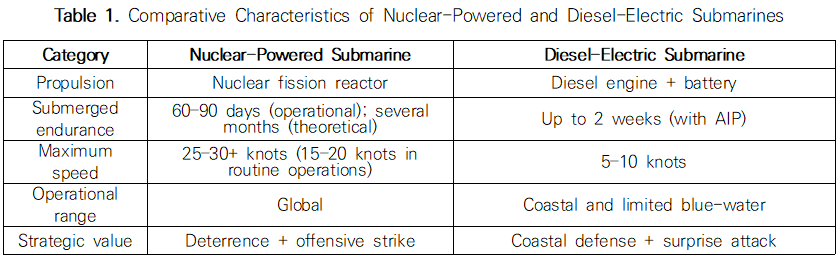
The most decisive difference is submerged endurance. Diesel-electric submarines can remain submerged for a maximum of three to four days, whereas nuclear-powered submarines can operate underwater for a minimum of three to six months. Diesel-electric submarines must surface to snorkel depth two or three times daily to recharge their batteries, while nuclear-powered submarines require no air supply, as their reactors generate propulsive power through nuclear fission. In practice, operational deployments typically run sixty to ninety days, given the physical and psychological limits of the crew and constraints on provisions and supplies. Even so, this represents a level of sustained submerged endurance that is simply beyond comparison with diesel-electric submarines.
The ROK Navy's most advanced submarine, ROKS Jang Yeong-sil of the Jangbogo-III class, combines diesel engines, lithium-ion batteries, and an air-independent propulsion (AIP) system to achieve submerged endurance of over four weeks, placing it among the most capable conventional submarines currently in service. It nonetheless remains in an entirely different category from the sustained endurance that nuclear propulsion makes possible.
The gap in speed and survivability is equally significant. Diesel-electric submarines achieve submerged speeds of five to ten knots, while nuclear-powered submarines can reach speeds in excess of twenty-five to thirty knots. In routine operations, SSNs typically cruise at fifteen to twenty knots to minimize noise from reactor coolant pumps and other sources. High-speed runs above twenty-five knots are reserved for crisis situations or contingencies requiring rapid maneuvering. This speed differential has direct implications not merely for mobility but for survivability. An SSN that is detected can disengage at high speed, whereas a diesel-electric submarine running at maximum submerged speed will rapidly exhaust its batteries and be rendered ineffective. -
-
North Korea's development of submarine-launched ballistic missiles (SLBMs) has introduced a new dimension of threat to South Korean security. In September 2023, North Korea unveiled the 3,000-ton Kim Kun Ok, and in March 2025 it disclosed the construction site of a nuclear-powered strategic missile submarine (SSBN) estimated at 5,000 to 6,000 tons, announcing plans to build two destroyers of 5,000 tons or above annually.
The fact that North Korea has reached the stage of miniaturizing nuclear warheads for SLBM delivery constitutes a serious threat. Unlike land-based missiles, SLBMs are extremely difficult to detect before launch, and once a submarine submerges, tracking becomes highly challenging. North Korea has diversified its launch platforms across road-mobile, rail-based, and submarine-based delivery systems, a strategy designed to disperse the targeting burden on ROK-U.S. preemptive strike capabilities.
Countering North Korea's SLBM threat requires the construction of an undersea and surface kill chain, and the nuclear-powered attack submarine is its central element.5) The relationship between the SSN agreed upon by the two governments and the undersea kill chain warrants clarification. What the ROK and the United States agreed to is a nuclear-powered attack submarine (SSN), which is distinct from the ballistic missile submarine (SSBN) that operates nuclear-armed SLBMs. The SSN South Korea intends to develop will be armed with conventional cruise missiles and torpedoes for multi-role offensive missions including enemy submarine tracking and attack, anti-surface warfare, and land-attack strike. The possibility discussed in some quarters of equipping the SSN with conventional SLBMs refers to fitting the vessel with a vertical launch system (VLS), a firepower enhancement measure within the SSN category rather than a conversion to SSBN status.
The kill chain concept refers to the rapid sequential execution of detect, identify, decide, and strike operations against indicators of enemy use of nuclear weapons, missiles, and other strategic weapons, with the objective of eliminating the threat at its source, before launch.
First, sustained tracking capability. Tracking North Korean submarines requires the ability to maintain pursuit over extended periods at speeds exceeding those of the target. Diesel-electric submarines face structural constraints in sustaining long-duration tracking of North Korean or Chinese submarines due to their limited submerged endurance.6)
Second, continuous high-speed response. Once an SLBM-equipped submarine departs a North Korean port, it must be tracked and monitored from the moment it submerges. This demands a nuclear-powered submarine capable of sustained high-speed maneuvering around the clock.
Third, multi-platform coordinated operations. Effective anti-submarine warfare requires SSNs to operate not in isolation but in coordination with maritime patrol aircraft such as the P-8, surface combatants, and underwater acoustic surveillance systems. In the U.S. Navy, SSNs typically conduct coordinated operations with reconnaissance and other anti-submarine warfare assets, unlike Ohio-class SSBNs, which generally operate independently.7) South Korea must develop an integrated anti-submarine warfare architecture in parallel with SSN acquisition.
Fourth, preemptive blockade and interdiction capability. Should North Korea succeed in developing a nuclear-armed SSBN, effectively blockading such vessels from their home ports and, where necessary, covertly tracking and sinking them will require a submarine capable of extended clandestine operations. North Korea's SLBM threat cannot be fully addressed by missile defense systems alone. Ground-based radars and interceptor missiles are oriented toward post-launch response, whereas the only instrument capable of eliminating the threat at its source, before launch -
Northeast Asian waters are becoming the most intensely contested arena for submarine competition in the world.
China, with a fleet of approximately 80 submarines, is fielding successive generations of new submarines with substantially improved quieting and strike capabilities. The new Type 095 SSN under development is expected to incorporate VLS tubes for cruise missiles and achieve extremely low acoustic signatures. China plans to add six SSNs and four SSBNs to its fleet by 2030 and is also developing the next-generation Type 096.
Brent Sadler, a senior fellow at the Heritage Foundation, has assessed that China "may be at the cusp of a technological leap that greatly improves the quieting of its submarines, making them much harder to track." China's military operational reach now extends well beyond the South China Sea into the deeper Pacific, and it has repeatedly conducted blockade and invasion exercises around Taiwan. South Korea faces potential friction with China over military structures Beijing is installing in the Yellow Sea and the question of jurisdiction over Ieodo. 8)
Even before the ROK-U.S. summit agreement on South Korea's nuclear-powered submarine program, Japan had begun to openly debate SSN acquisition. The twelve-point coalition agreement concluded on October 20 between the ruling Liberal Democratic Party and the Nippon Ishin no Kai specified a policy of pursuing submarines powered by "next-generation propulsion" capable of carrying long-range missiles and conducting extended long-distance operations, a formulation that indirectly refers to nuclear propulsion. On October 22, newly appointed Defense Minister Koizumi Shinjiro signaled openness to the idea at his inaugural press conference, stating that he would "not exclude any option" regarding the possible use of nuclear power for submarine propulsion.9)
Following the announcement of U.S. approval for South Korea's SSN program, Professor Ito Toshiyuki of Kanazawa Institute of Technology's Toranomon Graduate School, a former Japan Maritime Self-Defense Force submarine commander, told the Asahi Shimbun that "voices calling for the introduction of nuclear-powered submarines will grow louder within Japan as well." His reasoning was that once South Korea operates nuclear-powered submarines, the United States is likely to shift part of the burden of Pacific defense onto South Korea, increasing the pressure on Japan to strengthen its own defense capabilities accordingly.10) For this reason, Prime Minister Takaichi Sanae is therefore likely to move proactively toward SSN acquisition once South Korea's program gains full momentum.
South Korea currently faces potential territorial disputes with Japan over Dokdo and with China over jurisdiction of Ieodo. Matching Japan and China ship-for-ship in naval power to prepare for military contingencies arising from these disputes is not a realistic option given available defense resources. The nuclear-powered submarine must therefore be leveraged as an asymmetric strategic instrument.
For a trade-dependent economy, sea lines of communication (SLOCs) are a lifeline, sustaining the national economy through the transport of exports, imports, crude oil, and LNG in peacetime, and maintaining warfighting sustainability in the event of conflict. The long-range operational endurance of nuclear-powered submarines will play a decisive role in protecting the principal SLOCs within South Korea's geostrategic maritime domain.
Nuclear-powered submarines represent far more than a straightforward enhancement of military capability. They constitute a significant turning point in reshaping the strategic landscape of the ROK-U.S. alliance. The United States is pursuing a strategy of effectively checking its competitors while minimizing its own burden, and the nuclear-powered submarine is the optimal weapons system for executing that strategy. South Korea would thereby acquire the foundation to play a more active role alongside the United States across the Indo-Pacific.
In this regard, U.S. Chief of Naval Operations Admiral Daryl Caudle has stated that "the strategic value of having this capability is that you would have a submarine that you could actually deploy anywhere in the world," adding that "South Korea would be transitioning from not just a regionally focused navy, but a global navy."11) -
South Korea's nuclear-powered submarine program is expected to enter the construction phase as early as toward the end of the Lee Jae-myung administration, contingent on securing nuclear fuel. At a cabinet meeting chaired by President Lee on November 4, Deputy Minister for Resource Management Won Jong-dae of the Ministry of National Defense reported that "we are currently securing the core technologies required for SSN construction, including the reactor and weapons systems to be installed, and are conducting safety verification," adding that "we already possess world-class design and construction capabilities in the area of conventional submarines." He further projected that "if fuel for the SSN is secured through consultations with the United States and the program enters the construction phase in the late 2020s, it is assessed that the lead vessel could be launched in the mid-to-late 2030s."12)
Plans to establish a whole-of-government task force for SSN construction were also reported to the President at the same meeting. The SSN program, long pursued as a classified project, is now expected to be designated a national program at the whole-of-government level and to accelerate accordingly.
Minister of National Defense Ahn Gyu-baek has stated that "the conditions for building nuclear-powered submarines were already in place; what was needed at the end was the fuel." This foundation did not take shape overnight. It is the product of research and technological capability accumulated over many years. The preliminary research of the Agency for Defense Development (ADD), the design technology built up through Hanwha Ocean's Boiler Project, and South Korea's small modular reactor (SMR) capabilities constitute the decisive foundation and strategic assets on which the success of the SSN program will rest.13)
The Ministry of National Defense has indicated that a minimum of four SSNs displacing 5,000 tons or more will be required. Cost estimates vary across institutions and analysts, but the construction cost per vessel is estimated at approximately 2 to 3 trillion won, placing the construction cost for four vessels at roughly 8 to 12 trillion won. When design and development costs, small reactor development and safety certification, and the expansion of base, maintenance, and training infrastructure are included, total program costs are estimated to fall in the range of 18 to 25 trillion won.14) These figures are subject to variation depending on exchange rate movements, the difficulty of technology development, and the outcome of negotiations with the United States. The program will surpass in scale even the KF-21 Korean Fighter program, which carries a total program cost of 16.5 trillion won.
Should South Korea succeed in building nuclear-powered submarines, it would join a very small group of countries possessing an integrated suite of SMR, naval reactor, and ocean-going submarine technologies, opening new markets in defense, shipbuilding, and nuclear energy exports, including SSN cooperation arrangements, SMR-powered vessels, and overseas maintenance hubs. The costs, though substantial, are fully justifiable from a long-term cost-benefit perspective. -
Nuclear-powered submarine construction will open a new paradigm for the K-defense and K-shipbuilding industries. This is a strategic investment that goes well beyond military capability enhancement to fundamentally strengthen the competitiveness of South Korea's core industrial sectors. Military reactors demand high levels of continuous operability, shock resistance, and miniaturization, all of which are equally central to civilian SMR technology. The result is a long-term virtuous cycle: SSN development leads to SMR advancement, which enables nuclear energy exports and fuel cycle self-sufficiency, which in turn promotes the indigenization of strategic technologies. By applying South Korean SMR technology to submarine reactors and demonstrating their reliability and stability in that demanding environment, South Korea's shipbuilding industry could establish a dominant position in the emerging market for SMR-powered vessels.15)
As the Australian government pursues a $25 billion investment plan to develop the Henderson Maritime Precinct in Western Australia as a maintenance and basing hub for nuclear-powered submarines, Hanwha Ocean and HD Hyundai have emerged as leading candidate partners. Australia's defense and shipbuilding sectors have identified South Korea's major shipbuilding conglomerates, with their proven technical capabilities and large-scale investment capacity, as the most viable partners for the project.
Should South Korea enter the ranks of U.S. technology-based SSN development nations, the role of South Korean firms in the AUKUS supply chain and technology ecosystem is expected to expand significantly. The benefits would extend well beyond submarine construction itself, strengthening the position of South Korean companies across the broader defense industrial ecosystem in component, material, and equipment supply, maintenance, and technical services.16)
Nuclear-powered submarine construction requires a large-scale, highly skilled workforce across the full spectrum of design, construction, operation, and maintenance. This will generate high-quality employment in advanced technical fields including nuclear engineering, naval architecture, materials engineering, and electronics, while building the national pool of core technical talent over the long term. -
A nuclear-powered submarine is not simply a vessel concealed beneath the sea. It is a "mobile national strategic asset" at the intersection of South Korea's future industrial and security imperatives. South Korea’s acquisition of nuclear-powered submarines carries the following multifaceted significance.
First, it is the most effective instrument for countering North Korea's SLBM threat. As the centerpiece of the undersea kill chain, it provides the capability to track and monitor North Korean submarines over extended periods and, where necessary, to conduct preemptive strikes.
Second, it is an asymmetric strategic asset for maintaining the maritime balance of power with neighboring states. It enables South Korea to overcome the constraints of finite defense resources and secure strategic equilibrium in potential contingencies involving China, Japan, and Russia.
Third, it provides the means to protect sea lines of communication and marks the transition to a global navy. By opening the possibility of operations across the Indo-Pacific, it creates the conditions for South Korea to move from a regionally focused navy to a genuinely global one.
Fourth, it deepens the ROK-U.S. alliance strategically while strengthening self-reliant defense capabilities. It strikes a balance between contributing to the U.S. Indo-Pacific strategy and expanding South Korea's own strategic autonomy.
Fifth, it generates synergies across the defense industry, shipbuilding sector, and nuclear energy industry. SSN development will mark a significant advance in self-reliance in military nuclear technology and a major turning point in the history of South Korean security.
Achieving these objectives, however, requires overcoming substantial legal and institutional barriers on the U.S. side. As the AUKUS experience demonstrates, this process demands years of intensive diplomatic engagement and congressional cooperation.17) A whole-of-government effort and large-scale investment in U.S. shipbuilding modernization will be required. In a rapidly shifting security environment defined by North Korea's expanding submarine-based nuclear force, China's growing maritime assertiveness, and Japan's opening of a domestic debate on SSN acquisition, nuclear-powered submarine acquisition has ceased to be a matter of choice for South Korea. It has become a necessity for national survival.
| Five Key Features of the 'Kim Jong-un 2.0 Era' and Power Elite Reshuffling
| Operational Superiority of Nuclear-Powered Submarines: Conditions for a Game Changer
| North Korea's SLBM Threat and Strategic Imperative of Undersea Kill Chain
| Northeast Asian Submarine Competition: Reshaping the Strategic Balance
| South Korea's SSN Construction Capability and Cost Estimates
| Economic and Industrial Spillover Effects: Synergies Across the K-Defense, Shipbuilding, and Nuclear Energy Sectors
| Conclusion: A Strategic Choice for National Survival and Prosperity
1) O Dong-ryong, "President Kim Young-sam Ordered the Construction of a Korean-Style Nuclear-Powered Submarine in 1994," Wolgan Chosun, July 2009, https://monthly.chosun.com/client/news/viw.asp?nNewsNumb=200907100015.
2) Some experts argue that operating five or more diesel submarines in place of a single nuclear-powered submarine would suffice. Given that a domestically produced 3,000-ton-class diesel submarine costs approximately 1 trillion won per vessel, however, dismissing nuclear-powered submarines as "inefficient" on the basis of a simple numerical comparison is not appropriate.
3) Kim Hong-yu, "Invisible Deterrence: The Strategic Significance of a Korean-Style Nuclear-Powered Submarine," Hankyung BUSINESS, November 15, 2025.
4) Cheong Seong-Chang, "The ROK-U.S. Agreement on Nuclear-Powered Submarine Construction: Key Issues and Challenges — Construction Location and the Question of Uranium Enrichment and Reprocessing," Sejong Focus, November 28, 2025, p. 5.
5) Moon Geun-sik, "The Urgent Need to Establish an Undersea/Surface Kill Chain Against North Korea's SLBM Threat," KIMS Periscope, No. 55, September 11, 2016.
6) Jeong Du-san, "The Case for South Korea's Nuclear-Powered Submarine Acquisition and the Challenges to Be Resolved," KIMS Periscope, No. 275, May 11, 2022.
7) In the U.S. Navy, SSNs conduct anti-submarine warfare in coordination with maritime patrol aircraft such as the P-8, surface vessel sonars, and underwater acoustic surveillance systems such as SOSUS. Independent covert tracking is limited to special circumstances; multi-platform coordinated operations are essential for effective anti-submarine warfare.
8) Park Jeong-han, "China Advances Submarine Technology at a Rapid Pace, Fracturing Pacific Undersea Dominance," Global Economic, September 10, 2025.
9) Yun Da-jeong, "Japan Taken Aback by South Korea's Nuclear-Powered Submarine Plans; Calls for Domestic Acquisition Expected to Grow," News1, October 31, 2025.
10) Choe Yeong-jae, "South Korea's Nuclear-Powered Submarine Construction Draws Immediate Response from Japan," Asia Today, October 31, 2025.
11) Kwon Hyeok-cheol, "U.S. Chief of Naval Operations: 'Using South Korea's Nuclear Submarine to Deter China Is a Natural Expectation,'" Hankyoreh, November 16, 2025.
12) Kim Gyeong-su and Lee Jong-yun, "'Construction of Korean-Style Nuclear-Powered Submarine to Begin Within the Lee Administration's Term' — Securing Nuclear Fuel Is the Key," Financial News, November 4, 2025.
13) Jeong Jae-ho, "The New Paradigm for the Defense and Shipbuilding Industries Opened by the K-Nuclear-Powered Submarine," POSCO Group Newsroom, November 25, 2025.
14) Those who oppose nuclear-powered submarine acquisition often cite the astronomical costs involved, but according to Professor Moon Geun-sik, South Korea's foremost expert in this field, the construction cost per vessel for a Korean-style nuclear-powered submarine is estimated at approximately 2.5 trillion won, a figure that falls between the cost of the British Astute class and the U.S. Virginia class. Given that South Korea has lower labor costs than the United States and the infrastructure to build submarines in a shorter timeframe, it is estimated that constructing a nuclear-powered attack submarine in South Korea would cost considerably less than in the United States. See Cheong Seong-Chang and Peter Ward, "Directions for International Cooperation on South Korea's Nuclear-Powered Submarine Acquisition in the Trump 2.0 Era," Sejong Policy Brief, No. 2025-12, June 17, 2025, p. 14; Jeong Jae-heung, "The 'Nuclear Submarine,' the Largest Weapons Program in Korean History — A Whole-of-Government Program Office Likely to Be Established with a Budget of 20 Trillion Won," JoongAng Ilbo, October 31, 2025.
15) Jeong Jae-ho, "The New Paradigm for the Defense and Shipbuilding Industries Opened by the K-Nuclear-Powered Submarine," POSCO Group Newsroom, November 25, 2025.
16) Shipbuilding Industry Team, "Australia to Build 25-Billion-Dollar Nuclear Submarine Hub — Prospects for Cooperation with South Korea's Top Two Shipbuilders Rise Sharply," Haesa Sinmun, November 14, 2025.
17) Section 123 of the U.S. Atomic Energy Act sets strict requirements governing the overseas transfer of nuclear materials and related technology. The transfer of highly enriched uranium (HEU) is prohibited in principle, and the transfer of low-enriched uranium (LEU) requires congressional approval. In the case of AUKUS, the legal barrier was circumvented by invoking the Section 91 exemption of the Atomic Energy Act and incorporating the arrangement into the National Defense Authorization Act (NDAA), a process that required approximately three years of congressional diplomacy. Henry Sokolski, "Why an Exception for AUKUS Nuclear Submarines May Haunt Us," Nonproliferation Policy Education Center, 2023.
※ The contents published on 'Sejong Focus' are personal opinions of the author and do not represent the official views of Sejong Institue