File
File

|
The Prospects and Strategic Implications of Cross-Border Tourism among North Korea, China, and Russia: Focusing on the Restructuring of Border Transportation and Exchange |
| May 7, 2026 |
-
Eunju CHOIResearch Fellow, Sejong Institute | ej0717@sejong.org
-
North Korea's external exchange, which has been gradually restored since COVID-19 with a focus on freight transportation, is now expanding into the domains of passenger movement and people-to-people exchange. The resumption of passenger rail services on the Beijing-Pyongyang and Dandong-Pyongyang routes in March, along with the restoration of a Chinese airline's direct Beijing-Pyongyang air route, demonstrates that the existing freight-centered restoration of transportation is expanding into a preparatory stage for the resumption of people-to-people movement. In particular, the simultaneous resumption of both rail and air routes departing from Beijing carries the significance that the basic channels for diplomatic, economic, and tourism exchange linking the Chinese capital with Pyongyang have begun to function again, going beyond cross-border area transit.
At the same time, overland transportation corridors with Russia across the Tumen River are also being expanded. North Korea and Russia have been constructing a new road-only bridge connecting Khasan and Rason since 2025, with completion reportedly planned for June 2026. According to announcements from the Russian side, the bridge is designed to accommodate 300 vehicles and more than 2,000 persons per day. This represents the addition of a road transportation corridor to the existing DPRK-Russia connectivity centered on the Tumen River railway bridge, and is expected to be utilized as infrastructure for the expansion of tourism, trade, logistics, and people-to-people movement.
These changes are significant in that they are emerging at a juncture where the deepening of DPRK-Russia strategic cooperation, the resumption of DPRK-China people-to-people exchange, and North Korea's limited experience in receiving tourism are all converging. In particular, with Russia having emerged as the leading partner in the resumption of North Korean tourism and rail and air connectivity with China now also restored, North Korea's external people-to-people movement shows signs of expanding from a Russia-centered limited pilot program to broader exchange. The current changes may be understood as a process through which North Korea is selectively restoring people-to-people movement and tourism, centered on politically trusted counterparts and manageable routes. What is therefore needed at this juncture is to identify the countries and movement routes North Korea is prioritizing for opening, and to analyze the significance of those choices for DPRK-China-Russia border cooperation and the order surrounding the Korean Peninsula.
This paper views these trends of 2026 as an early phase of restructuring in the DPRK-China-Russia border transportation and exchange architecture, and examines the prospects for development toward cross-border tourism. In particular, focusing on the Tumen River triangle as the border region shared by the three countries of North Korea, China, and Russia, this paper examines the reactivation of North Korea's external economy, the prospects for tourism and economic cooperation at the border dimension, and the conditions under which South Korea may utilize multilateral and border cooperation going forward. It should be noted, however, that this pertains less to a fully realized tourism cooperation framework simultaneously connecting all three countries in the immediate term, and more closely approximates a medium to long-term possibility that may take shape as bilateral tourism resumption between North Korea and China and between North Korea and Russia accumulates over time. -
1. The Meaning and Conditions for the Establishment of Cross-Border Tourism
Cross-border tourism refers to a form of tourism in which border regions spanning two or more countries are planned and operated as a single tourism zone. It is distinguished from general international travel, which denotes a one-directional movement toward a specific destination country. Cross-border tourism is characterized by the fact that it utilizes the border space itself, where adjacent countries meet, as the core resource for tourism. This is an approach that converts the experience of boundary spaces where differing systems, cultures, living spheres, and transportation networks converge into tourism content. Accordingly, cross-border tourism can be realized not so much through tourist volume as when movement routes, customs procedures, border infrastructure, and cooperative structures among local governments all function in concert.
Cross-border tourism becomes possible when three elements are combined. The first is geographic scarcity. Border spaces where two or more countries meet constitute tourism content in and of themselves. The second is transportation corridors. Tourism routes are formed when rail, road, aviation, and maritime networks connect border countries into a single movement pathway. The third is institutional cooperation. In order for cross-border tourism to be sustained, customs, visa, safety management, payment, insurance, and cooperation among local governments must be institutionalized to a certain level or above.
2. The Tumen River Development Initiative and the Legacy of Northeast Asian Border Cooperation
Cross-border tourism and border cooperation are not new concepts in Northeast Asia. The Tumen River Area Development Programme (TRADP), launched in 1991 under the leadership of the United Nations Development Programme, was a representative multilateral cooperation initiative that sought to promote cooperation in transportation, logistics, tourism, and investment centered on the Tumen River basin, and was subsequently transformed into the Greater Tumen Initiative (GTI) in 2005. The current GTI member states consist of China, Mongolia, South Korea, and Russia, and North Korea has not returned since its withdrawal in 2009.
An institutional framework therefore exists; however, in the current circumstances, tourism cooperation involving North Korea's direct participation is more likely to emerge first through DPRK-China and DPRK-Russia bilateral cooperation rather than through a multilateral approach. Nevertheless, the reason cross-border tourism warrants attention is that it provides an outline of the transportation and tourism order that would take shape in border regions should the resumption of tourism between North Korea and China and between North Korea and Russia be sustained. Should the DPRK-Russia group tourism program, the restoration of DPRK-China rail and air connectivity, the preparations for the opening of the Tumen River road bridge, and the border tourism resources of Hunchun, Rason, Khasan, and Vladivostok all combine, the accumulation of bilateral tourism cooperation could over the long term serve as the foundation for the formation of a tourism zone in the DPRK-China-Russia border region.
3. Three Types of DPRK-China-Russia Cross-Border Tourism
DPRK-China-Russia cross-border tourism may be categorized into three types according to planning approach and spatial structure. The first is the border area tourism type, which converts the geographic scarcity of border zones or the heterogeneity of differing systems and cultures into tourism resources. Examples include scenic tourism along the Yalu River in Dandong, China, viewing of the tripoint where North Korea, China, and Russia meet from Fangchuan, and border experience programs connecting Rason and the Primorsky Krai region from Hunchun. This type has a relatively higher prospect of realization in that China and Russia may plan and implement it from their respective sides even when visits to North Korean territory remain restricted.
The second is the corridor tourism type, which connects multiple countries along rail, road, and aviation infrastructure. Representative examples include the Beijing-Dandong-Pyongyang rail route and the Vladivostok-Khasan-Rason rail and road route. As of 2026, the currently operating DPRK-China passenger trains and the preparations for the completion and opening of the DPRK-Russia Tumen River road bridge are forming the infrastructure foundation for this type.
The third is the broad economic zone linkage type, which develops tourism alongside transportation, logistics, ecology, and cultural exchange within the framework of multilateral economic cooperation initiatives such as the GTI, Northeast Asian local cooperation mechanisms, and the Tumen River basin development program. While this type may require a considerable period of time to realize given that it necessitates an institutional foundation and multilateral consensus, it holds the greatest potential in terms of sustainability and scale.
Viewed through this typological framework, the recent changes may be understood as a trend in which the border tourism cooperation agenda that was raised in the earlier Tumen River development initiative is once again attracting attention in a transformed security environment, going beyond the mere restoration of transportation networks. -
1. Restoration of DPRK-China Rail and Air Routes
As noted above, in the context of DPRK-China relations, the resumption of passenger rail services and the restoration of a Chinese airline's Pyongyang route represent the core changes in the expansion of people-to-people exchange. While North Korea's Air Koryo had already resumed DPRK-China air operations from 2023, the year 2026 has seen a further broadening of the scope of DPRK-China people-to-people exchange with the restoration of Beijing-Pyongyang and Dandong-Pyongyang passenger train services and the reopening of Air China's direct Beijing-Pyongyang route. However, in the current early stage of resumption, boarding is reportedly limited primarily to holders of business visas and similar categories, and the number of passengers on the first Air China direct flight is also understood to have been modest. It is therefore difficult to conclude that the restoration of transportation routes is synonymous with the resumption of tourism; nonetheless, the fact that people-to-people movement has recommenced carries the significance that the preconditions for a future resumption of DPRK-China tourism are being established.
In this respect, whether DPRK-China tourism resumes is a key variable in gauging the trajectory of DPRK-China-Russia cross-border tourism. China represents the largest potential market for North Korean tourism, and border regions such as Dandong, Hunchun, and Yanbian possess geographic and economic incentives that could be combined with North Korean tourism. However, given that China must simultaneously weigh sanctions against North Korea, tensions on the Korean Peninsula, strategic calculations regarding the deepening of DPRK-Russia relations, and the safety of its own nationals, it faces greater difficulty than Russia in rapidly highlighting North Korean tourism as a political achievement. Accordingly, DPRK-China tourism is more likely to open in a limited and incremental manner rather than through an immediate large-scale resumption.
2. DPRK-Russia Overland Connectivity and the Expansion of Non-Military Cooperation
In the context of DPRK-Russia relations, a qualitative transformation in overland transportation corridors is anticipated. The Tumen River road bridge connecting Khasan in Russia's Primorsky Krai region and the Rason area of North Korea is infrastructure that supplements the existing rail-centered connectivity with road transportation. Upon completion of this bridge, the movement of people and goods by bus, passenger vehicle, and freight truck is expected to become considerably easier. Russia has also described the bridge as serving as a foundation for strengthening tourism, trade, and people-to-people movement.
DPRK-Russia tourism cooperation has already proceeded on a limited basis. The first foreign group tourism North Korea permitted following COVID-19 was visits by Russian tourists. According to reports citing statistics from the border services of Russia's Federal Security Service (FSB), the number of visits to North Korea by Russian nationals increased from 1,238 in 2023 to 6,469 in 2024 and 9,985 in 2025, of which 5,075 visits in 2025 were classified as tourism in purpose. The significant point is the fact that North Korea permitted limited Russian group tourism before permitting general tourism by Chinese nationals. This demonstrates that tourism is being utilized as a means of making visible the friendly relations between the two countries amid the deepening of DPRK-Russia strategic cooperation. In particular, North Korea appears to be moving in the direction of gradually expanding non-military economic cooperation encompassing tourism, transportation, and infrastructure on the basis of its preemptive strategic cooperation relationship with Russia. The prior resumption of Russian group tourism may accordingly be interpreted not merely as a response to tourism demand, but as an early instance of expanding DPRK-Russia strategic cooperation into economic and livelihood cooperation.
DPRK-Russia cooperation is also expanding beyond tourism and transportation infrastructure into the health and livelihood domains. In April 2026, North Korea reported that a groundbreaking ceremony was held for the construction of the DPRK-Russia Friendship Hospital (Choro Friendship Hospital) near the Wonsan-Kalma coastal tourist zone. The hospital was described as part of the implementation of agreements reached between the two countries' leaders, and North Korea is highlighting it as a project demonstrating the promotion of the welfare of the peoples of both countries and the development of their friendly cooperative relationship. While the DPRK-Russia Friendship Hospital is not a direct tourism facility, it has the potential to function as infrastructure supplementing the foreign visitor accommodation, emergency medical care, and health service foundation when combined with the Wonsan-Kalma coastal tourist zone. This case therefore demonstrates that DPRK-Russia cooperation is not confined to the military and strategic domains, but is broadening the external reach of non-military cooperation by combining with the living and health infrastructure surrounding the tourism zone. -
1. The Spatial Potential of the Tumen River Triangle
The most promising space for DPRK-China-Russia cross-border tourism is the Tumen River triangle. While border regions where China, Russia, and Mongolia meet also exist in Northeast Asia, the Tumen River triangle warrants particular attention as a DPRK-China-Russia border space in which North Korea's Rason, China's Hunchun and Fangchuan, and Russia's Khasan and Vladivostok are in close proximity, thereby connecting directly to the Korean Peninsula issue. In particular, this region is a space where North Korea's external economic hub, China's Northeast region's sea access aspirations and border tourism foundation, and Russia's Far East port and urban tourism resources can all converge. The Tumen River triangle therefore merits attention not merely for the geographic scarcity of a tripoint border, but as a strategic nexus where transportation, tourism, and economic cooperation linking the Korean Peninsula and Northeast Asia can connect.
Among the features of this area, North Korea's Rason Special Economic and Trade Zone has been developed as a hub for attracting foreign investment and border trade since the 1990s, and possesses the conditions to serve as an initial hub for cross-border tourism. From a tourism perspective, Rason is a region that can provide the scarcity value of a North Korea visit without venturing deep into the North Korean interior. From North Korea's perspective, it is well suited for use as a testing ground for initial tourism cooperation in that movement routes can be managed with relative ease and foreign visitors can be accommodated within a limited border space.
The locational advantages of Rason, when combined with surrounding tourism resources, form the conditions under which the Tumen River triangle can develop into a single border tourism zone. North Korea possesses geographic symbolism and landscape resources unique to the DPRK-China-Russia border region, including Rason and the Tumen River estuary. China's Northeast region possesses tourism demand and a foundation for border tourism centered on Yanbian Korean ethnic culture, Changbai Mountain tourism, and Hunchun. However, in circumstances where visits to North Korea remain restricted, Chinese side border tourism may function as a substitute for North Korean tourism; should DPRK-China tourism resume and border routes such as the Hunchun-Rason corridor open, Yanbian and Hunchun have the potential to function complementarily as the departure point, transit point, and consumption hub for North Korean tourism. Russia's Primorsky Krai possesses Vladivostok urban tourism and Far East natural ecology tourism resources, and its accommodation, transportation, and tourism service infrastructure is relatively stable compared to North Korean border areas. Ultimately, the tourism resources of the Tumen River triangle currently possess simultaneously the potential for both substitution and complementarity, and the nature of that relationship may shift depending on the degree of North Korea's future tourism opening and the modes of cross-border movement.
2. Potential Development Pathways and Prospects for Phased Expansion
Synthesizing the current infrastructure restoration trends and geographic conditions, the development prospects for DPRK-China-Russia cross-border tourism may be examined around three potential connectivity pathways.
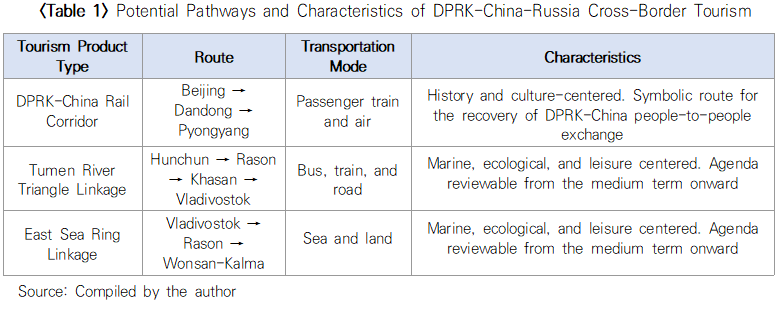
Among the three pathways, the one with the highest short-term feasibility is the Tumen River Triangle Linkage Type. While the Beijing-Dandong-Pyongyang route carries significant symbolic meaning as a representation of the recovery of DPRK-China people-to-people exchange, it is difficult to regard it as the core pathway for cross-border tourism directly connecting all three countries of North Korea, China, and Russia. By contrast, the Hunchun-Rason-Khasan-Vladivostok route has a structure that all three countries of China, North Korea, and Russia can access. In particular, should the Tumen River road bridge open, bus transportation from Russia's Primorsky Krai to North Korea's Rason would become possible, and the physical conditions for constructing a tripoint border tourism route linking China's Hunchun would also be strengthened.
The East Sea Ring Linkage Type may be viewed as an agenda item for the medium term and beyond. Marine and leisure tourism connecting Vladivostok, Rason, and Wonsan-Kalma possesses both symbolic significance and development potential; however, realizing this would require the concurrent establishment of maritime transportation, port infrastructure, insurance, payment, and safety management systems. Accordingly, a more realistic approach would be for pilot tourism cooperation projects centered on the Tumen River border tourism route to proceed first in the short term, with the combination of the Wonsan-Kalma and East Sea Ring tourism zone to follow over the medium to long term. -
1. Regime Security Concerns and the Dilemma of Managed Tourism
The first variable determining whether DPRK-China-Russia cross-border tourism can be realized is North Korea's concern for regime security. The influx of tourists entails the introduction of outside information, formal and informal contact with residents, and the burden of movement control. In order to minimize these risks, North Korea has preferred group tourism over independent travel, designated movement routes, managed consumption spaces, and accompanied local guide arrangements. Should tourism expand beyond a certain scale in the future, these management approaches may also come to be linked with digital management infrastructure combining identity verification, movement route management, and payment and settlement systems. Even if such approaches are partially employed, they are more likely to operate as restricted management infrastructure targeting designated zones and approved tourists rather than as an open tourism platform.
Nevertheless, given that the 9th Congress of the Korean Workers' Party held in February publicly disclosed a policy of designating tourism as an economic sector with revenue generation and foreign currency procurement functions and pursuing its "industrialization," international tourism may be viewed as an external economic domain that North Korea intends to resume and expand. However, the economic necessity of expanding international tourism does not automatically resolve the burden of external information introduction and tourist movement management. The instances in 2025 in which the resumption of foreign tourist accommodation in the Rason area and the Wonsan-Kalma coastal tourist zone was halted or temporarily suspended immediately after reopening also demonstrate that the process of resuming North Korean international tourism has yet to reach a stage of stable operation. North Korea's expansion of international tourism therefore remains a challenge that must be calibrated between the necessity of industrialization for foreign currency earnings and the management imperatives of regime security.
2. Asymmetric Tourism Structure and Infrastructure Constraints
DPRK-China-Russia cross-border tourism is expected to develop differently from bilateral tourism in the general sense. While conventional cross-border tourism presupposes the mutual movement of tourists across national borders, in the case of North Korea, the free visitation of China or Russia by North Korean residents as tourists is difficult in the short term. Accordingly, for the foreseeable future, the predominant form will be foreign tourists from China, Russia, and other countries visiting North Korean territory, or utilizing tourism routes linked to North Korea in Chinese and Russian border regions. In this process, North Korean residents are likely to participate as members of managed tourism spaces in roles such as guiding, service provision, performance, and commercial facility operation. In this respect, DPRK-China-Russia cross-border tourism takes on the character of a limited and asymmetric border tourism arrangement approved by North Korea rather than free people-to-people movement.
North Korea's tourism infrastructure and service capabilities also constitute an important constraining factor. While North Korea has concentrated tourism infrastructure development around key hubs such as Wonsan-Kalma, Samjiyon, and Rason, accommodation, sanitation, medical care, communications, payment, and emergency response systems remain inadequate. Cross-border tourism requires the concurrent availability of border crossing procedures, vehicle transportation, insurance, incident handling, and multilingual guidance systems, and therefore entails considerably greater institutional coordination and on-site management burdens than general group tourism. For DPRK-China-Russia tourism cooperation to possess industrial sustainability rather than remaining a one-time symbolic exchange, not only must border infrastructure be expanded, but the economic viability of actual tourism routes must also be verified.
3. The Sanctions Gray Zone and the Divergent Interests of the Three Countries
International sanctions against North Korea and financial and payment issues must also be addressed with care. While tourism itself does not constitute a direct violation of United Nations Security Council sanctions against North Korea, the burden associated with sanctions compliance can increase considerably when the attribution structure of tourism revenues, transactions with sanctioned entities, the provision of transportation, financial, and insurance services, and facility investment are combined. In particular, large-scale cash payments, opaque settlement structures, the operation of tourism facilities through North Korean state-owned institutions, and indirect transactions mediated by third-country travel agencies and transportation operators may escalate into sanctions evasion concerns.
However, China and Russia are likely to seek to interpret tourism and livelihood exchange as a domain separate from sanctions. For this reason, DPRK-China-Russia tourism cooperation will unfold in a limited manner within a gray zone where interpretations of sanctions compliance and the raising of political concerns intersect. As long as the United States maintains its ban on travel by its nationals to North Korea, demand from Western tourists will inevitably be constrained, and the sanctions environment targeting Russia may also dampen the participation of third-country tourists and international operators. Accordingly, DPRK-China-Russia cross-border tourism is expected in the near term to be pursued in the form of small-scale border tourism utilizing existing infrastructure, rather than large-scale investment-driven development or the broad expansion of international tourism.
All three countries of North Korea, China, and Russia have interests in tourism cooperation, but their motivations differ. China has incentives in the revitalization of the economies of the three northeastern provinces and the maintenance of political influence over North Korea, but must also consider the management of the security situation on the Korean Peninsula and the balance of its external relations. Russia, in the context of international isolation following the war in Ukraine, has a strong motivation to make visible its friendly relations with North Korea, and can utilize tourism as a relatively low-burden deliverable of DPRK-Russia cooperation. North Korea requires the deliverables of foreign currency earnings and local development, but prioritizes information control and regime security. This asymmetric motivational structure is a core variable determining the pace and form of cross-border tourism. Accordingly, DPRK-China-Russia tourism cooperation is likely to open and close in a manner limited to specific periods, specific counterparts, and specific regions, which is also consistent with North Korea's preferred mode of limited and management-centered border exchange. -
1. The Possibility of Preempting Border Exchange Operating Practices
The strategic significance of DPRK-China-Russia cross-border tourism lies not so much in the volume of tourists itself as in the fact that the operating modalities of border exchange may take shape first. Even if tourism resumes on a limited basis, practical standards governing border exchange operations may begin to accumulate, including movement routes, customs procedures, payment and settlement methods, safety management, and the division of roles between travel agencies and local governments. This is not confined to the tourism sector. The operating practices accumulated through border tourism can serve as a reference framework when subsequently extended to logistics, people-to-people movement, special economic zone development, and health and disaster safety cooperation.
In this respect, the Tumen River road bridge and the restoration of DPRK-China rail and air routes go beyond the mere resumption of transportation means. Should this infrastructure be combined with tourism, DPRK-China and DPRK-Russia bilateral cooperation will accumulate a degree of operational experience at the border region level. Even if DPRK-China-Russia trilateral cooperation is not formally institutionalized, the accumulation of such experience means that the pathways and operating modalities of border exchange may become established first on a China and Russia-centered basis. What therefore warrants attention at the current stage is not the immediate expansion of tourist numbers, but rather how the design of movement routes, the formation of payment, settlement, and safety management standards, and the positioning of operating entities are being configured.
2. The Sanctions Environment and Changes in the Border Economic Order
DPRK-China-Russia tourism cooperation may also have implications for the manner in which the sanctions environment against North Korea operates. The sanctions gray zone issue examined above does not merely signify a constraint on tourism cooperation. The tendency of China and Russia to seek to interpret tourism and livelihood exchange as a domain separate from sanctions may reinforce a structure in which formal international sanctions norms and economic cooperation at the field level coexist in the DPRK-China-Russia border region.
This trend also connects to changes in the operating modalities of border region economic cooperation. Should DPRK-China-Russia tourism cooperation proceed even on a limited basis, payment and settlement methods, the roles of transportation operators, and the modes of involvement of local governments and special economic zones may be established first at the field level. This suggests that beyond the question of the effectiveness of the sanctions framework, the manner in which actual economic cooperation takes place in border regions may undergo change.
3. The Possibility of South Korea's Strategic Marginalization
Should DPRK-China-Russia tourism cooperation expand while Mount Kumgang and Kaesong tourism remain suspended, North Korea's tourism infrastructure and border transportation and exchange architecture may come to be established first on a China and Russia-centered basis. This suggests that even if a phase of improvement in inter-Korean relations opens in the future, South Korea would find it difficult to respond to the transformed spatial structure of North Korean tourism cooperation solely through the resumption of the existing Mount Kumgang tourism model.
While South Korea is currently a GTI member state, it is in a situation where direct involvement in border tourism cooperation encompassing North Korea is difficult. Accordingly, South Korea must prepare not only for the restoration of existing inter-Korean tourism cooperation centered on Mount Kumgang and Kaesong, but also for approaches that can be linked to multilateral and border cooperation initiatives such as the Tumen River triangle and the East Sea Ring tourism zone. This carries the significance of laying the groundwork for broadening South Korea's room for cooperation in a future phase of inter-Korean relations improvement. -
DPRK-China-Russia cross-border tourism is not merely a tourism trend, but a development that demonstrates that the border transportation and exchange architecture is undergoing change. Ultimately, South Korea must continuously monitor the trajectory of DPRK-China-Russia border tourism while proactively preparing the policy space for multilateral and border cooperation that can be utilized in a future phase of inter-Korean relations improvement.
Three responses are needed from South Korea. First, relevant trends must be systematically monitored. It will be necessary to continuously examine the restoration of DPRK-China-Russia transportation networks, the launch of tourism programs, travel agency trends, the nationality and scale of tourists, the receiving regions within North Korea, and changes in payment methods. In particular, the resumption of DPRK-China tourism warrants separate attention as a key variable that may precede DPRK-China-Russia cross-border tourism. It will be necessary to monitor whether the traditional Dandong-Pyongyang-centered route is restored first or whether border tourism routes such as Hunchun-Rason open on a priority basis, as well as the combined patterns of group tourism, business visits, and cultural exchange-nominationed travel, and the structure of role division among the Chinese central government, local governments, and travel agencies. The operating modalities of DPRK-China tourism may serve as a preceding case from which to gauge the operating modalities and structure within which DPRK-China-Russia border tourism will take shape going forward.
Second, a medium to long-term multilayered tourism cooperation initiative must be formulated. The South Korean government, in its 2026 Ministry of Unification work report, presented the rapid normalization of the Kaesong Industrial Complex and Mount Kumgang tourism upon the resumption of U.S.-DPRK and inter-Korean dialogue, and the resumption of Mount Kumgang tourism linked to international Wonsan-Kalma peace tourism, as official agenda items. However, DPRK-China-Russia border tourism is likely to unfold in spaces and through modalities that differ from the existing inter-Korean cooperation framework centered on Mount Kumgang and Kaesong. A multilayered inter-Korean tourism cooperation vision encompassing Paektu Mountain, Wonsan, Rason, and the Tumen River must be established in advance, and the specific modalities through which South Korea can link to the border spaces being constructed first by North Korea, China, and Russia must be concretely designed. South Korea needs to prepare not only for the restoration of existing inter-Korean cooperation agenda items, but also for multilateral and border cooperation initiatives encompassing the Tumen River triangle and the East Sea Ring tourism zone.
Third, functional cooperation agenda items in areas such as ecology, health, disaster safety, and cultural heritage must be utilized to secure the possibility of linkage with Northeast Asian border cooperation. While examining the potential for utilizing existing multilateral cooperation frameworks including the GTI, it will also be necessary to establish a foundation through which South Korea can participate in discussions on Northeast Asian border tourism cooperation via ecotourism, border city cooperation, cultural exchange, overseas Korean diaspora visits, and academic cooperation. For instance, joint ecological surveys of the Tumen River basin, joint border region infectious disease response systems, disaster safety cooperation encompassing forest pests, flooding, and wildfires, migratory bird route and wetland conservation surveys, and joint surveys of border region cultural heritage are projects for which the likelihood of sanctions violation is relatively low and the justification for multilateral cooperation is relatively easy to secure. These agenda items are less direct measures for the immediate resumption of tourism cooperation than a starting point for accumulating the information and field-level cooperation foundation that can be expanded into future ROK-DPRK-China or ROK-DPRK-China-Russia border tourism cooperation. Rather than understanding DPRK-China-Russia border tourism solely as the limited tourism cooperation of neighboring countries, South Korea must perceive it as an early development demonstrating changes in the exchange structure of the Northeast Asian border region and the conditions for inter-Korean cooperation, and prepare a strategic response accordingly.
Ⅰ. Problem Statement: The Restoration of External Exchange and the Emergence of Tourism Prospects
Ⅱ. The Concept of Cross-Border Tourism: Treating Border Spaces as a Single Tourism Zone
Ⅲ. Recent Trends: Restoration of DPRK-China Connectivity and Expansion of DPRK-Russia Connectivity
Ⅳ. Key Spaces and Development Pathways for DPRK-China-Russia Cross-Border Tourism
Ⅴ. Prospects and Constraints: Conditions for the Realization of Managed Tourism
Ⅵ. Strategic Implications: Changes in the Border Exchange Structure and South Korea's Room for Response
Ⅶ. South Korea’s Strategic Preparedness
※ The contents published on 'Sejong Focus' are personal opinions of the author and do not represent the official views of Sejong Institue