File
File

|
Military Affairs at North Korea's 9th Party Congress: Assessment and Implications |
| February 27, 2026 |
-
Beomchul SHINPrincipal Research Fellow, Sejong Institute | bcshin@sejong.org
- North Korea's 9th Party Congress concluded on February 25. Defense policy pronouncements, absent from the earlier sessions of the congress, were released through state media immediately following its close.1) General Secretary Kim Jong Un's remarks were lengthy, yet substantively offered little that was new. They represented a continuation of policies North Korea has pursued in recent years, namely a hardline posture toward South Korea grounded in the parallel pursuit of nuclear and conventional military capabilities. Nevertheless, the address is significant insofar as it clearly articulates the priorities and trajectory of North Korea's military strategy, carrying important implications for South Korea's efforts to build a credible deterrence posture. This paper examines the military policy directions that emerged from the 9th Party Congress and draws out their key policy implications.
-
At the 9th Party Congress, General Secretary Kim Jong Un described an independent defense capability as the cornerstone of state survival and reaffirmed the commitment to sustained military buildup. Three defining themes emerge from his remarks: the evolution of North Korea's nuclear force development, a transformation toward a high-technology military, and the fortification of border areas coupled with strengthened deterrence against South Korea.
Evolution of North Korea's Nuclear Force Development
On nuclear matters, North Korea is pressing ahead with the quantitative expansion of its arsenal while placing growing emphasis on the systematization of command and control. Whereas prior statements stressed numerical growth and technological advancement, this congress centered on strengthening operational employment capabilities, a shift that reflects a meaningful evolution in nuclear doctrine.
On the quantitative side, Kim explicitly called for increasing the number of nuclear warheads, declaring it "the unwavering will of our Party to further expand and strengthen the state nuclear force, which constitutes the backbone of our war deterrence strategy and warfighting strategy, and to fully assert our standing as a nuclear-armed state." To that end, Pyongyang announced plans to establish annual production targets, increase warhead numbers, and diversify delivery means and operational platforms. Particular emphasis was placed on naval nuclear armament; the congress noted that "great significance has been attached to rapidly and continuously upgrading naval operational capabilities, centering on the nuclearization of surface and submarine naval forces."
North Korea also referenced expanding the operational domain of nuclear weapons, language that points to a broader infrastructure buildout accompanying the diversification of delivery systems. The pledge to "further strengthen security and guard systems for nuclear-related facilities" warrants attention. While no incidents within North Korea's nuclear infrastructure have been publicly confirmed, this language reflects heightened institutional attention to safety and security concerns as operational facilities are expanded.
On the qualitative side, the congress stressed not only numerical growth but also continuous performance upgrades to bolster the reliability of the nuclear deterrent, to be pursued through sustained testing and exercises. This signals that North Korea is likely to persist with strategic provocations, including ICBM launches, for the foreseeable future. Notably, the congress asserted that "continuously testing the reliability and effectiveness of the elements of the nuclear deterrent and demonstrating their destructive power is, in itself, a responsible exercise of war deterrence," a formulation that signals Pyongyang's intent to leverage strategic provocations as instruments of coercive signaling against the United States and South Korea when deemed necessary.
Considerable attention was also devoted to the systematization of nuclear command and control, underscoring the imperative of building systems capable of employing nuclear weapons in a timely and reliable manner. This reflects a focus on the operational dimension: ensuring that effective command authority can be transmitted at the moment of need. The emphasis on mastering "the activation and operational testing of the nuclear release authority, that is, the integrated nuclear crisis management system, as well as nuclear weapons handling protocols and operational procedures" speaks directly to this operational priority. The congress further signaled the adoption of conventional-nuclear integration (CNI) concepts, evident in the commitment to "upgrade supplementary strike means and operational support systems to enhance the military utility of various nuclear weapons tailored to targets and assigned missions." This reflects an intent to strengthen the operational employment of nuclear forces across contingency scenarios.
Transformation Toward a High-Technology Military
With respect to conventional military capabilities, North Korea has laid out a course of military innovation aimed at fielding advanced forces, with the congress emphasizing three priorities: the performance improvement and operational deployment of weapons systems, the revitalization of defense science and technology research, and the strengthening of education and training.
Kim Jong Un called for advancing North Korea's conventional weapons to world-class standards and directed the commissioning of "new secret weapons and special strategic assets" into the armed forces. The weapons systems specifically highlighted included "submarine-launched intercontinental ballistic missile systems, various artificial intelligence-enabled unmanned strike systems, special assets for attacking enemy satellites in contingency scenarios, highly capable electronic warfare systems for paralyzing enemy command centers, and more advanced reconnaissance satellites." It is reasonable to expect that North Korea will move to develop, test, and field these systems in the coming years.
The congress also placed considerable emphasis on the revitalization of defense science and technology research, calling for "boldly continuing the struggle to research, develop, and serially produce cutting-edge weapons and equipment commensurate with the goals of advancing and modernizing the military technology of the Republic's armed forces, in step with global trends in defense science." Developing the weapons systems described above demands proficiency across a broad range of advanced technologies, domains in which North Korea currently lags considerably. The emphasis on research revitalization appears intended to close that gap.
Education and training rounded out the conventional military agenda. The congress called for "further intensifying the two major frontlines of strong-army building, namely the revolution in military education and the revolution in training, in keeping with the rapid advancement of military science and technology and the demands of modern warfare, so as to achieve significant progress in enhancing the Korean People's Army's warfighting capabilities." This reflects a concerted effort to adapt to the evolving character of warfare, as illustrated by the conflict in Ukraine. Political and ideological education was also addressed; while publicly framed as building "a revolutionary strong army that prevails through the power of ideology," this is best understood as an effort to cultivate unconditional loyalty to Kim Jong Un within the ranks.
Border Fortification and Strengthened Deterrence Against South Korea
The most distinctive feature of the military agenda at the 9th Party Congress was the emphasis on border fortification and the forward deployment of military forces. Consistent with its characterization of South Korea as an adversary, North Korea has designated the Military Demarcation Line as the "southern border" and is pressing ahead with its fortification. The congress also called for reinforcing the guard and fire support systems along these installations, signaling that North Korea's activities along the Military Demarcation Line observed in recent years will only intensify.
North Korea further announced plans for the operational deployment of weapons systems specifically targeting South Korea. Over the next five years, Pyongyang declared its intent to "annually augment and deploy the 600mm multiple rocket launcher systems, new 240mm multiple rocket launcher systems, and operational-tactical missile complexes — the primary strike assets for deterring the Korean region — so as to significantly enhance the density and sustainability of massed strikes, thereby further strengthening the core element of war deterrence capability." This points to the forward deployment of artillery assets capable of striking the Seoul metropolitan area along and behind the Military Demarcation Line. Such moves appear designed to offset North Korea's conventional inferiority vis-à-vis South Korea. Pyongyang has declared its intention to build, within five years, a defense capability that South Korea will be unable to counter. While achieving that objective within such a compressed timeframe will prove difficult, the scope of military innovation announced warrants close attention and a calibrated response. -
The military agenda of the 9th Party Congress largely represents a continuation of that of the 8th, which similarly emphasized the strengthening of both nuclear and conventional forces.2) At the same time, a closer examination reveals several substantive differences, as summarized in the table below.
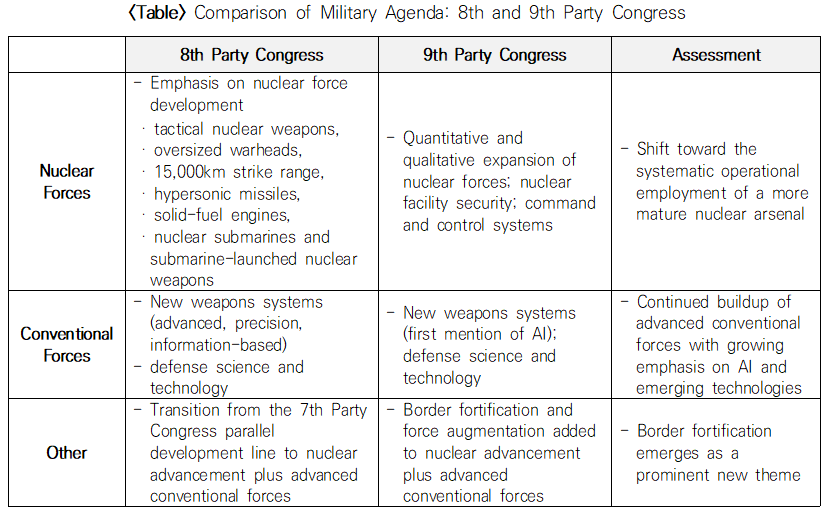
The defining feature of the 8th Party Congress on the nuclear side was the diversification and precision enhancement of nuclear forces. Under a five-year national defense development plan, North Korea set out to miniaturize nuclear weapons through tactical nuclear development, increase destructive yield through oversized warhead production, improve strike accuracy at ranges up to 15,000km to enable strikes across the continental United States, neutralize South Korea's missile defenses through the development of hypersonic glide vehicles (HGVs), shorten launch preparation times through the development of underwater and ground-based solid-fuel engines, and diversify strike options through the acquisition of nuclear submarines and submarine-launched nuclear strategic weapons. These efforts translated into a series of tests over the past five years, yielding meaningful advances by North Korea's own standards.
On advanced conventional forces, the 8th Party Congress placed emphasis on intelligence, surveillance, and reconnaissance capabilities to monitor the Korean Peninsula. Military reconnaissance satellites and unmanned aerial vehicles were cited as priorities, and over the subsequent five years North Korea conducted three reconnaissance satellite launches and developed multiple UAV variants. Defense science and technology also featured prominently, with a declared commitment to "irreversibly strengthen national defense capabilities through a defense industry revolution."
These priorities carried over into the 9th Party Congress, with nuclear forces, advanced conventional capabilities, and defense science and technology again featuring as central themes. On nuclear matters, whereas the 8th Party Congress stressed weapons development, the 9th Party Congress reflected a growing preoccupation with operational employment. This shift appears to build on the achievements of the intervening five years, including multiple ICBM and reconnaissance satellite launches, a broad range of missile tests, and submarine construction. As a result, the emphasis has moved away from the development of new nuclear weapons toward the command-and-control arrangements and storage infrastructure required to employ existing weapons under operational conditions.
On advanced conventional forces, the 9th Party Congress broadly continued the trajectory set at the 8th, though with greater depth. The linkage between defense science and technology development and the production of advanced weapons was again stressed, with artificial intelligence receiving notable emphasis for the first time. This signals that North Korea recognizes the centrality of AI in modern warfare and is actively working to develop and militarize relevant capabilities. Separately, border issues received sustained and substantive treatment distinct from force buildup considerations, reflecting the military expression of North Korea's evolved policy toward South Korea.
At the 8th Party Congress, North Korea declared the completion of the parallel development line of nuclear force and economic construction pursued under the 7th Party Congress and charted a new course centering on the parallel advancement of nuclear and conventional forces, marking a significant strategic shift. The 9th Party Congress, by contrast, appears focused on deepening and consolidating the existing lines of effort across each domain. This trajectory is best understood as an effort to reinvigorate conventional force development, which gained renewed impetus in the aftermath of the war in Ukraine, even as the nuclear program continues its advance toward greater sophistication. -
The shifts in North Korea's military policy evident at the 9th Party Congress portend an intensifying arms competition on the Korean Peninsula. Having long conceded conventional inferiority to South Korea, North Korea is now demonstrating a clear intent to close that gap, emboldened by lessons drawn from the war in Ukraine and the expansion of its defense industrial base that the conflict has catalyzed. Given South Korea's position of acute disadvantage vis-à-vis North Korea's nuclear arsenal, maintaining overwhelming superiority in conventional forces is not optional — it is a strategic imperative. This dynamic raises serious concerns about an escalating arms competition between the two Koreas.
North Korea's choices, however, are rooted in a distorted reading of its security environment. Pyongyang continues to pursue absolute security. As articulated in its own terms, North Korea holds that "even as the security situation and state of tension in the region continue to worsen, the fact that national security is being maintained at a higher level than in previous periods clearly demonstrates that war can be effectively deterred if there exists a sovereign force capable of controlling the objective situation, however grave it may be." This reflects a deeply entrenched deterrence-through-strength logic that shows no signs of receding.
That North Korea maintains this rigid threat perception even as neither the Trump administration nor the Lee Jae-myung government has adopted an overtly confrontational posture toward Pyongyang speaks to the internal imperatives of the Kim Jong Un regime. To be sure, U.S. military operations such as the precision strikes on Iranian nuclear facilities and the arrest of Venezuelan President Maduro have not gone unnoticed in Pyongyang. Yet President Trump has consistently expressed a desire for a summit with Chairman Kim, and the Lee government has signaled its interest in improving inter-Korean relations through a range of concrete measures. Against this backdrop, North Korea's continued cultivation of an external threat narrative — and its insistence that nuclear and overwhelming military power are essential to overcoming that threat — is best understood as an instrument of domestic political consolidation, binding the population to the Kim regime under the logic that loyalty is the price of survival. So long as this calculus remains unchanged, the substantive threats posed by North Korea's nuclear buildup, its forward military posture along the border, and the attendant military tensions are unlikely to diminish.
South Korea's response must nonetheless operate at a higher strategic register. A nuanced and expansive reading of the security environment is required, one that keeps open the possibility of meaningful change in North Korean behavior and preserves the flexibility to respond accordingly. Throughout this process, however, the deterrence posture essential to South Korea's security must be maintained without gaps. The following policy considerations warrant serious attention.
First, South Korea need not match every incremental addition to North Korea's coercive nuclear and conventional buildup. North Korea's external policy has historically tracked shifts in the broader international environment, and its current hardline messaging toward Seoul is best read as a reflection of a regional context — shaped in large part by the ongoing war in Ukraine — that offers Pyongyang no compelling reason to moderate its posture. Escalating military tensions at this juncture would serve only to reinforce Kim Jong Un and the Korean Workers' Party's domestic narrative. The prudent course is to track the direction of North Korean military policy, prepare measured countermeasures, and simultaneously extend signals of reconciliation through public diplomacy. This need not translate into undue accommodation; North Korea's response is more likely to be hostile than conciliatory. What is called for is a patient engagement strategy, one that positions South Korea to take advantage of shifts in the international environment as they emerge.
Second, careful management of the border area is essential. In an environment of active North Korean hostility, South Korea must avoid providing Pyongyang with any pretext for provocation. North Korea has demonstrated a willingness to follow through on its stated military threats, and any military clash would exact human and material costs while destabilizing the South Korean economy and society. Field commanders along the border must exercise exceptional vigilance to prevent even minor errors during reconnaissance and training activities, and additional command attention to this risk is warranted.
Third, South Korea must sustain and strengthen its military readiness and combined defense posture. While direct provocative responses to North Korean actions should be avoided, a rigorous readiness posture capable of deterring North Korea's growing military power is essential to undermining Pyongyang's willingness to escalate and to creating conditions for longer-term tension reduction. Any perception on North Korea's part that South Korean readiness has weakened could invite testing, with the risk of inadvertent military conflict. It bears emphasis that strengthening readiness is a defensive, not an offensive, undertaking. At the same time, the ROK-U.S. combined defense posture must be reinforced to make unmistakably clear that North Korea's military buildup cannot translate into military superiority over South Korea. This requires the continuation of established combined exercises at a level that does not unnecessarily provoke Pyongyang, while demonstrating that the alliance-based combined defense architecture remains fully functional.
Fourth, South Korea must develop asymmetric response capabilities capable of overpowering the weapons systems North Korea is currently fielding or developing across each domain. South Korea holds an existing advantage in advanced conventional forces, but complacency is not an option. Superiority must be maintained across the full spectrum of advanced conventional capabilities. Of particular importance is monitoring and disrupting potential technology transfers between Russia and North Korea — an effort that, while difficult to execute immediately, should be treated as a top priority once the war in Ukraine concludes, with intelligence collection initiated now. North Korea's AI capabilities remain difficult to assess, but indirect intelligence gathering through channels involving China and Russia should be pursued actively. The capacity for overseas intelligence acquisition, at both the national and military levels, has never been more consequential. In parallel, the Presidential Office must exercise systematic oversight to ensure that threat assessments drive inter-service requirements generation, defense acquisition processes, and defense industrial base strengthening in a coherent and integrated manner.
Fifth, extended deterrence cooperation and efforts to accelerate the acquisition of nuclear-powered submarines must be intensified. The 9th Party Congress made clear that North Korea is working to integrate nuclear and conventional forces to maximize military utility. Strategic and operational-level responses to this development must be developed, and the ROK-U.S. Nuclear Consultative Group (NCG) should regularly assess the combined nuclear and conventional threat and elevate its response options to the level of operational planning. North Korea's pronounced interest in submarine-launched nuclear capabilities must also be factored into South Korea's force planning. The case for acquiring nuclear-powered submarines has only grown stronger, and South Korea should move urgently to persuade the U.S. administration to support an accelerated construction timeline.
| Key Defense Agenda of the 9th Party Congress
| Comparison with the Military Agenda of the 8th Party Congress
| Policy Implications and Recommendations
1) Rodong Sinmun, February 26, 2026.
2) "Key Contents of Kim Jong Un's Work Report at the 8th Korean Workers' Party Congress," Yonhap News Agency, January 9, 2021, https://www.yna.co.kr/view/AKR20210109036200504(accessed February 26, 2026). "Summary of the Work Report at the 8th Korean Workers' Party Congress (Full Text)," Tongil Times, January 13, 2021, https://www.tongiltimes.com/news/articleView.html?idxno=87(accessed February 26, 2026). "General Secretary Kim Jong Un's Concluding Remarks at the 8th Korean Workers' Party Congress (Full Text)," Tongil Times, January 13, 2021, https://www.tongiltimes.com/news/articleView.html?idxno=97(accessed February 26, 2026).
※ The contents published on 'Sejong Focus' are personal opinions of the author and do not represent the official views of Sejong Institue