File
File
|
Strategy and Roadmap for ROK-France Cooperation on Nuclear-Powered Submarines: LEU-Based Naval Integration and a Mutually Beneficial Partnership Model |
| February 10, 2026 |
-
Seong-Chang CHEONGPrincipal Research Fellow, Sejong Institute | softpower@sejong.org
-
South Korea’s development of nuclear-powered submarines has a far longer history than is generally recognized. In 1994, when the first North Korean nuclear crisis erupted, President Kim Young-sam secretly ordered the construction of a nuclear-powered submarine. The Ministry of National Defense and the Korea Atomic Energy Research Institute (KAERI) obtained nuclear submarine blueprints and compact reactor technology from Russia’s OKBM (Experimental Design Bureau of Machine Building).1)
In 2003, under the Roh Moo-hyun administration, Project Unit 362 was established within the Navy, and in early 2004, KAERI’s “Integrated Reactor Development Unit” completed the basic design of a reactor for a 4,000-ton nuclear submarine.2)
South Korea’s nuclear submarine technology development has continued since then. KAERI began developing the SMART (System-integrated Modular Advanced ReacTor) reactor in 1997 and in 2012 became the first in the world to obtain standard design approval for a small integrated modular reactor.3) While the SMART reactor was based on Russian OKBM technology transfer, its design tools and safety analysis software were developed entirely with indigenous technology, independent of American technology. It is therefore not subject to the ROK-U.S. Nuclear Cooperation Agreement.
In late October 2025, at the APEC summit held in Gyeongju, South Korea, President Trump announced following his meeting with President Lee Jae-myung that he would approve South Korea’s construction of nuclear-powered submarines.4) However, as American experts have pointed out, significant legal barriers exist between the president’s political approval and the actual transfer of technology, including the U.S. Atomic Energy Act.5)
In this context, cooperation with France presents a new strategic alternative. It is crucial to note, however, that South Korea does not need to adopt French technology from scratch. The country has accumulated thirty years of reactor design capabilities, and cooperation with France should focus on elevating these existing competencies to the level of naval integration, as well as completing the nuclear fuel cycle and safe operations systems. -
Reactor Design Capabilities
The SMART reactor developed by KAERI is a small integrated reactor with a thermal output of 330 MWt and an electrical output of 100 MWe, in which the core, steam generators, coolant pumps, and pressurizer are all installed within a single pressure vessel. This integrated design fundamentally eliminates the risk of large-bore pipe break accidents, significantly enhancing safety. However, as the SMART reactor was designed for land-based power generation, it is not suitable for direct installation in a submarine and requires the development of a separate compact naval reactor.
Meanwhile, South Korea is developing the i-SMR (innovative Small Modular Reactor) as the successor to SMART. The i-SMR is a pressurized water reactor with an electrical output of 170 MWe that adopts the same integrated design as SMART—incorporating the reactor and steam generators into a single pressure vessel—while applying boron-free operation technology to dramatically reduce radioactive waste generation and improve operational efficiency. The government has been pursuing the “Innovative SMR Technology Development Program” since 2023 with total funding of 399.2 billion won through 2028, involving more than 43 industry, academic, and research institutions. The i-SMR Technology Development Consortium aims to complete the reactor design by the end of 2025, obtain standard design approval in 2028, and achieve commercialization in the 2030s.6) Notably, the i-SMR is being developed with proprietary technology to avoid patent disputes with foreign companies such as Westinghouse. Like SMART, it is expected to be a purely indigenous technology not subject to the ROK-U.S. Nuclear Cooperation Agreement. The i-SMR’s integrated design technology and boron-free operation experience are core competencies directly applicable to the future development of submarine reactors.
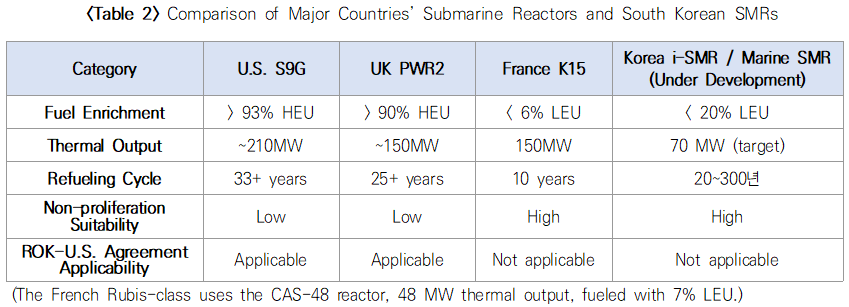
Additionally, KAERI broke ground in 2021 on the Munmu Daewang Science Research Center in Gampo-eup, Gyeongju, where it is developing a 70 MWt marine small modular reactor.7) This experience in developing marine SMRs can serve as a technological foundation for the future development of submarine reactors. Historically, the U.S. Navy used reactors with a thermal output of approximately 70 MWt in its early nuclear submarines.
Professor Lee Jeong-ik of the Department of Nuclear and Quantum Engineering at KAIST assessed that “the small reactor SMART developed by KAERI in 2012 is not based on American technology and is therefore not subject to the ROK-U.S. Nuclear Cooperation Agreement; while a submarine reactor is more technically challenging than a commercial reactor, it is a feasible endeavor.8) This means that it is not the SMART technology itself, but rather the reactor design capabilities accumulated through SMART’s development that can be leveraged for submarine reactor development.
Submarine Construction Capabilities
Since acquiring German Type 209 submarine technology in the late 1980s, South Korea has indigenously built nine Jangbogo-II class submarines based on the Type 214, establishing world-class diesel submarine technology. Currently, Hanwha Ocean and HD Hyundai Heavy Industries possess critical infrastructure—including large dry docks—necessary for manufacturing nuclear submarine platforms. Hanwha Ocean, in particular, has been operating an internal nuclear submarine technology verification program known as the “Boiler Project,” conducting reactor mounting structure and navigation simulations.
A shipbuilding industry official stated: “While cooperation is needed for the reactor technology itself, in terms of platform construction capability alone, the Korean shipbuilding industry has already reached a considerable level,” adding that “once the design is finalized, the infrastructure to immediately commence construction is already in place.9)
Remaining Challenges
The technologies South Korea still needs to acquire for nuclear submarine construction can be summarized in three major areas.
First, naval integration technology for adapting land-based reactors to submarines maneuvering in three dimensions. Unlike land-based reactors, submarine reactors must simultaneously address cooling, shielding, and structural stability challenges under conditions of rapid depth changes, hull vibration, and high-speed maneuvering—issues that cannot be adequately verified through simulation alone without actual construction and operational experience.
Second, a reliable supply system for low-enriched uranium (LEU) nuclear fuel. South Korea currently possesses no uranium enrichment facilities and must establish an international cooperation framework to ensure a stable supply of LEU with enrichment below 20% for the sustained operation of its nuclear submarines.
Third, safe operations and maintenance systems for nuclear-powered submarines. These require radiation management, reactor maintenance, and emergency response systems that are fundamentally different from those of diesel submarines, and such systems can only mature through decades of actual operational experience.
France is precisely the only Western nation to have accumulated more than 40 years of experience in all three of these areas since the commissioning of its first Rubis-class attack submarine in 1983. France has designed, built, and operated a total of 17 nuclear-powered vessels: 6 Rubis-class SSNs, 6 Suffren-class SSNs (including those under construction), 4 Triomphant-class SSBNs, and the aircraft carrier Charles de Gaulle.10) -
A Pioneer in LEU-Based Naval Nuclear Propulsion
France has been developing naval nuclear propulsion technology using low-enriched uranium (LEU) since the 1980s. The Rubis-class attack submarine, commissioned in 1983, used a 48 MW CAS-48 reactor with LEU enriched to 7%. From then through the delivery of the Suffren in 2020, France is the only Western nation to have successfully operated naval nuclear propulsion with LEU for more than 40 years.
The K15 reactor installed on the Suffren class is a 150 MW pressurized water reactor designed by TechnicAtome, using LEU enriched to less than 6% while achieving a ten-year refueling cycle.11) This is complementary to the SMR technology South Korea is developing. South Korea possesses integrated reactor design capabilities, while France has over 40 years of experience integrating such reactors into naval vessels.
France also has a history of using highly enriched uranium (HEU) in its early nuclear submarine development. However, it has now fully transitioned to LEU. The early variants of the Le Redoutable-class SSBNs, France’s first independently developed strategic nuclear submarines in the 1970s, were equipped with reactors using weapons-grade HEU. In the 1960s, while enrichment capabilities were limited, highly enriched fuel was essential to increase the power output of compact submarine reactors. Weapons-grade uranium produced at the Pierrelatte military enrichment facility was used for this purpose.
It was in the early 1980s, during the development of the Rubis-class SSNs, that France fundamentally shifted its fuel policy. Under French Navy safety regulations, submarine reactors must undergo a mandatory overhaul every ten years. Since a complete disassembly was required every decade in any case, it was concluded that there was no need to use expensive HEU (with an approximately 25-year lifespan). Using less costly LEU (with a 10-year lifespan) and replacing the fuel during the overhaul period was judged to be far more economical and safe. As a result, from the Rubis class (CAS-48 reactor) through today’s Triomphant and Suffren classes (K15 reactor), France has exclusively used LEU (enriched to 5–7.5%). France reached the conclusion that “having tried HEU, it is more rational to switch to LEU in alignment with the ten-year maintenance cycle.”
The duration of the IPER (Indisponibilité Périodique pour Entretien et Réparations), or major refit/overhaul, varies by class but averages approximately 18 to 24 months (1.5 to 2 years). During this period, the submarine enters dry dock and is disassembled to a near-complete level, with fuel replacement, hull reinforcement, and equipment modernization carried out.
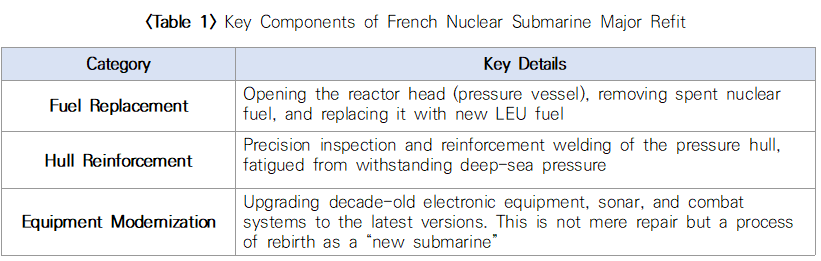
French nuclear submarines are thus “hospitalized” (in maintenance) for approximately 1.5 to 2 years every decade to replace their “heart” (fuel) and renovate their “body” (hull). South Korea must therefore factor this cycle into its overall fleet planning.
U.S. nuclear submarines do not undergo “decennial fuel replacement,” but cannot avoid “major refits” themselves. Virginia-class submarines undergo a major depot-level maintenance known as DMP (Depot Modernization Period) approximately every 7 to 10 years, lasting 10 to 24 months. During this period, external hull panels are opened, internal equipment is replaced and modernized, and the hull structure is inspected. The critical difference from France’s IPER is that the United States does not open the reactor pressure vessel itself. Equipped with HEU cores designed to last the entire service life of the vessel (33 years or more), fuel replacement is unnecessary, and therefore no major opening of the reactor compartment is required. In contrast, France’s IPER includes opening the reactor pressure vessel head and replacing fuel assemblies, requiring radiation management, specialized equipment, and dedicated nuclear maintenance facilities.
It would therefore be a misconception to think that “adopting the American approach (HEU) eliminates the need for major refits.” The United States must also periodically enter dry dock for extended periods for equipment modernization and hull inspection. The only difference lies in whether or not the reactor is opened.
Independence from U.S. ITAR Regulations
French naval nuclear propulsion technology was independently developed without reliance on American technology. Cooperation with France is therefore not subject to U.S. International Traffic in Arms Regulations (ITAR). This parallels KAERI’s approach of excluding American technology dependence when developing the SMART reactor.
Professor Lee Jeong-ik of KAIST analyzed that “South Korea’s cooperation with countries that have already developed nuclear technology through pathways independent of the United States—such as the United Kingdom, France, and Russia—is not affected by the ROK-U.S. Nuclear Cooperation Agreement.”12) This means that cooperation with France represents a realistic alternative capable of circumventing American political uncertainties and legal barriers.
 | Specific Directions for ROK-France Cooperation
 -
Nuclear Fuel Cycle Cooperation: Enrichment and Reprocessing
In the November 2025 ROK-U.S. summit agreement, the United States indicated its willingness to cooperate on fuel supply. However, this requires a legal process involving U.S. Congressional approval and the conclusion of additional agreements, with the possibility of delays depending on shifts in the American political landscape. Securing LEU through France’s Orano, the world’s largest nuclear fuel cycle company, serves as a complementary alternative (hedging strategy) to the U.S. pathway, contributing to the diversification of South Korea’s nuclear fuel sources and the enhancement of its strategic autonomy.
Orano’s Georges Besse II enrichment facility currently has an annual capacity of 7,500 tSWU (tonne Separative Work Units: a unit measuring the scale of enrichment work required to increase the proportion of fissile U-235 in natural uranium)13) and plans to progressively expand from 2028, reaching approximately 10,000 tSWU by 2030.14) If South Korea operates 6 nuclear submarines, it would require approximately 6–12 tSWU of enriched uranium annually, which represents less than 0.1% of Georges Besse II’s capacity.
Since South Korean submarine fuel would have an enrichment below 20%, it falls within the LEU range permitted under the NPT regime and can be procured through commercial enrichment services rather than a dedicated military enrichment pathway. French submarine fuel is supplied through the CEA’s (Commissariat à l’énergie atomique et aux énergies alternatives) military nuclear fuel system, but in South Korea’s case, the commercial nature of LEU enables direct enrichment service contracts with Orano.
South Korea could consider securing “virtual enrichment” rights through equity participation (1–2%) in Georges Besse II. SETH (Société d’Enrichissement du Tricastin Holding), Orano’s uranium enrichment company, already counts Japan (JFEI) and Korea Hydro & Nuclear Power (KHNP) among its shareholders, so additional Korean equity participation would be an extension of the existing cooperative structure. This represents a realistic means for South Korea to secure fuel supply autonomy without constructing its own enrichment facilities.
Cooperation with the La Hague reprocessing facility is also important. This facility can process 1,700 tons of spent nuclear fuel annually and recycles 96% of materials through the PUREX process. 15) South Korea can complete its nuclear fuel cycle by entrusting the reprocessing of its submarine spent fuel to La Hague, without having to construct its own reprocessing facilities.
Naval Integration Technology Cooperation
What South Korea needs most is not reactor “design” per se, but the technology for “integrating” a reactor into a submarine. France’s TechnicAtome and Naval Group have accumulated unparalleled experience in this field by building 12 SSNs (6 Rubis-class and 6 Suffren-class), 4 SSBNs, and the aircraft carrier Charles de Gaulle.16)
Specific areas of cooperation include reactor-hull interface design, noise reduction technologies (pump-jet propulsion, vibration isolation), radiation shielding and crew protection systems, and emergency response protocols. South Korea can complete a Korean-design submarine reactor by building upon SMART reactor technology while incorporating French naval integration know-how.
Establishing Safe Operations and Maintenance Systems
The core of nuclear submarine operations is safety. France’s EAMEA (École des Applications Militaires de l’Énergie Atomique), established in 1956, has accumulated extensive experience in training nuclear submarine crews and managing safety.17) Headquartered in Cherbourg with a practical training facility at Cadarache, EAMEA trains approximately 900 to 1,200 students annually and operates more than 50 specialized training programs, ranging from reactor operations engineers to radiation protection technicians. South Korea should, in cooperation with EAMEA, establish a nuclear submarine crew training program and develop operations and maintenance manuals.
The construction of dedicated nuclear submarine maintenance facilities and base infrastructure is also necessary. France performs nuclear submarine maintenance and refueling at the Toulon naval base, and South Korea can benefit from sharing in the design and operational experience of such facilities.
IAEA Safeguards Cooperation
The AUKUS Naval Nuclear Propulsion Agreement (ANNPA) established for the first time a legal framework for the transfer of naval nuclear propulsion technology to a non-nuclear-weapon state.18) Australia is currently pursuing a safeguards exemption for non-proscribed military activities under Article 14 of the IAEA Comprehensive Safeguards Agreement (CSA).19)
South Korea should also begin consultations on the application of IAEA Article 14 in connection with nuclear submarine construction. France has an advantage from a non-proliferation perspective by using LEU-based technology, and can share the experience accumulated through the AUKUS precedent. South Korea can, jointly with France, propose “enhanced transparency measures” to the IAEA to allay international concerns. -
For ROK–France nuclear submarine cooperation to materialize, France must have sufficient incentive to participate. The partnership should not be structured as a one-sided technology transfer, but as a mutually beneficial arrangement in which both sides exchange their respective strengths. Korea can offer France tangible value in the following areas.
Provision of World-Class Shipbuilding Infrastructure
France’s Naval Group depends on a single shipyard in Cherbourg, creating a structural bottleneck in production capacity.20) The fact that construction of the six Suffren-class SSNs spans from 2007 to 2030—23 years—starkly illustrates this. In contrast, South Korea, centered on Hanwha Ocean and HD Hyundai Heavy Industries, possesses large-scale shipbuilding infrastructure ranked first globally in order volume.21) South Korea’s shipbuilding infrastructure holds great value as a construction partner for France’s overseas submarine export programs. Naval Group has already accumulated experience cooperating with overseas construction partners, as demonstrated in the Brazilian Scorpène-class submarine program.22) The large dry docks, precision welding technology, and modular construction capabilities of Korean shipyards constitute a strategic asset that France could leverage as a construction-sharing partner in future submarine exports to third countries.
Mutual Exchange of Korean SMR Technology
South Korea’s indigenously developed SMART reactor technology and the marine SMR technology of the Munmu Daewang Science Research Center are also of reference value to the French nuclear industry. France had been pursuing the Nuward SMR project, led by EDF with the participation of TechnicAtome, Naval Group, and CEA. In July 2024, the decision was made to reconsider the original innovative integrated design and transition to a new, simplified design (400 MWe class) based on proven technologies, with development relaunching under new management in January 2025. With EDF having stepped back from the integrated design, South Korea’s SMART/i-SMR integrated design know-how possesses independent value that France could reference in diversifying its future SMR portfolio.23)
In particular, the integrated design technology South Korea has accumulated through the SMART reactor—integrating the core, steam generators, coolant pumps, and pressurizer into a single pressure vessel—has strong technical complementarity with France’s research on miniaturizing naval reactors. Bilateral SMR technology exchange can extend beyond the nuclear submarine domain to joint entry into the civilian small modular reactor market.
Defense Industry Package Cooperation
South Korea is rising as a major global arms exporter through expanded exports of systems such as the K9 self-propelled howitzer, the FA-50 light combat aircraft, and the Cheongung missile system.24) Rather than pursuing nuclear submarine cooperation as an isolated initiative, it is advantageous for both countries to design it as part of a comprehensive ROK-France defense cooperation package.
Specifically, mutual component and system supply relationships can be established between French defense companies (Thales, MBDA, Safran, etc.) and South Korean defense firms. For example, South Korea would adopt French sonar technology or submarine combat systems, while France would leverage South Korean naval construction capabilities or electronic warfare equipment. Such a package approach can also help secure political support within France for nuclear submarine technology cooperation.
Indo-Pacific Strategic Partnership
The 2021 AUKUS affair caused France to lose the Australian next-generation submarine contract (valued at approximately AUD 90 billion), significantly weakening its strategic position in the Indo-Pacific region. France possesses overseas territories in the Indo-Pacific—New Caledonia, French Polynesia, Réunion—where approximately 1.5 million of its nationals reside, making the maintenance of strategic influence in this region a national imperative.
South Korea, as a key maritime power in this region, represents a strategic alternative for France capable of replacing the Indo-Pacific partnership lost after AUKUS. ROK-France nuclear submarine cooperation transcends a mere technology transaction; it can form the foundation of a long-term strategic alliance between the two nations. The selection of Naval Group by the Dutch government in March 2024, followed by the official signing of the delivery contract in September of the same year, is part of this search for new partnerships.
Direct Economic Returns for France’s Nuclear Industry
Nuclear submarine cooperation generates diverse direct revenue streams for the French nuclear industry. Equity participation in Orano’s Georges Besse II enrichment facility (1–2%), reprocessing contracts entrusted to La Hague, naval integration consulting contracts from TechnicAtome, and design advisory contracts from Naval Group guarantee French nuclear and defense companies stable revenues spanning several decades.
In particular, the scale of contracts generated over the course of South Korea’s construction of 6 to 8 nuclear submarines—including nuclear fuel supply, maintenance technical advisory, and crew training programs—can make a meaningful contribution to the international revenues of France’s nuclear industry. This provides the economic rationale necessary for the French government to approve the cooperation. -
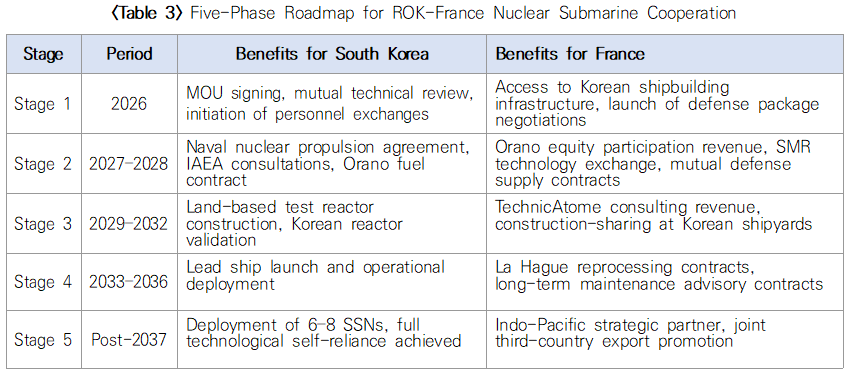
Given South Korea’s existing technological capabilities and the mutually beneficial cooperative assets it can offer France, bilateral cooperation should focus not on “technology transfer” but on “technology advancement and mutual complementarity.” The five-phase roadmap based on this principle is as follows.
Phase 1 (2026): Establishing the Foundation for Cooperation
A Memorandum of Understanding (MOU) on nuclear submarine cooperation will be signed at the ROK-France summit in April 2026. This phase will focus on mutual review of existing Korean technologies (SMART, Munmu Daewang Research Center SMR) and French technology (K15), and identifying complementarities. Simultaneously, the French side will conduct due diligence on Korean shipbuilding infrastructure and negotiate the basic framework for a defense package cooperation. Exchanges of personnel—Korean technical staff dispatched to France and French experts advising in Korea—will commence.
Phase 2 (2027–2028): Technology Integration and Deepening Economic Cooperation
A ROK-France Naval Nuclear Propulsion Agreement will be concluded, modeled on the AUKUS ANNPA (Agreement for the Exchange of Naval Nuclear Propulsion Information), and consultations with the IAEA regarding Article 14 application will begin. A long-term contract with Orano for fuel supply will be signed and equity participation in Georges Besse II will be executed. A joint R&D program between KAERI and TechnicAtome will be launched to commence the naval integration design of the Korean reactor. Concurrently, mutual component and system supply contracts will be concluded between French defense companies (Thales25) , MBDA26) , and etc.) and South Korean defense firms.
Phase 3 (2029–2032): Validation and Construction Commencement
A Land-Based Test Site (LBTS) reactor will be constructed at the Munmu Daewang Science Research Center to conduct validation testing of the Korean nuclear submarine reactor. This reactor will be based on SMART/i-SMR technologies with French naval integration design know-how applied. Following validation, construction of the lead ship will commence. At this phase, construction-sharing with Korean shipyards for Naval Group’s overseas export programs will be fully scaled up.
Phase 4 (2033–2036): Construction Completion and Commissioning
The target is to launch the lead ship in 2034 and achieve operational deployment in 2036. Reprocessing entrusted to La Hague will begin, and France’s long-term maintenance advisory contract will enter full operation.
Phase 5 (2037 onward): Fleet Expansion and Technological Self-Reliance
A fleet of 6 to 8 nuclear submarines will be established by the 2040s. At this stage, South Korea will achieve technological self-reliance across the entire cycle—design, construction, and operation—of nuclear submarines, and the relationship with France will evolve into a mutually beneficial technology exchange. Ultimately, the two countries can explore new areas of cooperation such as joint exports of conventional submarines or surface vessels to third countries. -
South Korea’s construction of nuclear-powered submarines must build upon the technological capabilities accumulated over 30 years since 1994. The technology obtained from Russia, the experience of developing the SMART reactor, and the capability to independently design and build 3,000-ton diesel submarines demonstrate that South Korea already possesses a substantial foundation.
Cooperation with France should focus on “completing” these existing capabilities. South Korea possesses reactor design competencies; France holds over 40 years of experience in integrating reactors into naval vessels. The cooperation between the two countries is complementary and should aim for technological self-reliance, not technological dependence.
At the same time, this cooperation must not be a one-way technology import but a mutually beneficial partnership in which both countries exchange their respective strengths. South Korea’s world-class shipbuilding capabilities, SMR technology, and defense industry competitiveness can provide tangible value to France. France, too, faces the challenge of reconfiguring its Indo-Pacific strategy post-AUKUS, and South Korea meets the criteria for the new strategic partner France is seeking in this region.
The ROK-France summit in April 2026 is a historic opportunity to put this strategic cooperation into motion. The Korean-design nuclear submarine should not be merely the product of importing foreign technology, but the fruition of 30 years of technological accumulation. By completing the remaining pieces of the puzzle through cooperation with France, the ultimate goal is South Korea’s complete technological self-reliance. This is the right path to bring to fruition South Korea’s nuclear submarine program, steadfastly pursued since 1994.
| Progress and New Challenges in South Korea’s Nuclear Submarine Program
| Current Status of South Korea’s Nuclear Submarine-Related Technological Capabilities
| Strategic Value of French Technology: Complementing South Korea’s Capabilities
| Cooperative Assets South Korea Can Offer France
| Five-Phase Cooperation Roadmap: Focused on Technology Advancement and Mutual Benefit
| Conclusion: The Right Direction for Completing South Korea’s Nuclear Submarine Program
1) OKBM is a reactor development bureau established in the Soviet Union in 1945 to develop nuclear industry equipment. It participated in the reactor design of the first nuclear-powered icebreaker Lenin and designed naval, military, commercial, and plutonium production reactors. https://wiki.onul.works/w/OKBM (Search date: February 9, 2026).
2) OH Dong-ryong, “President Kim Young-sam Orders Production of Korean Nuclear-Powered Submarine in 1994,” Monthly Chosun, July 2009; PARK Seong-jin, “The Republic of Korea’s Nuclear Submarine Odyssey: 32 Years of Uninterrupted Efforts Behind the Scenes,” Weekly Gyeonghyang, November 12, 2025.
3) KIM In-han, “22 Years of Technological Accumulation ‘SMART’… Dreaming of Dominating the Small Nuclear Reactor Market,” HelloDD, April 8, 2019.
4) Deepa Shivaram, “Trump announces support for South Korea to build nuclear-powered submarines,” NPR, October 29, 2025.
5) Lowell Schwartz, “Legal and Policy Options for a U.S-South Korea Nuclear Submarine Program,” Just Security, December 8, 2025.
6) Ministry of Science and ICT, “Innovative SMR Technology Development Program,” 2023; i-SMR Technology Development Consortium, https://ismr.or.kr. The i-SMR was ranked 10th in technological maturity among 74 global SMR designs in the OECD Nuclear Energy Agency (NEA)’s “SMR Dashboard 3rd Edition.”
7) JEONG Du-san, “Necessity and Challenges of South Korea’s Nuclear Submarine Acquisition,” KIMS Periscope, No. 275, May 11, 2022.
8) JEONG Seung-im, “The Nuclear Submarine Ignited by Kim Jong-un: Can’t We Build It Without U.S. Approval?” Hankook Ilbo, January 26, 2021.
9) PARK Young-woo, “ROK-U.S. Agree to Build Nuclear-Powered Submarines in Korea… Korean Shipbuilding’s Prestige Elevated,” JoongAng Ilbo, November 14, 2025.
10) Naval Group, “Our Submarines,” https://www.naval-group.com; TechnicAtome, https://www.technicatome.com (Search date: February 1, 2026).
11) Naval News, “French Navy Suffren Class Nuclear Attack Submarine,” 2022; Arms Control Association, “The Feasibility of Ending HEU Fuel Use in the U.S. Navy,” October 2016.
12) LEE Jeong-ik, “Misconceptions and Facts About South Korea’s Nuclear Submarine Development,” KIMS Periscope, No. 215, November 21, 2020.
13) tSWU (tonne Separative Work Unit) is the international standard unit for measuring the scale of uranium enrichment work. Natural uranium contains only 0.7% of the fissile material U-235, and to raise this to levels usable in reactors (3–5% for power plants, below 20% for submarines), U-235 and U-238 must be separated through centrifuges. SWU quantifies the work invested in this separation process; the higher the target enrichment, the exponentially greater the SWU required.
14) Orano, “Orano Announces 30% Increase in Uranium Enrichment Capacity by 2028,” October 2023; EIB, “EIB and Orano sign a loan agreement for €400 million,” March 2025.
15) https://www.orano.group/en/nuclear-expertise/orano-s-sites-around-the-world/recycling-spent-fuel/la-hagu e/unique-expertise (Search date: February 1, 2026).
16) TechnicAtome, https://www.technicatome.com; Naval Group, “Barracuda Programme,” https://www.naval-group.com.
17) French Ministry of the Armed Forces, “L’École des applications militaires de l’énergie atomique (EAMEA),” https://www.defense.gouv.fr (Search date: February 1, 2026).
18) UK Government, “AUKUS Naval Nuclear Propulsion Information Agreement enters into force,” January 2025, https://www.gov.uk/ (Search date: February 1, 2026).
19) IAEA, “IAEA Director General Statement on AUKUS,” March 2025, https://www.iaea.org/ (Search date: February 1, 2026).
20) “France's Third Suffren-Class SSN Tourville Enters Service,” Naval News, July 2025.
21) Clarkson Research, “World Shipyard Monitor,” 2025. South Korea recorded the highest global shipbuilding order volume in 2024.
22) João Paulo Moralez, “Brazil’s nuclear submarine program advances with new contract for Naval Group,” Naval News, September 5, 2025.
23) EDF, “Nuward SMR Project,” https://www.edf.fr (Search date: February 1, 2026).
24) SIPRI, “Arms Transfers Database,” 2025, https://www.sipri.org/databases/armstransfers. South Korea rose to become the 9th largest arms exporter globally during 2020–2024.
25) Thales is one of Europe’s largest defense electronics multinational companies, headquartered at La Défense, Paris. Thales holds approximately 25–35% of Naval Group’s equity, giving it deep involvement in French submarine and surface vessel programs. Its core products include submarine sonar systems, underwater detection equipment, and naval combat systems; Thales technology is also integrated into the electronic equipment of the Suffren-class SSNs.
26) MBDA is Europe’s largest missile-specialized defense company, headquartered in Le Plessis-Robinson, southwest of Paris. Excluding American companies, it is the only company in the Western world capable of designing and producing missile systems across all domains: air-to-air, air-to-ground, ship-to-ship, and surface-to-air.
※ The contents published on 'Sejong Focus' are personal opinions of the author and do not represent the official views of Sejong Institue