File
File
|
Outcomes of the 57th ROK–U.S. Security Consultative Meeting (SCM) and Policy Implications |
| November 13, 2025 |
-
Beomchul ShinPrincipal Research Fellow, Sejong Institute | bcshin@sejong.org
-
On November 4, the ROK–U.S. annual Security Consultative Meeting (SCM) was convened. It is held every year between the defense ministers of the two countries, 1) yet this round drew exceptional attention because the framework for the tariff negotiations had been settled and President Trump had approved Korea’s construction of a nuclear-powered submarine at the ROK–U.S. summit on October 30. Following the meeting, the two defense ministers briefed the press on the outcomes of their discussions regarding key ROK–U.S. alliance issues.2)
However, the specific agenda items addressed at the SCM have been disclosed only in part, because the detailed results are scheduled to be released after the publication of the “Joint Fact Sheet” outlining the agreements reached at the ROK–U.S. summit, followed by the issuance of the “Joint Communiqué of the 57th SCM.” As a result, the release of full details has been delayed.
The delay in the SCM Joint Communiqué is understood to stem from the question of how to incorporate the details related to the agreement on nuclear-powered submarine construction reached at the summit. Because this issue carries significant weight and the Joint Fact Sheet has been released later than initially announced, the publication of the SCM Joint Communiqué is also expected to face a considerable delay. This raises concerns that attention may shift away from critical alliance issues such as combined defense posture, denuclearization of the Korean Peninsula, the strategic flexibility of U.S. forces in Korea (USFK), the transfer of wartime operational control, and the scale of U.S. forces stationed in Korea. Based on the information disclosed to date, this paper evaluates the SCM outcome and identifies policy implications. It first reviews the significance and evolution of the SCM, then examines the main issues of the 57th SCM in comparison with the 56th SCM, and concludes with policy implications. -
The SCM is an annual ministerial level meeting between the defense ministers of the Republic of Korea and the United States. It functions as a formal forum for consultation and coordination on major security issues between the defense authorities of the two countries. Since 1968, the meeting has been held alternately in each country on an annual basis. Its establishment followed the January 21 armed infiltration by the Kim Shin-jo unit and the January 23 capture of the USS Pueblo in 1968. These incidents heightened awareness of the need for closer defense cooperation and led to the creation of a ministerial consultative body. The designation of SCM has been used since 1971 and continues to this day. Following the establishment of the ROK-U.S. Combined Forces Command in 1978, the Military Committee Meeting (MCM) between the chairmen of the Joint Chiefs of Staff of both countries has been convened separately prior to the SCM.
Through the SCM, the defense ministers of the two countries have engaged in discussions on assessments of the regional security environment and military threats, the formulation of shared defense policy, and military cooperation measures aimed at advancing the alliance. Assessments of the security environment and military threats have focused primarily on North Korean threat while also encompassing broader international developments and regional military challenges. With regard to defense policy and military cooperation, the SCM has addressed issues such as the transfer of wartime operational control, adjustments to the scale and roles of USFK, and the strengthening and management of combined defense capabilities.
Over time, the focus of the SCM has shifted in line with changing security conditions. The 1970s were defined by debates over reductions in USFK, followed in the 1980s by an emphasis on the modernization of the ROK Military. In the 1990s, further reduction of USFK again became a central issue. Since the 2000s, attention has increasingly turned to responding to North Korea’s nuclear threat and modernizing the alliance. The 56th SCM, which represents the most recent session, was held in Washington, DC, on October 30, 2024. It addressed policies aimed at advancing the ROK-U.S. alliance into a “Global Comprehensive Strategic Alliance,” including measures to strengthen deterrence against North Korea’s nuclear threat, responses to North Korea’s overseas troop deployments and the deepening of North Korea-Russia relations, enhanced ROK-U.S.-Japan trilateral cooperation, and expanded security cooperation in the Indo-Pacific region.3) In this way, the SCM has evolved into a substantive high level consultative mechanism in which defense ministers directly deliberate on critical alliance issues and set their strategic direction. -
The 57th SCM held this year drew considerable attention as it marked the first meeting between the newly appointed defense ministers following changes in the administrations of both the Republic of Korea and the United States. After the conclusion of the SCM, the two ministers announced the principal items discussed through a joint press conference. The key points were as follows:
First, the construction of nuclear-powered submarines was addressed. Secretary Hegseth stated that “U.S. President Donald Trump had approved the South Korea’s construction of nuclear-powered submarines” and affirmed that the United States would actively support this initiative. He further emphasized that “he was confident this (nuclear-powered submarines) would contribute not only to Korea’s self defense but also to the ROK–U.S. alliance,” thereby clearly positioning the issue as a core area of future bilateral cooperation. At the same time, he noted that “close coordination would be required with other relevant agencies, including the Department of State and the Department of Energy.” This remark suggested that full consensus within the U.S. government has not yet been achieved. While further interagency coordination remains necessary, the decision represents a significant shift when compared with past U.S. opposition to Korea’s pursuit of nuclear-powered submarines.
Second, in terms of the combined defense posture, greater emphasis was placed on the ROK military’s independent role. Secretary Hegseth noted that “ROK would take the lead in defending against North Korea’s conventional military capabilities.” Compared with last year’s formulation, which emphasized strengthening the alliance’s overall deterrence and response posture to North Korean aggression, this language places clearer weight on ROK military’s primary responsibilities and signals a more pronounced delineation of roles within the alliance.
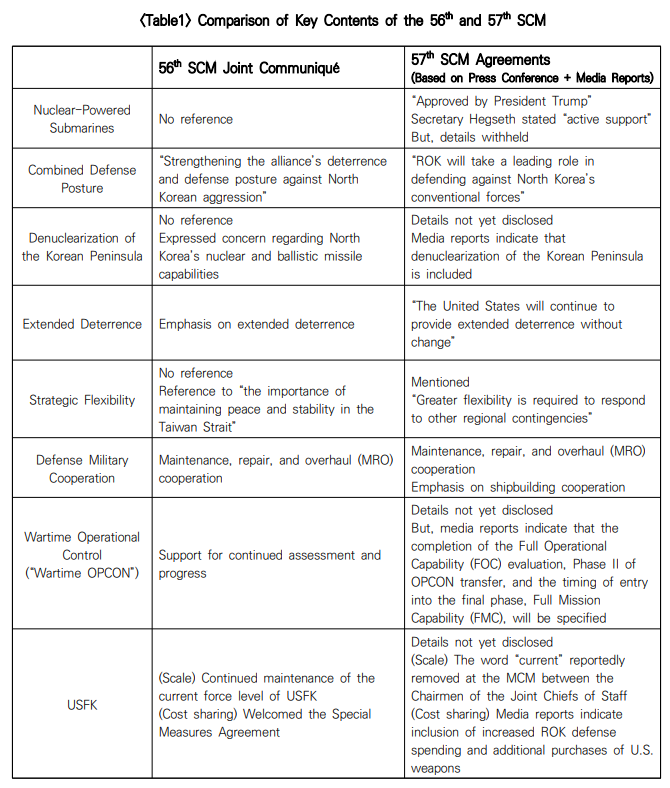
Third, the Joint Communiqué includes the denuclearization of the Korean Peninsula.4) In previous SCM Joint Communiqué’s denuclearization had been consistently reaffirmed. In the statement issued last year, however, this language was omitted. This omission reportedly stemmed from the drafting process, during which the Korea’s preference for stronger wording was not fully reflected. Instead, the document emphasized deterrence of North Korea’s nuclear capabilities through the strength of the alliance. This shift gave rise to unnecessary perceptions of divergence between ROK and U.S. on the issue of denuclearization.5) The reinstatement of denuclearization in this year’s joint statement is therefore expected to dispel such misunderstandings.
Fourth, ROK–U.S. extended deterrence cooperation was discussed. At last year’s SCM, extended deterrence discussions emphasized the ROK–U.S. Nuclear Consultative Group (NCG) and the Conventional-Nuclear Integration (CNI), while also stating the intention to advance extended deterrence to the level of strategic guidance. Secretary Hegseth stated that “the United States would continue to provide extended deterrence without change.” Accordingly, the Joint Communiqué is expected to include provisions on extended deterrence cooperation at a level consistent with previous years.
Fifth, the Joint Communiqué is expected to partially reflect U.S. perspectives regarding the strategic flexibility of USFK. While the previous year's SCM remained silent on strategic flexibility—reiterating the conventional stance of recognizing the importance of maintaining peace and stability in the Taiwan Strait—Secretary Hegseth’s recent press conference remarks emphasizing “the need to enhance flexibility to respond to other regional contingencies” suggest that language explicitly addressing strategic flexibility will likely be incorporated into this year's Joint Communiqué.
Sixth, the importance of ROK–U.S. defense industrial cooperation appears to have been substantively discussed. As in the previous year, maintenance, repair, and overhaul (MRO) cooperation was highlighted during the joint press conference by the two defense ministers, and Secretary Hegseth in particular underscored cooperation in shipbuilding. He noted that Korea possesses world class capabilities in the shipbuilding sector and emphasized the potential for cooperation not only in submarines but also in surface combatants. Accordingly, it is anticipated that related language will be reflected in the Joint Communiqué.
Seventh, with regard to the transfer of wartime operational control, related discussions are expected to be included, although the precise level of agreement reached remains unclear. While both defense ministers appeared aligned on the need to continue advancing the transition of wartime operational control, attention has focused on whether the joint statement will specify the completion of the Phase II Full Operational Capability (FOC) evaluation and the timing of entry into the final phase, namely Full Mission Capability (FMC).
Eighth, indications of potential change were observed concerning the scale of USFK. While the issue was not addressed in specific terms during the joint press conference by the two defense ministers, the expression “current level” was removed from the phrase “maintaining the current force level of USFK” at the MCM between the two Chairmen of the Joint Chiefs of Staff held on October 31. Possibly for this reason, some media outlets have reported that similar wording would be included in the Joint Communiqué.6) Meanwhile, with respect to burden sharing, whereas last year’s communiqué included language welcoming the relevant agreement, this year’s communiqué is expected to reference increases in South Korea’s defense budget and purchases of U.S. weapon systems. Taken together, the 57th SCM appears to have introduced a greater number of new elements than in previous years. -
An assessment of the 57th SCM suggests that, as implied by discussions surrounding the construction of nuclear-powered submarines, the ROK–U.S. alliance is further strengthening its cohesion in security terms. While the United States has placed unprecedented pressure on its allies in the economic domain through measures such as tariffs and demands for increased investment in the U.S., the security sphere presents emerging opportunities for deeper cooperation. That said, a closer examination of the issues discussed at the SCM indicates several areas that require particular caution in future policy implementation.
First, a range of options should be prepared with regard to the construction of nuclear-powered submarines.
It is reported that this issue explains why a joint fact sheet has yet to be released. President Trump reportedly prefers construction in the United States, whereas South Korea favors domestic construction in Korea. When the two leaders hold divergent views, it becomes difficult for working level officials to narrow differences. From South Korea’s perspective, the most advantageous option would be to construct the submarines domestically, with the United States providing only the enriched uranium required as fuel. This approach would be the most cost effective and would also allow Korea to accumulate its own technological capabilities.
At the same time, delays in reaching an agreement must be avoided. A significant number of nonproliferation advocates remain influential within the United States, and they are not favorably disposed toward South Korea acquiring nuclear-powered submarines. In addition, complex legal constraints within the United States must be overcome. Above all, it is essential to reach a written agreement on core issues related to the construction of nuclear-powered submarines within President Trump’s term, preferably before the midterm elections. If the numerous practical obstacles cannot be addressed in a timely manner, the entire initiative could ultimately collapse.
Under these circumstances, achieving an early agreement between the ROK and the United States requires adherence to the principle of domestic construction while also considering alternative arrangements. For example, if four nuclear-powered submarines were to be built, two could be constructed in the United States and two in Korea, thereby facilitating early alignment between the two governments. In return, Korea could seek U.S. consent to manufacture the reactors for the submarines constructed domestically. While domestic construction remains important, missing the window of opportunity and allowing the project to fail would result in greater costs than benefits. Prior to such negotiations, however, Korea must conduct a sober and thorough assessment of its reactor manufacturing capabilities, the scale of the submarines, construction timelines, and the cost implications of construction in the United States.
Second, with respect to the combined defense posture, ROK should systematically prepare to assume a leading role in addressing North Korea’s conventional military threats.
The foreign policy orientation of the second Trump administration is grounded in an “America First” approach that urges allies to shoulder a greater share of responsibilities. This logic also applies to the combined defense posture for countering the North Korean threat. Moreover, once such a policy orientation becomes entrenched, it is likely to persist even under a future U.S. administration. In this context, South Korea should ensure that increases in its defense budget are allocated efficiently toward force enhancement while simultaneously strengthening its independent deterrence capabilities.
At the same time, the enhancement of the ROK Military’s autonomous capabilities will have a direct bearing on the transfer of wartime operational control. Although discussions on the transfer of wartime operational control appear to be progressing smoothly, if South Korea’s military capabilities fail to reach a certain threshold, it will inevitably be constrained by the U.S. position. It is therefore essential to systematically link South Korea’s leading role in countering North Korea’s conventional threats with the transfer of wartime operational control, while concentrating investment on the development of essential capabilities.
In parallel, the United States’ extended deterrence commitments related to North Korea’s nuclear threat should be continuously specified and reinforced, and response capabilities should be multiplied through the advancement of CNI by integrating nuclear and conventional forces. In particular, by systematically preparing pathways through which South Korea’s construction of nuclear powered submarines could contribute to future ROK-U.S. CNI cooperation, South Korea should also strengthen its independent response capabilities for deterring North Korea’s nuclear threats.
Third, greater attention should be devoted to the issue of strategic flexibility and the maintenance of the current USFK force level.
At present, it remains unclear how the concept of strategic flexibility for USFK will be articulated Although Secretary Hegseth offered relatively specific remarks, the ROK government has historically maintained a cautious and negative stance on this issue. Accordingly, the precise scope and tone of any reference can only be assessed once the Joint Communiqué is released. In light of the enduring role of USFK in supporting security on the Korean Peninsula and the broader regional security implications, careful wording will be required to ensure that the language reflects appropriate restraint.
At the same time, strategic flexibility is closely linked to the scale of USFK. A stable and consistent force presence has long functioned as a symbol of the United States’ commitment to the defense of the Korean Peninsula and as a tangible source of deterrence against North Korean threats, forming a core pillar of the alliance’s military readiness. In this context, the omission of the phrase “at the current level” from the MCM joint statement regarding force levels is a source of concern. To be sure, some argue that even without explicit reference to the current level, the accompanying premise of maintaining a defense posture for the South Korea suggests that any reduction or out of area deployment would be offset by supplementary forces, thereby preventing gaps in deterrence against North Korea. Moreover, the U.S. National Defense Authorization Act (NDAA) includes provisions stating that approximately 28,500 U.S. troops in Korea are to be maintained at current levels, which suggests a degree of stability in the near term.
Nevertheless, in diplomacy, projections and contextual explanations are less consequential than formally agreed language. If the phrase “current level” is removed from the Joint Communiqué, the government must carefully ascertain its implications and prepare for potential downstream effects. Such wording could signal greater flexibility in the movement of USFK, a more streamlined posture, and the possibility of temporary reductions in force level. Accordingly, a thorough review of measures to ensure the maintenance of an appropriate level of USFK capabilities is required, and South Korea’s security concerns must be fully reflected throughout this process.
| Introduction
| The Significance and Evolution of the ROK-U.S. SCM
| Key Agendas of the 57th ROK-U.S. SCM
| Policy Implications
1) 미국 국방부(Department of Defense)의 경우 트럼프 2기 행정부에서 전쟁부(Department of War)로 명칭을 변경하였으나, 이 글에서는 국방부로 통일하기로 한다.
2) 대한민국 국방부 유튜브, “제57차 한미안보협의회의(SCM) 공동기자회견,” https://www.youtube.com/watch?v=kpgLqDbGjOY (2025. 11. 8. 방문)
3) 대한민국 정책브리핑, “제56차 한미안보협의회(SCM),” 「대한민국 전자정부 누리집」 (2024. 10. 31.), https://www.korea.kr/briefing/pressReleaseView.do?newsId=156657961&pWise=sub&pWiseSub=J1 (2025. 11. 8. 방문)
4) 윤상호, “[단독]한미 SCM 공동성명에 ‘北비핵화’ 다시 담길듯,” 「동아일보」 (2025. 11. 6.), https://www.donga.com/news/Politics/article/all/20251106/132712588/2 (2025. 11. 8. 방문)
5) 양지호, “한미 SCM 공동성명에서 '北 비핵화' 9년 만에 빠졌다,” 「조선일보」 (2024. 11. 1.), https://www.chosun.com/politics/2024/11/01/T4ATETIWOVEQPDJLWUJZS3SHSA/ (2025. 11. 8. 방문)
6) 윤상호·손효주, “[단독]한미 SCM 성명 ‘주한미군 현 전력수준 유지’ 빠져,” 「동아일보」 (2025. 11. 7.), https://www.donga.com/news/Politics/article/all/20251107/132721196/2 (2025. 11. 8. 방문)
※ The contents published on 'Sejong Focus' are personal opinions of the author and do not represent the official views of Sejong Institue