File
File

|
Australia’s Strategic Recalibration and Why Korea Matters: Henderson and Beyond |
| September 29, 2025 |
-
Yoon-Jung ChoiPrincipal Research Fellow, Sejong Institute | yjchoi@sejong.org
-
Across the international system, states are reassessing their strategic postures amid growing geopolitical uncertainty and accelerating great-power competition. In the Indo-Pacific, one of the most consequential developments has been Australia’s strategic recalibration. Long regarded as a reliable partner of the United States on the southern flank of the region, Australia now finds itself navigating a more transactional diplomatic environment under the second Trump administration. This shift has prompted Canberra to re-evaluate the foundations of its trade, foreign policy, and security strategy.
Uncertainty surrounding the implementation of AUKUS has become a central driver of this reassessment. Prolonged reviews within the U.S. Department of Defense, combined with recurring tensions between Congress and the executive branch, have delayed key decisions related to the submarine pathway. These delays have injected a degree of unpredictability into Australia’s defence planning and defence-industrial strategy, raising questions about timelines, capability sequencing, and long-term industrial readiness. At the same time, Australia has not been insulated from the economic effects of Washington’s renewed tariff measures. Despite being one of the few U.S. partners that traditionally runs a trade deficit with the United States, Australia has been subject to the second Trump administration’s 10 percent baseline tariff, 50 percent tariffs on steel and aluminium, the imposition of a 100 percent tariff on pharmaceuticals, and the termination of de minimis import exemptions.
These developments have had perceptible effects on Australian public opinion. According to the 2025 Lowy Institute Poll, only 36 percent of Australians expressed confidence that the United States would act responsibly in global affairs, a decline of 20 percentage points from the previous year and the lowest level recorded since the survey began.1) This erosion of public trust has reinforced policy debates in Canberra about alliance dependence, strategic autonomy, and the need for greater resilience in Australia’s external relationships.
Against this backdrop, the Australian government has moved swiftly to strengthen its domestic defence and industrial foundations. On September 14, 2025, the Department of Defence announced an upfront investment of AUD 12 billion to modernise the Henderson Defence Precinct in Western Australia. This decision represents both a symbolic and substantive commitment to sustaining AUKUS-related capabilities while reinforcing Australia’s sovereign defence-industrial base. 2) The investment also constitutes a concrete step in implementing the “Continuous Naval Shipbuilding and Sustainment” strategy released in late 2024,3) which aims to anchor long-term naval capability within Australia’s own industrial ecosystem.
Australia’s response to strategic uncertainty has not been limited to defence-industrial policy. Canberra has simultaneously sought to diversify and densify its external partnerships. Efforts to expand maritime cooperation with ASEAN, deepen diplomatic engagement with Pacific Island states, and strengthen strategic ties with Japan reflect a deliberate attempt to construct a more resilient network of cooperation in which the United States remains important, but no longer functions as the sole strategic axis. This approach was articulated clearly by Foreign Minister Penny Wong at the ASEAN Foreign Ministers’ Meeting in Malaysia on July 10, 2025, where she emphasised the importance of a regional order in which military capability supports diplomacy, and security is grounded in choice rather than coercion. Her remarks underscored Australia’s self-identification as a middle power committed to autonomous defence capacity and multilateral solidarity.
This paper examines how Australia is responding to changes in its trade, foreign policy, and security environment under the second Trump administration. It evaluates Australia’s evolving strategic choices, with particular attention to defence-industrial investment, alliance management, and regional network-building. The analysis then explores the implications of these developments for South Korea’s policy toward Australia and considers how bilateral cooperation might be advanced beyond traditional defence and shipbuilding into a more integrated model of strategic engagement. -
Australia’s initial expectation that it might pass through Trump-era tariff turbulence relatively quietly reflected a distinctive bilateral trade structure. In 2024, Australia exported US$23.8 billion to the United States and imported US$50.6 billion, producing a bilateral trade deficit of US$26.9 billion from Australia’s perspective.4)
This pattern is the inverse of the U.S. trade deficit that President Trump has frequently invoked as evidence of “unfair trade.” Australia’s export profile to the United States is concentrated in primary and quasi-primary goods—including meat and meat preparations (US$6.1 billion) and non-monetary gold (US$2.9 billion)—as well as pharmaceuticals (US$2.1 billion). By contrast, Australia imports high value-added manufactured products from the United States, including road vehicles (US$5.8 billion), electrical machinery and equipment (US$3.9 billion), and other transport equipment (excluding vehicles) and specialized machinery (US$3.8 billion each).5)
A temporary swing toward a U.S. surplus appeared in early 2025, driven by a surge in non-monetary gold exports. However, this shift reflected short-term volatility associated with safe-haven demand rather than a structural transformation in the bilateral trade relationship.
Since 2020, Australia has pursued elements of an economic decoupling strategy vis-à-vis China, while simultaneously strengthening economic and security cooperation with the United States amid intensifying U.S.–China competition in economic security. Canberra has already moved to institutionalize linkages between economics and security through mechanisms such as the U.S.–Australia Critical Minerals Working Group, a cyber threat analysis memorandum of understanding, and cooperation in the civilian space domain, including participation associated with the Artemis program. Under Trump 2.0, Australia has further recalibrated trade policy with an emphasis on supply chain resilience and critical minerals security. It has played a proactive role in advancing regional rule modernization and supply chain architecture through the upgraded AANZFTA (ASEAN–Australia–New Zealand Free Trade Agreement), which entered into force in April 2025, as well as the IPEF supply chain agreement.
Australia’s Comprehensive Economic Cooperation Agreement (CECA) negotiations with India have faced friction, particularly in agricultural and alcoholic beverage sectors, yet Canberra has sought to expand cooperation in digital trade, services, and mobility frameworks. In critical minerals, Australia has moved toward institutionalizing resource-based economic security through an A$1.2 billion strategic stockpiling initiative and the introduction of 2025 investment attraction guidelines. In parallel, Australia has deployed more trade missions to Southeast Asia and Europe and has strengthened cooperation in the green economy, reflecting an increasingly deliberate strategy of market diversification and export stabilization.
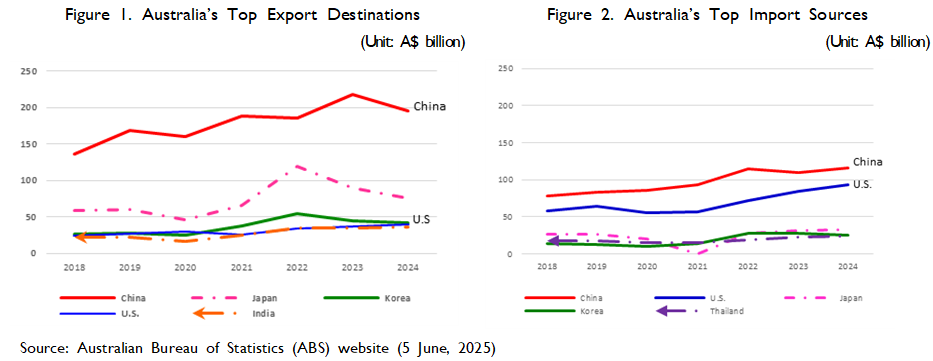
Toward China, Australia has pursued a strategy of “managed thaw”: maintaining a high level of security vigilance while restoring trade flows. After Australia’s call in 2020 for an investigation into the origins of COVID-19, China expanded import restrictions on Australian beef, barley, coal, and wine. From 2024 onward, however, China lowered barriers again—removing tariffs on wine and resuming imports of Australian beef, among other measures. Structurally, Australia’s economic interdependence with China remains substantial. In 2024, 30.4 percent of Australia’s exports (A$644.4 billion) went to China (A$196.0 billion). Australia’s overall trade surplus of A$30.2 billion was largely anchored in a surplus with China of A$80.4 billion. Iron ore exports to China alone reached A$148.6 billion in 2024, accounting for more than roughly 65 percent of China’s iron ore imports. This level of economic connectivity functions as a structural incentive for Australia to adopt a pragmatic approach in China policy, even as strategic competition and security concerns persist. -
Australia’s participation in AUKUS, announced in 2021 alongside the United States and the United Kingdom, represents the largest defence-related investment in the country’s history and a watershed in its strategic posture. More than a traditional security arrangement, AUKUS constitutes a trilateral framework that integrates defence, industry, and advanced technology cooperation with the explicit aim of strengthening deterrence and interoperability in the Indo-Pacific. Its emergence reflects growing concern over China’s accelerating military modernisation and increasingly assertive regional behaviour, and it has become a central pillar of Australia’s long-term security planning.
Structurally, AUKUS rests on two interrelated pillars. Pillar I focuses on enabling Australia to acquire and operate nuclear-powered submarines. This pathway begins with rotational deployments and visits of U.S. and UK nuclear submarines, progresses toward Australia achieving “sovereign ready” status in nuclear stewardship and command, and ultimately envisages the acquisition of three to five Virginia-class submarines, followed by the joint development and construction of the SSN-AUKUS platform with the United Kingdom. Pillar II, by contrast, concentrates on collaborative development in advanced defence technologies, including quantum computing, artificial intelligence, hypersonic capabilities, and autonomous systems. Through this pillar, the three partners seek to lower technological barriers, accelerate innovation, and enhance operational interoperability across multiple domains.
Yet the trajectory of AUKUS has become less certain under the second Trump administration. Prolonged reviews within the U.S. Department of Defense, combined with ongoing tensions between Congress and the executive branch, have delayed key implementation decisions. These uncertainties have spilled over into Australia’s broader defence and defence-industrial planning, raising concerns about timelines, capability gaps, and industrial readiness. It is against this backdrop of alliance volatility that Canberra has moved to reinforce its own capacity for strategic self-reliance through proactive domestic investment.
The most prominent manifestation of this approach is the decision announced on September 14, 2025, to invest AUD 12 billion upfront in the modernisation of the Henderson Defence Precinct in Western Australia. This initial allocation forms part of a broader AUD 25 billion, ten-year plan to transform Henderson into a comprehensive naval industrial hub. The investment aligns with Australia’s “Continuous Naval Shipbuilding and Sustainment” strategy unveiled in late 2024 and signals a deliberate effort to anchor long-term naval capability within Australia’s own industrial base, irrespective of uncertainties surrounding AUKUS implementation.
Henderson is designed to function as far more than a conventional shipyard. Its planned scope encompasses the construction, maintenance, repair, and overhaul of nuclear-powered submarines, as well as the building of surface combatants, amphibious vessels, and naval support ships. In addition, the precinct will support sustainment, training, and testing functions, with projections indicating the creation of approximately 10,000 high-skilled jobs. From an industrial geography perspective, the expansion of Henderson also marks a significant shift. By extending shipbuilding capacity beyond the traditional hubs of Sydney and Adelaide to Western Australia, Australia aims to rebalance its defence industrial ecosystem while establishing a strategic gateway linking the Indian Ocean and the South China Sea.
Australian officials have been explicit about Henderson’s centrality to AUKUS. Defence Minister Richard Marles has described the precinct as “core” to the partnership, noting that U.S. and UK naval vessels are also expected to utilise the facility. Western Australia’s location reinforces its strategic value, positioning Henderson as a critical node in regional maritime security architectures. Importantly, this industrial commitment has proceeded even as Washington reassesses elements of the AUKUS submarine pathway, underscoring Canberra’s intent to hedge against alliance uncertainty rather than await external decisions.
At the same time, AUKUS cooperation has continued to deepen through other channels. In July 2025, Australia and the United Kingdom concluded a 50-year submarine partnership, commonly referred to as the Geelong Treaty.6) This agreement further institutionalised bilateral collaboration on nuclear-powered submarine capabilities and reinforced the durability of UK–Australia cooperation independent of U.S. domestic debates. Taken together, these developments suggest that while implementation risks persist under Trump’s second term, Australia and the United Kingdom remain committed to sustaining the strategic logic of AUKUS over the long term.
Australia’s emphasis on early industrial investment also reflects a broader reassessment of undersea warfare. Advances in quantum sensing and AI-enabled detection have intensified debates about the emergence of a “transparent ocean,” potentially eroding the traditional advantages of stealth enjoyed by submarines. In this evolving environment, Australia has increasingly recognised the need for a more layered deterrence posture. While nuclear-powered submarines remain central, they are now complemented by expanded deployment of unmanned underwater vehicles, enhanced anti-submarine warfare capabilities, and strengthened protection of undersea infrastructure such as communication cables. Henderson and HMAS Stirling are thus envisioned not merely as submarine facilities, but as hubs supporting a multidomain undersea warfare ecosystem.
This shift aligns closely with the concept of an “Integrated Focused Force” articulated in Australia’s 2024 National Defence Strategy and Integrated Investment Program.7) The framework emphasises the integrated operation of land, sea, air, space, and cyber capabilities, coordinating platforms, systems, infrastructure, and regulatory regimes within a unified strategic design. The re-elected Albanese government in May 2025 has signalled its intention to deepen this approach, prioritising flexibility and integration as means of adapting to both alliance volatility and rapid technological change.
In this context, Australia’s AUD 12 billion upfront investment at Henderson should be understood not as a narrow industrial project, but as a strategic hedge. By strengthening domestic naval infrastructure in advance, Canberra seeks to enhance the resilience of deterrence, reduce dependence on uncertain external timelines, and preserve strategic autonomy within an increasingly transactional alliance environment. Even if AUKUS proceeds largely as planned, the benefits of a robust sovereign industrial base remain substantial. Should implementation falter or be delayed, those investments become even more critical, ensuring that Australia retains meaningful capacity to shape its own maritime security future. -
Australia has long pursued a security strategy that extends beyond its bilateral alliance with the United States. While the alliance remains foundational, Canberra has consistently invested in a web of complementary partnerships designed to diversify risk, enhance regional presence, and preserve strategic flexibility. In recent years, this networked approach has gained renewed importance as uncertainty surrounding U.S. regional engagement has increased.
One dimension of this strategy is Australia’s calibrated use of minilateral frameworks. As the Quad has evolved toward a broader agenda encompassing climate change, vaccine distribution, and technology cooperation, Australia has relied more heavily on the Trilateral Security Dialogue (TSD) with the United States and Japan to sustain cooperation focused on traditional defence and security concerns. Established in 2002, the TSD predates the Quad and has demonstrated notable institutional resilience. Even during the period when the Quad temporarily lost momentum after 2008, the TSD remained active, maintaining regular consultations and operational coordination.
Through the TSD, Australia has participated in a series of recurring joint exercises aimed at strengthening interoperability across land, maritime, and air domains. These include Southern Jackaroo exercises, drills in the South China Sea, and Exercise Cope North. Beyond training value, the TSD has acquired strategic significance by signalling the three partners’ willingness to respond collectively to contingencies in what Australia identifies as the Indo-Pacific’s most acute flashpoints: the Taiwan Strait, the Korean Peninsula, and the broader Pacific theatre. In this sense, the TSD functions as a stabilising mechanism that complements broader, and often less security-focused, multilateral initiatives.
A particularly notable development has been the deepening of Australia’s defence engagement with Southeast Asia. In November 2024, Canberra released the “Defence Partnership for the Future” statement, which outlined a comprehensive agenda for regional defence cooperation. The initiative includes the establishment of new defence engagement programs, expansion of scholarship opportunities, extension of maritime security research, and the institutionalisation of annual defence-related symposia. Under this framework, Australia committed to investing USD 64 million by 2028 in maritime partnerships supporting law enforcement at sea, maritime domain awareness, sustainable ocean resource management, and marine conservation.
This effort is reinforced by a substantial increase in development assistance. Australia’s decision to provide AUD 1.28 billion in development support to Southeast Asia in 2025 reflects an explicit attempt to align defence engagement with broader objectives of regional stability and institutional resilience.8) Rather than framing security cooperation in narrowly military terms, Canberra has emphasised its role as a responsible middle power contributing to a rules- and institutions-based regional order.
Strategically, this approach serves multiple purposes. It enables Australia to construct a first line of regional resilience in Southeast Asia against the spillover effects of China’s more assertive regional posture, while simultaneously addressing concerns among ASEAN member states regarding AUKUS. Indonesia and Malaysia, in particular, have expressed apprehension that AUKUS could accelerate regional arms competition or exacerbate tensions in the South China Sea. Both countries have also raised concerns that the transit of nuclear-powered submarines through Southeast Asian waters could conflict with the principles of the Southeast Asia Nuclear Weapon-Free Zone (SEANWFZ) and the Zone of Peace, Freedom, and Neutrality (ZOPFAN).
In response, Australia has pursued active reassurance diplomacy. In September 2025, Foreign Minister Penny Wong conducted consecutive visits to Indonesia and Malaysia, underscoring Canberra’s position that AUKUS would not undermine regional stability. During the ninth Australia–Indonesia 2+2 Foreign and Defence Ministers’ Meeting, the two sides agreed to expand joint military exercises, enhance interoperability, and strengthen cooperation in maritime and cyber security. In Malaysia, Wong used the ASEAN Foreign Ministers’ Meeting to reaffirm Australia’s support for ASEAN centrality and the principle of shared responsibility for regional stability.
Beyond diplomatic engagement, Australia has also taken steps to reinforce deterrence through operational cooperation. In the second half of 2025, Canberra expanded joint exercises with the Philippines and pursued arrangements related to base access and rotational deployments, thereby strengthening on-the-ground deterrence in the South China Sea. Multilateral maritime exercises conducted between August and September 2025 involving Australia, the Philippines, and Canada further demonstrated this approach. The participation of U.S. Marine Corps units in these drills highlighted both the expanding scope of cooperation and Australia’s capacity to operate within flexible, coalition-based frameworks.
Taken together, these initiatives illustrate Australia’s deliberate effort to operationalise a networked security strategy. Rather than substituting one partnership for another, Canberra has sought to layer bilateral, trilateral, and multilateral mechanisms in ways that reinforce one another. This approach reflects an assessment that no single axis of cooperation is sufficient to manage the region’s growing complexity. By investing simultaneously in alliance management, minilateral coordination, and regional capacity-building, Australia aims to mitigate strategic risk while maintaining autonomy of action. -
Within the broader framework of regional resilience-building, Australia has increasingly adopted more diverse and innovative approaches to engagement in the Pacific Island states. These initiatives reflect Canberra’s recognition that traditional security cooperation alone is insufficient to address the complex mix of strategic competition, climate vulnerability, and development challenges shaping the South Pacific.
A prominent example of this approach is the Australia–Tuvalu Falepili Union agreement, concluded in November 2023. Widely regarded as the world’s first bilateral climate mobility treaty, the agreement allows up to 280 Tuvaluan citizens per year to migrate to Australia under a special visa arrangement designed to address existential risks posed by climate change. The agreement has been praised internationally as a pioneering response to climate-induced displacement and as a model for integrating humanitarian considerations into foreign policy.
Beyond its humanitarian dimension, however, the Falepili Union carries significant strategic implications. Article 4 of the treaty requires Tuvalu to consult with Australia and seek mutual agreement before entering into security- or defence-related arrangements with third parties. This provision has been interpreted by some observers as effectively granting Australia a degree of influence over Tuvalu’s security policy. From this perspective, the agreement is seen not only as a climate adaptation mechanism but also as a strategic instrument aimed at limiting China’s expanding presence in the Pacific.
Australia has complemented this treaty-based framework with substantial development assistance. During the 2024–25 period, Canberra provided approximately USD 57 million in official development assistance to Tuvalu. These funds have supported the construction of the country’s first undersea telecommunications cable, expansion of national trust funds, and initiatives to improve aviation safety and connectivity. The integration of economic support, security considerations, and humanitarian assistance into a single policy package illustrates Australia’s evolving regional strategy, one that seeks to align development and security objectives rather than treat them as separate domains.
At the same time, Australia has adopted a more cautious and differentiated approach toward other Pacific partners, most notably Papua New Guinea (PNG). Initial discussions regarding a Mutual Defence Treaty were ultimately deferred due to quorum-related issues within PNG’s cabinet, and the proposal was replaced with a joint defence statement. Although PNG authorities have publicly denied allegations of growing Chinese influence, the episode has nonetheless raised questions about the credibility and sustainability of Australia’s “Pacific Partnership” diplomacy.
In response, Australia has moved to expand practical cooperation under the Pacific Maritime Security Program (PMSP). The program has been significantly scaled up, including a doubling of funding for aerial surveillance capabilities. PMSP has evolved into a long-term, 30-year initiative designed to enhance maritime security across Pacific Island countries through fixed-wing aircraft and unmanned aerial systems. The emphasis on persistent surveillance and capacity-building reflects Australia’s assessment that maritime governance and domain awareness constitute foundational elements of regional stability in the Pacific.
Another distinctive feature of Australia’s regional engagement strategy is the use of sports diplomacy as a tool for strengthening social and political ties. In its relationship with PNG, Australia has expanded cooperation centred on rugby league and football, leveraging the cultural significance of these sports to foster people-to-people connections. Similar initiatives have been extended to other Pacific Island states through cultural and arts exchange programs. These efforts aim to complement Australia’s material capabilities with soft power, reinforcing trust and long-term influence in societies where formal diplomatic presence is often limited.
Taken together, these initiatives illustrate Australia’s attempt to move beyond conventional security assistance toward a more integrated model of regional engagement. By combining climate adaptation, development finance, security cooperation, and cultural diplomacy, Canberra seeks to maximise the cumulative impact of its regional policies. This approach reflects a strategic calculation that influence in the Pacific is increasingly shaped not only by military presence, but also by the ability to respond credibly to the everyday challenges facing local communities. -
Defence Cooperation: Achievements and Constraints
Defence industrial cooperation between South Korea and Australia has already produced tangible outcomes, while also revealing structural constraints that must be addressed for further expansion. A flagship example is Hanwha Aerospace’s entry into the Australian market. The December 2023 contract with the Australian government for 129 Redback infantry fighting vehicles, valued at approximately KRW 3.2 trillion, marked the first establishment of an overseas production base by a Korean defence firm. Beyond the contract itself, the depth of localisation is particularly noteworthy. Hanwha has concluded agreements with Penske Australia for Redback engine assembly, testing, and supply; produces the AS9 Huntsman, an Australian variant of the K9 self-propelled howitzer, at the H-ACE facility in Geelong, Victoria; and has accelerated local supply-chain integration through multimillion-dollar component contracts with Australian firms such as TEi Services.9)
At the same time, the rejection of Hanwha’s proposal to acquire Austal underscores the limits of defence cooperation under current institutional conditions. Austal’s role as a major designer and builder of naval vessels for the U.S. Navy meant that any acquisition required approval not only from Australia’s Foreign Investment Review Board (FIRB), but also from U.S. security-related bodies including the Committee on Foreign Investment in the United States (CFIUS) and defence intelligence authorities. Although CFIUS approved Hanwha’s stake acquisition in June 2025, FIRB has continued a cautious review from the perspective of national security and industrial sovereignty. This case illustrates that for Korean firms to expand sustainably in Australia’s defence sector, commercial competitiveness must be matched by trust-building with Australian authorities and careful navigation of allied regulatory ecosystems.
Henderson and AUKUS: Strategic Opportunities Under Two Scenarios
The development of the Henderson Defence Precinct presents significant opportunities for Korean shipbuilding and defence industries. Over the next fifteen years, Australia plans to construct a diverse range of naval platforms, including surface combatants, amphibious vessels, and support ships, alongside the nuclear-powered submarine program.10) Korea’s experience with continuous shipbuilding and advanced naval platforms, such as the KSS-III submarine and next-generation destroyers (FFX and KDDX), aligns closely with Australia’s “Make in Australia” defence industrial policy.11)
Looking ahead, cooperation related to AUKUS can be approached through two strategic scenarios. In the first scenario, AUKUS proceeds broadly as planned. Australia would remain committed to a long-term submarine pathway from the Virginia-class to SSN-AUKUS, with Henderson evolving into a central maintenance, repair, and overhaul hub. Under these conditions, Korea’s scope for direct involvement in nuclear submarine technologies would remain limited. However, substantial opportunities would exist in complementary areas, including surface combatants, unmanned underwater vehicles, anti-submarine warfare systems, sensors, training, and sustainment. Designing parts of the Henderson MRO ecosystem around a Korea–Australia division of labour could allow Korean shipyards and defence firms to contribute meaningfully without crossing sensitive technological thresholds.
In the second scenario, AUKUS experiences significant delays or partial retrenchment. Even in this case, Australia’s commitment to strengthening sovereign defence capabilities is unlikely to waver. Here, Korea could pursue a more proactive role by engaging selectively in Pillar II technology projects, such as quantum applications, artificial intelligence, hypersonics, and autonomous systems. Parallel strategies could include establishing local subsidiaries or joint ventures using Australia’s Defence Industry Vendor Qualification (DIVQ) system and Industry Capability Network (ICN), thereby embedding Korean firms directly within Australia’s defence supply chains.12) In such a context, Korea’s conventional submarine and surface combatant technologies could assume greater relevance as Australia explores supplementary pathways to maritime capability development.
Critical Minerals and Institutional Foundations
Cooperation on critical minerals has emerged as another pillar of the Korea–Australia partnership, supported by a triangular framework linking government, industry, and finance. In May 2025, POSCO established the Australia Critical Minerals Research Institute in Perth, becoming the first Korean company to set up a dedicated resource research facility in Australia.13) Through a memorandum of understanding with Australia’s Commonwealth Scientific and Industrial Research Organisation (CSIRO), joint research is underway on low-carbon steelmaking, lithium refining, and rare-earth extraction technologies. Financial cooperation has also expanded, including joint support for lithium projects involving Korea Eximbank, the Korea Trade Insurance Corporation, and the U.S. Export–Import Bank.
To fully leverage these initiatives, Korea should further institutionalise mechanisms that facilitate private-sector participation in Australian resource projects while securing stable supply chains for battery and advanced manufacturing industries. At the same time, diplomatic and security dialogues must evolve accordingly. The sixth Korea–Australia 2+2 Foreign and Defence Ministers’ Meeting in 2024 reaffirmed the deepening of the Comprehensive Strategic Partnership and identified joint infrastructure, decarbonisation, supply chains, critical minerals, and Southeast Asia as priority areas. Going forward, consideration should be given to more formalised arrangements, such as a Reciprocal Access Agreement or a defence technology cooperation framework equivalent in scope to a DTCA, to reduce institutional frictions constraining shipbuilding and defence collaboration.
Regional Minilateralism and the Concept of Meta-Diplomacy
Beyond bilateral cooperation, Korea and Australia are well positioned to institutionalise minilateral formats involving ASEAN and Pacific Island states. Establishing standing Korea–Australia–ASEAN and Korea–Australia–Pacific Island cooperation frameworks could transform discrete projects into a sequenced and mutually reinforcing chain of initiatives. Such efforts could be closely linked with Australia’s flagship regional program, Aus4ASEAN Futures, creating synergies that amplify both countries’ regional engagement.
A defining feature of Australia’s recent approach has been its integration of economic policy, defence and security cooperation, climate action, and cultural engagement. The Falepili Union with Tuvalu, sports diplomacy with Papua New Guinea, and maritime cooperation with ASEAN reflect a coherent strategy that combines material capability with normative and societal influence. This integrated model offers important lessons for Korea as it seeks to expand its regional role.
In this context, this paper proposes the concept of “meta-diplomacy” as a guiding framework for Korea’s future external engagement. Meta-diplomacy refers to an integrated diplomatic strategy that systematically links security, industry, trade, technology, norms, and culture within a whole-of-government and whole-of-nation approach. It emphasises dense, multi-layered networks connecting governments, industries, academia, and allied partners, with the objective of enhancing national influence and strategic resilience in a rapidly reconfigured global order.
The opportunity to operationalise this framework is imminent. For Korea, the Gyeongju APEC Leaders’ Meeting scheduled for October represents a critical platform to demonstrate integrated statecraft. By institutionalising trust-based cooperation in defence and shipbuilding while simultaneously projecting cultural and normative appeal, Korea can leverage the APEC summit to articulate a more comprehensive and confident international role. Achieving this will require sustained coordination across policy domains, but it also offers a pathway to elevate Korea’s standing as a strategic partner capable of shaping, rather than merely adapting to, regional and global transformations
| Introduction
| Australia Caught in the Tariff War
| AUKUS & Sovereign Defense: The Meaning of the A$12 Billion Upfront Investment
| Beyond the U.S. Alliance: Managing a Dense Security Network
| Creative Regional Engagement: A New Model with Pacific Islands
| Assessment and Implications: Toward Korean “Meta-Diplomacy” Beyond Defense and Shipbuilding
1) Lowy Institute, Lowy Institute Poll 2025 (Sydney: Lowy Institute, June 22, 2025), accessed September 10, 2025, https://poll.lowyinstitute.org/files/lowyinsitutepoll-2025.pdf.
2) Australia, Department of Defence, “Additional Defence funding to deliver the Henderson Defence Precinct,” Media Release, 14 September 2025, https://www.minister.defence.gov.au/media-releases/2025-09-14/additional-defence-funding-deliver-henderson-defence-precinct.
3) Australia, Department of Defence, 2024 Naval Shipbuilding and Sustainment Plan December 20, 2024, https://www.defence.gov.au/about/strategic-planning/2024-naval-shipbuilding-sustainment-plan.
4) Australian Bureau of Statistics, "Australia's Trade with the United States of America," ABS, June 5, 2025, https://www.abs.gov.au/articles/australias-trade-united-states-america.
5) Australian Bureau of Statistics, "Australia's Trade."
6) Australia, Department of Defence, “Joint Statement on the Australia–United Kingdom Nuclear-Powered Submarine Partnership and Collaboration Treaty,” July 26, 2025, https://www.minister.defence.gov.au/statements/2025-07-26/joint-statement-australia-united-kingdom-nuclear-powered-submarine-partnership-collaboration-treaty.
7) Australia, Department of Defence, “2024 National Defence Strategy and 2024 Integrated Investment Program.” April 17, 2024. https://www.defence.gov.au/about/strategic-planning/2024-national-defence-strategy-2024-integrated-investment-program.
8) Minister for Foreign Affairs Penny Wong, "Joint Statement on ASEAN and Australia's Shared Future," Australian Government Department of Foreign Affairs and Trade, July 10, 2025, https://www.foreignminister.gov.au/minister/penny-wong/media-release/joint-statement-asean-and-australias-shared-future.
9) "Hanwha Aerospace Signs Redback Engine Assembly, Test and Supply Agreement with Penske Australia," Hanwha Aerospace Press Release, 2025.; "Hanwha's AS9 Huntsman Production and Supply Chain Expansion in Australia," Defense Industry News, August 2025.
10) Australia, Department of Defence, “Continuous Naval Shipbuilding and Sustainment Enterprise,” accessed September 24, 2025, https://www.defence.gov.au/business-industry/industry-capability-programs/continuous-naval-shipbuilding-and-sustainment-enterprise.
11) Australia, Department of Defence, "Defence industry builds ties with South Korea," News, August 21, 2025, accessed September 24, 2025, https://www.defence.gov.au/news-events/news/2025-08-21/defence-industry-builds-ties-south-korea; Jennifer Parker, "Australia–South Korea: The case for a new maritime focus," Lowy Institute, May 29, 2025, accessed September 15, 2025, https://www.lowyinstitute.org/the-interpreter/australia-south-korea-case-new-maritime-focus.
12) “ASC Opens Door to AUKUS Supply Chain,” Australian Defence Magazine, September 22, 2025, https://www.australiandefence.com.au/news/news/asc-opens-door-to-aukus-supply-chain.
13) ARC Centre of Excellence for Critical Resources for the Future, "Launch of POSCO's Critical Minerals R&D Lab in Perth, Western Australia," Critical Resources, May 30, 2025, https://criticalresources.org.au/launch-of-poscos-critical-minerals-rd-lab-in-perth-western-australia-30-may-2025/; AustCham Korea, "POSCO Opens Australia Critical Minerals R&D Lab in Perth," AustCham Korea, June 4, 2025, https://austchamkorea.org/2025/06/04/posco-opens-australia-critical-minerals-rd-lab-in-perth/.
※ The contents published on 'Sejong Focus' are personal opinions of the author and do not represent the official views of Sejong Institue